By Alex Host · Founder of Top Care Cleaning · Updated 2026-05-04
This is not legal advice. I'm an operator, not a TCPA attorney. Consult a TCPA attorney for your specific situation.
Disclaimer: This article is an educational overview of TCPA requirements for small business operators sending review request texts. It is not legal advice. Consult a licensed attorney familiar with telecommunications law before implementing an SMS campaign or if you have specific compliance questions.
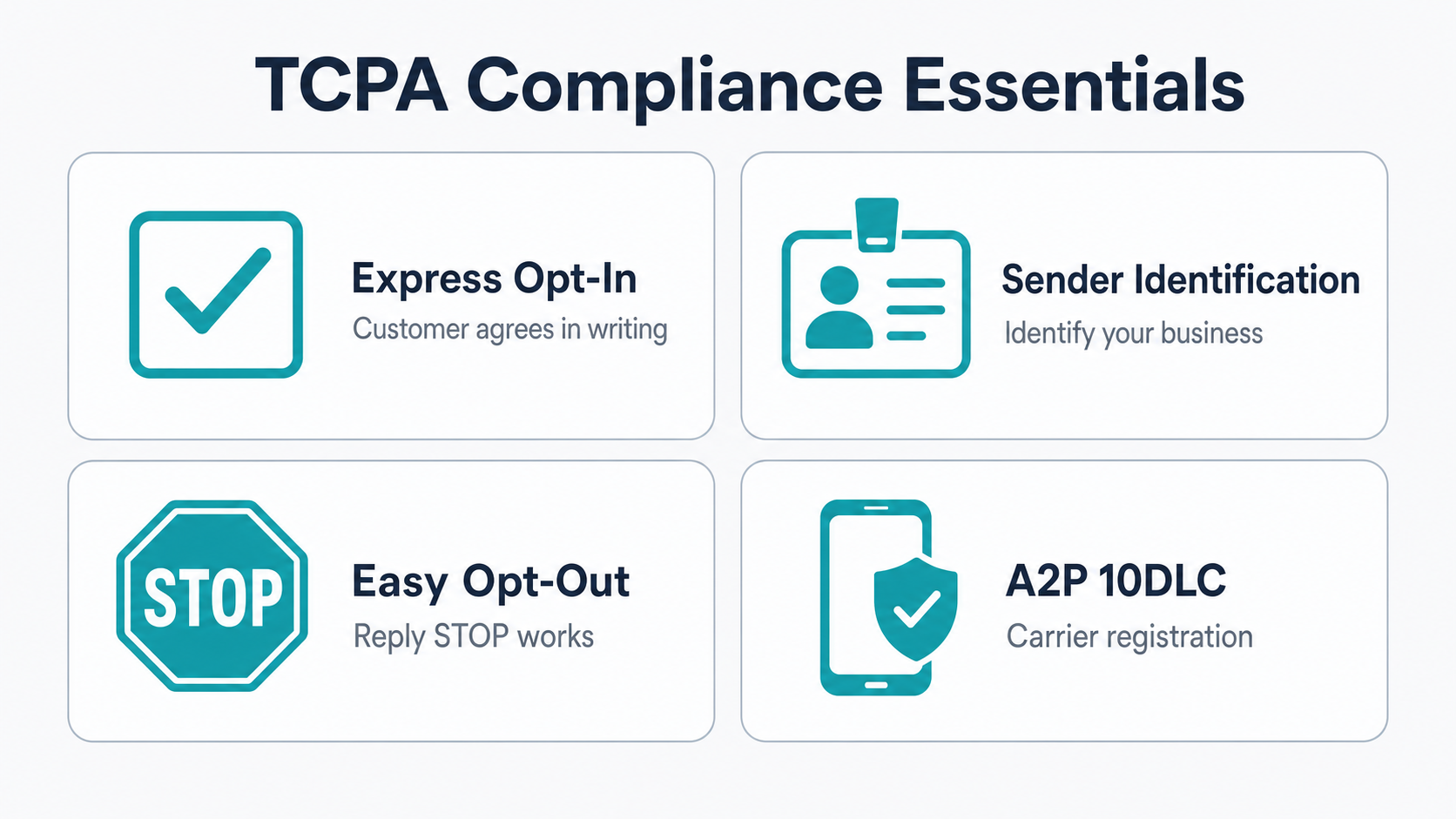
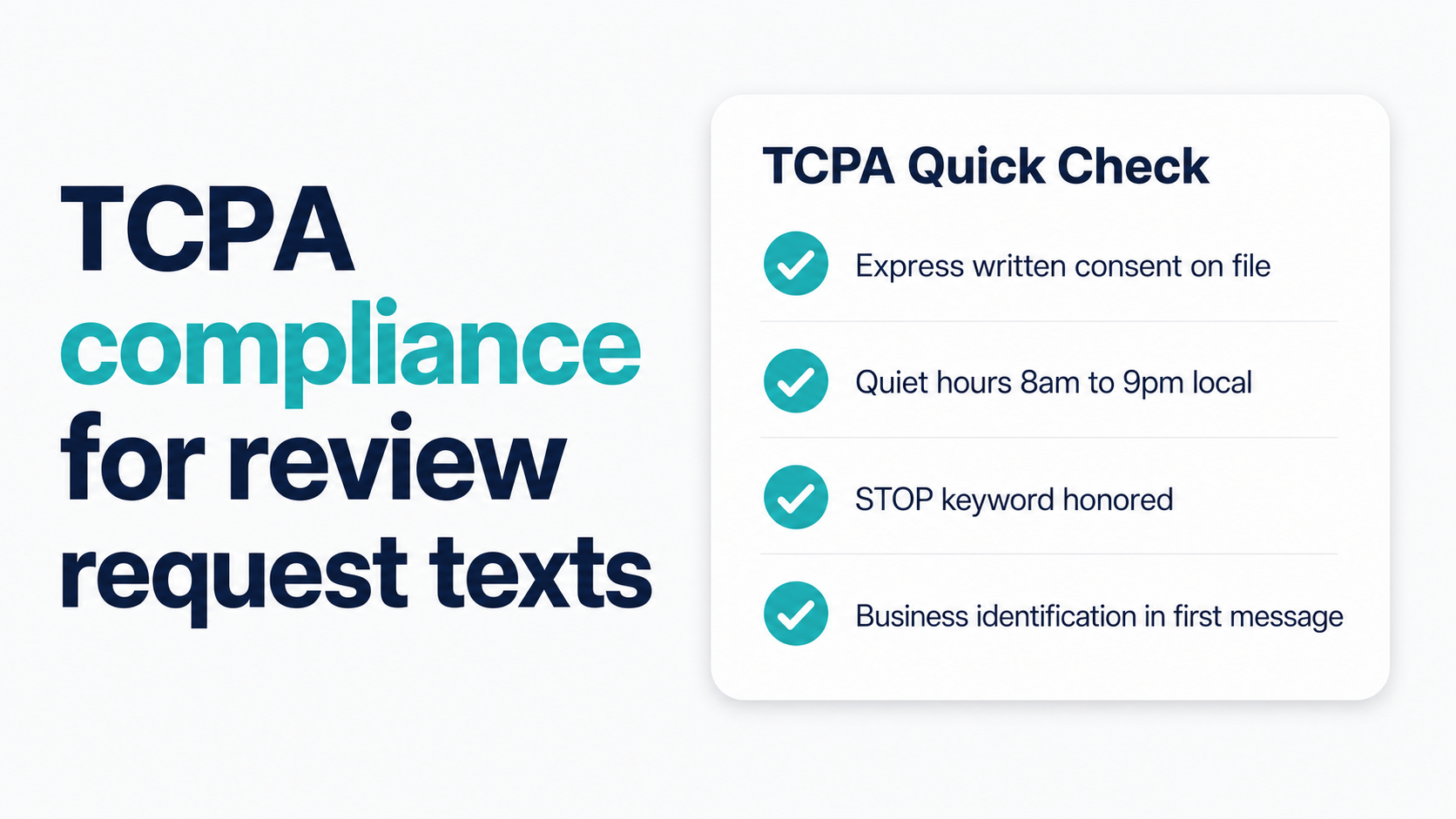
The TCPA (Telephone Consumer Protection Act, 47 U.S.C. § 227) requires prior express written consent before sending marketing texts. A review request text is likely considered a marketing communication. The safe-harbor path is a clear opt-in at point of service, an identified sender, and a compliant opt-out mechanism in every message.
What the TCPA actually says (plain-English summary)
The statute — 47 U.S.C. § 227 in plain language
The Telephone Consumer Protection Act (47 U.S.C. § 227) is the federal law that governs automated phone and text communications to consumers. The statute was passed in 1991 to address telemarketing abuse and has been updated several times by FCC rulemaking.
The core requirement: before sending a marketing text via an automatic telephone dialing system (ATDS) or prerecorded message to a consumer's mobile phone, the sender must have the consumer's "prior express written consent."
"Prior" means consent must exist before the first message is sent. "Express" means the consumer actively agreed — not implied or assumed. "Written" means documented — a checkbox, a signature, a text-based confirmation flow.
The statute itself is accessible at 47 U.S.C. § 227 via Cornell Law School's Legal Information Institute.
Are review request texts "marketing"?
The FCC's position, reflected in its TCPA implementing rules, is that a message is "marketing" if it has any promotional or advertising element — including messages that benefit the sender's business, even if they are also useful to the consumer.
A text that asks a customer to leave a public Google review benefits the business (reputation, local search visibility). The FCC's guidance on TCPA scope indicates that this type of message is likely subject to the prior express written consent requirement for marketing messages, not the lesser "prior express consent" standard that applies to purely informational or transactional messages.
Source: FCC TCPA rules and guidance
FCC enforcement context
TCPA violations can result in statutory damages of $500 to $1,500 per violation — per text message sent. Class action lawsuits under TCPA are common, particularly when businesses send automated texts to consumers without documented consent.
The FCC publishes enforcement actions against TCPA violators at fcc.gov/enforcement. Most large enforcement actions involve massive volumes of messages (millions of texts) — but small businesses are not immune. Any automated send without documented consent creates exposure.
The four requirements for TCPA-compliant review request texts
Requirement 1 — Prior express written consent
This is the core requirement and the one most businesses skip. Before you send any automated review request text, you must have documentation that the customer agreed to receive it.
What counts:
- A checkbox on your booking form: "By providing your mobile number, you consent to receive automated review requests from [Business Name]. Reply STOP to opt out."
- A customer's signature on an invoice that includes opt-in language
- A text-based confirmation flow where the customer replies "YES" to a first message confirming consent
What does not count:
- A customer calling to book and verbally giving their phone number (verbal consent is not sufficient for automated sends)
- A customer's number in your phone from a prior personal interaction
- A pre-checked checkbox (the consumer must actively check it)
Source: FCC guidance on prior express written consent for marketing texts
Requirement 2 — Identified sender
Every automated marketing text must clearly identify who is sending it. "Top Care Cleaning" must appear in the message, not just a generic shortcode or number. Customers who do not recognize the sender are more likely to file complaints.
Example language: "Hi [Name], this is Top Care Cleaning — thanks for having us out today. If you're happy with the clean, we'd love a quick Google review: [link]. Reply STOP to opt out."
Requirement 3 — Opt-out mechanism
Every automated marketing message must include a way for the consumer to opt out — and the opt-out must work. The industry standard is "Reply STOP to unsubscribe" or similar language in the message body.
When a customer replies STOP, the opt-out must be honored within a reasonable time (industry practice and CTIA Best Practices recommend honoring STOP requests immediately or within a single business day). Sending additional marketing texts to someone who has opted out is a TCPA violation.
Source: CTIA Messaging Principles and Best Practices
Requirement 4 — A2P 10DLC registration
A2P 10DLC (Application-to-Person, 10-Digit Long Code) is the carrier industry's registration system for business SMS senders. If you are sending automated business texts from a standard 10-digit phone number, carriers require that your brand and message campaigns be registered.
A2P 10DLC registration involves:
- Registering your business brand with The Campaign Registry (TCR) through your SMS carrier or platform
- Submitting a description of your message use case (for review requests: "customer service — review requests for completed service jobs")
- Providing your opt-in language (the exact text customers see when they consent)
- Waiting for carrier approval of the campaign registration
Carriers that enforce A2P 10DLC requirements will filter or block unregistered business SMS traffic. This means unregistered sends may never reach customers — and even if they do, you are operating outside the carrier compliance framework.
Source: CTIA Messaging Principles and Best Practices
Checklist table:
| Requirement | What you need | Example language |
|---|---|---|
| Prior express written consent | Checkbox or signature at booking | "By providing your mobile number, you consent to receive automated review requests from [Business Name]. Reply STOP to opt out." |
| Identified sender | Business name in every message | "This is Top Care Cleaning — {message text}" |
| Opt-out mechanism | STOP keyword in message | "Reply STOP to unsubscribe" |
| A2P 10DLC registration | Brand + campaign registered with carrier | Submitted through SMS platform or carrier |
A2P 10DLC — what it is and why it matters
What A2P 10DLC registration is
A2P 10DLC is not a legal requirement under TCPA — it is a carrier industry requirement. The carriers (AT&T, Verizon, T-Mobile) enforce A2P 10DLC registration because unregistered business SMS has been a major source of spam and fraud.
CTIA (the wireless industry trade association) developed the A2P 10DLC framework through its Messaging Principles and Best Practices guidelines. The framework requires businesses sending automated SMS to register their brand and describe the specific message use case so carriers can apply appropriate traffic filters.
Source: CTIA Messaging Principles and Best Practices
How I registered Top Care Cleaning under A2P 10DLC
I registered Top Care Cleaning under A2P 10DLC when we set up our automated review request system through Hosted Reviews. Here is what the process looked like from the operator's side:
Timeline: The registration process took approximately 2–4 weeks from initial submission to full carrier approval. Most of that time was carrier-side review, not back-and-forth. We submitted the application through the Hosted Reviews platform, which handles the brand and campaign registration on behalf of our business.
Information required:
- Legal business name and EIN (for brand registration)
- Business website URL
- Message use case description ("customer service — post-job review requests for completed cleaning jobs")
- Opt-in language: the exact text customers see when they consent to receive messages
- Sample message: the actual message content we send (reviewed for compliance)
What "campaign verification" looks like: Once the brand registration is approved, the specific message campaign (the review request template) is reviewed against carrier policies. The review checks that the message content matches the stated use case, the opt-out mechanism is present, and the sender is clearly identified.
After approval: Messages from our registered number are processed with higher throughput and lower filtering rates by major carriers. Before registration, some messages were being filtered as potential spam. After registration, delivery improved substantially.
What happens if you do not register
Unregistered business SMS to consumers sends a signal to carrier filtering systems that the messages may be unauthorized commercial traffic. Carriers may:
- Filter or soft-block messages (they are sent but never delivered)
- Hard-block messages from unregistered shortcodes or long codes
- Apply lower throughput limits (messages send slowly or queue indefinitely)
The result: your review request texts do not reach customers, and you do not know it because there is no delivery failure notification on your end. You think you sent 50 review requests; customers received 12.
Source: CTIA carrier filtering guidelines
Opt-in language — what works
Where to collect consent
Three practical locations for collecting SMS consent:
- Online booking form — the most reliable method. Add a checkbox with the opt-in language before the "Book Now" or "Submit" button. The customer actively checks it, and the form submission creates a dated, documented record.
- Invoice footer — add the opt-in language to your standard service invoice. Customer signature on the invoice constitutes written consent. Make sure the opt-in language is readable (not buried in footnotes).
- Verbal confirmation at job completion followed by text confirmation — tech asks at the door; customer responds "yes" by text to a confirmation message that also includes the opt-in language. The text response is the documented consent.
Example opt-in language
The language Top Care uses at booking (close approximation — exact copy pending):
"By providing your mobile number and checking this box, you consent to receive automated review requests and service-related text messages from Top Care Cleaning. Message and data rates may apply. You may opt out at any time by replying STOP."
What does NOT count as valid consent
- Pre-checked checkboxes (consumer must actively check)
- A phone number provided verbally for service coordination
- Implied consent from a past business relationship alone
- A customer's email newsletter signup (that is not SMS consent)
Source: FCC guidance on prior express written consent
TCPA opt-out requirements
The STOP keyword requirement
Every automated marketing text must include opt-out instructions. The industry standard is "Reply STOP to unsubscribe" or equivalent. When a consumer replies with STOP, STOP ALL, UNSUBSCRIBE, CANCEL, END, or QUIT, the opt-out must be honored.
How fast must you honor opt-outs
CTIA Best Practices recommend honoring STOP requests within a reasonable time — in practice, immediately or within one business day. After a STOP reply, no further marketing texts should be sent to that number. A single auto-reply confirming the opt-out ("You have been unsubscribed from Top Care Cleaning texts. Reply START to re-subscribe.") is acceptable, but nothing more.
Source: CTIA Messaging Principles and Best Practices
What to do when someone opts out mid-conversation
If a customer opts out during an active review request sequence (after the screening message but before the review link is delivered), stop all further automated sends to that number immediately. Do not send the review link. If the customer later contacts you directly and requests the review link, you may provide it manually — but do not resume automated sends until new consent is documented.
The CTIA Code of Conduct (the practical operator checklist)
CTIA's Messaging Principles and Best Practices are the industry standard for business SMS compliance. Key requirements relevant to review requests:
Message frequency disclosure: Your opt-in language should indicate approximate message frequency. For review requests, this is typically "occasional" — one to two texts per job completion. You do not need to specify an exact number, but "we will send you 500 messages per year" framing is obviously unacceptable.
Message content rules: Texts must clearly identify the sender, not use deceptive sender IDs (you cannot send as "Google" or "Your Government"), and not disguise marketing as urgency-based notifications.
Help keyword: In addition to STOP, your system should respond to HELP with a brief description of the service and contact information.
Source: CTIA Messaging Principles and Best Practices
Frequently asked questions
Do I need a lawyer to send review request texts?
For basic compliance setup, no — the requirements (opt-in, identified sender, STOP mechanism, A2P 10DLC registration) are practical steps that any operator can implement. For questions about whether your specific opt-in language is sufficient, whether past sends created TCPA exposure, or if you receive a TCPA demand letter, consult a TCPA attorney.
Can I text customers who gave me their number verbally?
For automated marketing texts: no. Verbal consent is not documented written consent under TCPA for automated sends. For a manual, one-off text from your personal phone, the risk profile is lower — but you are still in a gray area. The cleanest path is always documented written consent.
What is the fine for a TCPA violation?
The statute provides for $500 per violation (per text message) and up to $1,500 per willful violation. In class action contexts, aggregate damages can be substantial. Source: 47 U.S.C. § 227(b)(3).
Do I need to register A2P 10DLC if I send fewer than 10 texts a day?
A2P 10DLC registration requirements depend on carrier policy, not absolute message volume. Even low-volume business SMS senders benefit from registration because unregistered traffic is subject to carrier filtering. Check with your SMS platform — most reputable platforms require A2P 10DLC registration regardless of daily volume.
Is a review request text subject to TCPA?
Yes, in general. The FCC's position is that a message with any marketing element (including reputational benefit to the sender) is subject to the prior express written consent requirement. A review request is typically considered marketing.
What does prior express written consent actually look like?
A checkbox on a booking form that says: "I consent to receive automated review request texts from [Business Name]. Reply STOP to opt out." The customer must actively check it. The form submission creates a dated record of consent.
What this means for your Hosted Reviews account
Hosted Reviews handles A2P 10DLC registration as part of the account setup process. When I registered Top Care Cleaning, the registration flow in the product reflected exactly what I had gone through manually when I first started sending SMS review requests. The brand registration, campaign description, opt-in language submission, and carrier approval process are built into the Hosted Reviews onboarding.
This does not eliminate your responsibility for maintaining documented opt-in consent at your point-of-service. The platform handles the carrier infrastructure; the opt-in language on your booking form is yours to implement.
I built Hosted Reviews to automate this for Top Care Cleaning — and now for other local service businesses. 14-day trial, no card required.
Remember: this article is an educational overview of TCPA requirements written from an operator's perspective. It is not legal advice. For specific compliance guidance, consult a licensed TCPA attorney.
About the author
Alex Host runs Top Care Cleaning, a Grand Rapids home services company with 400+ Google reviews, and built Hosted Reviews to automate what he was doing manually. Alex is an operator who has personally registered under A2P 10DLC for Top Care Cleaning — not a TCPA attorney. Reviews-facet bio.
I run Top Care Cleaning, a Grand Rapids home services company with 400+ Google reviews, and built Hosted Reviews after manually asking for reviews for years. The data in these articles comes from our own system. — hostedbrands.com/about