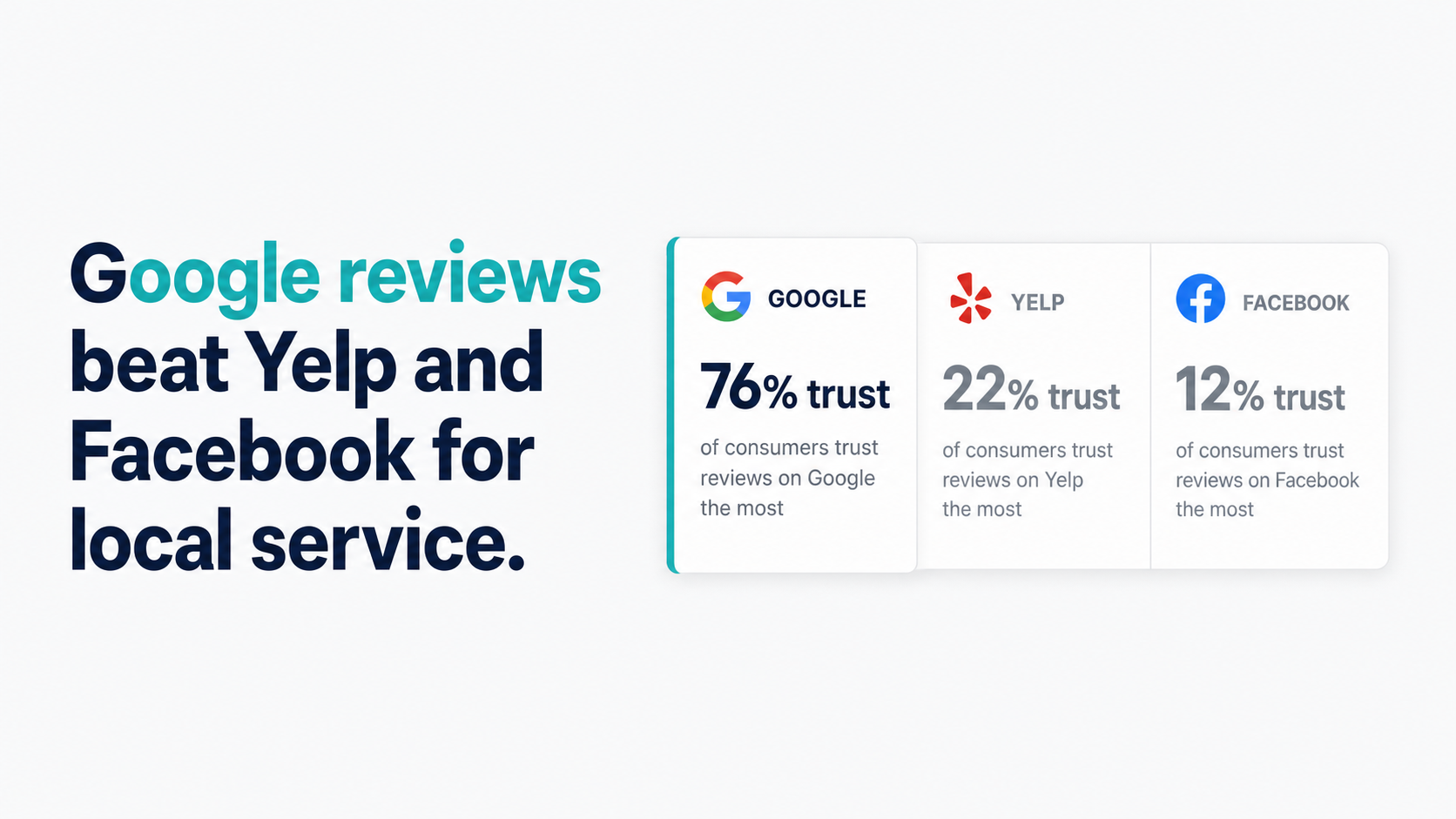
By Alex Host · Founder of Top Care Cleaning · Updated 2026-05-04
For local service businesses competing in Google Search and the local pack, Google reviews are the primary lever — they directly influence local pack ranking and appear in the SERP result. Yelp matters for hospitality-adjacent businesses and in cities with high Yelp adoption. Facebook reviews matter for word-of-mouth in existing community groups but have minimal direct impact on local search visibility.
What "driving jobs" actually means for local service
When I say a review platform "drives jobs," I mean it produces new customer inquiries that convert to paid work. Not impressions. Not follower counts. Bookings.
For a local service business, most new customer bookings start the same way: someone searches Google. "Gutter cleaning Grand Rapids." "House cleaning near me." "Pressure washing company." The customer is in discovery mode, has a specific job in mind, and is comparing options in their area. The business that appears in the local pack — the three businesses Google surfaces with a map, star rating, and review count — gets the clicks. Everyone else gets the leftovers.
At Top Care Cleaning, the vast majority of new customer inquiries begin with a Google search. Our Yelp profile exists and occasionally generates an inquiry, but it produces a fraction of what Google-sourced inquiries produce. Our Facebook page has a reviews section, and we get the occasional booking from existing followers who see us mentioned in a neighborhood group. Neither platform is in the same category as Google for new customer acquisition.
This isn't unique to Top Care. Local service businesses compete in a defined geographic market, and Google's local search products — Maps, the local pack, the knowledge panel — are how homeowners find service businesses. That's where the jobs come from, and that's where your reviews need to be strongest.
Google reviews — why they're the primary platform for local service
Google reviews are embedded directly into the products homeowners use to find local services. When you search for a cleaning company on Google Maps, every result has a star rating and review count. When the local pack appears in a Google search, each business shows its rating. When you click a local business listing, the reviews are the primary content of the knowledge panel.
Three specific mechanisms make Google reviews the dominant driver of local service bookings:
Local pack ranking. Review count, velocity, and star rating are among the factors that influence whether your business appears in the local pack. A business with consistent, recent reviews has a higher probability of holding local pack positions than a business with stale or thin review profiles. BrightLocal's Local Consumer Review Survey confirms that review signals are a core component of local search algorithm behavior.
Trust threshold at point of decision. When a prospect clicks your listing, your review count and star average are the first things they see. BrightLocal data shows that most consumers need to read at least a few reviews before they'll contact a business. A 400-review profile with a 4.9 average communicates something a 12-review profile cannot, regardless of how good the individual reviews are.
Google review requests convert at a higher rate than Facebook outreach. At Top Care, our Google review requests converted at a meaningfully higher rate than our Facebook outreach attempts. This is a qualitative observation, not a controlled experiment — we didn't run A/B tests with identical messaging across platforms — but the directional finding is consistent with what other operators report. Customers are already in Google's ecosystem; meeting them where they are reduces friction.
Yelp — when it matters (and when it doesn't)
Yelp's value for local service businesses depends heavily on two variables: geography and category.
Geography. Yelp adoption is high in West Coast cities, particularly San Francisco, Los Angeles, and Seattle. In these markets, homeowners use Yelp for service discovery alongside Google. In Midwest and rural markets, Yelp adoption is lower and Google is more dominant. A cleaning company in Grand Rapids, Michigan competes in a Google-primary market. A cleaning company in San Francisco may need to take Yelp seriously.
Category. Yelp is strongest in restaurants, hospitality, personal care, and some home services categories. For residential cleaning and exterior services, Yelp is weaker than for, say, a plumber or electrician in a Yelp-dominant city. Yelp's category strength varies — if your service category generates high Yelp activity in your city, it's worth having a maintained profile. If not, it's a secondary consideration.
The other factor is Yelp's consumer-led review model. Unlike Google, where businesses can directly ask customers to leave reviews with a link, Yelp actively discourages soliciting reviews. Yelp's policies state that businesses should not ask customers to leave reviews, and Yelp's algorithm filters reviews that appear to be solicited. This means you can't run the same systematic ask-after-every-job process that works on Google — which is another reason Google is the better investment of your review-building effort for most local service operators.
A Yelp review widget on your website — which displays your Yelp star rating and reviews to website visitors — is worth setting up if you have an established Yelp profile with meaningful reviews. The widget keyword "yelp review widget" has modest search volume from business owners wanting to display their Yelp rating. If you have 50+ Yelp reviews, using the Yelp widget alongside your Google review widget gives visitors more social proof data points.
Facebook reviews — the word-of-mouth play
Facebook Reviews (now called "Recommendations") work differently from Google and Yelp. When a customer recommends your Facebook page, that recommendation is visible to their Facebook friends, their local neighborhood groups, and anyone who finds your Facebook page. The social distribution is the value.
For local service businesses with an active Facebook community — businesses with 500+ local followers, or businesses whose customers participate in active neighborhood Facebook groups — Recommendations can generate real referral bookings. A satisfied customer who posts "Just had Top Care do my windows — highly recommend!" in a neighborhood group can produce several direct inquiries.
The limitations are significant:
No local pack impact. Facebook Recommendations do not feed Google's local pack ranking algorithm. Building Facebook reviews won't improve your visibility in Google search results.
Audience decay. Facebook organic reach for business pages is low. Most of your followers won't see an individual recommendation without paid amplification.
Discovery channel is different. Facebook is primarily a community and word-of-mouth channel. It's not where people search for service businesses the same way they search on Google. The user who finds you on Facebook is typically already in your network — a referral, not a cold discovery.
When to prioritize Facebook Recommendations: if your business has an active local Facebook community with substantial organic reach, or if your primary customer base is older and more Facebook-native than Google-native. Otherwise, direct your energy to Google first.
The verdict — where to focus for a local service business
Clear recommendation: Google first, always.
Yelp second, only if you're in a Yelp-dominant market or category — specifically, if your city has high Yelp adoption and your service category generates Yelp search activity.
Facebook third, only if you have an established community of local followers and active neighborhood group presence.
The time cost argument applies here. Managing three review platforms manually — asking for reviews, responding to reviews, monitoring notifications — takes hours every week. For a small service business owner who is also running jobs, managing technicians, and handling scheduling, that time doesn't exist. The correct answer is: automate Google (the highest-ROI platform), maintain a basic presence on Yelp and Facebook, and don't try to optimize all three simultaneously.
For the Google setup: start with How to Set Up Google Reviews for Your Business, which covers the GBP setup, review link retrieval, and the basic ask workflow from scratch.
Hosted Reviews automates your Google review requests — start a 14-day trial — no card required: app.hostedreviews.com.
Can I collect Yelp and Facebook reviews with Hosted Reviews?
Hosted Reviews is built around Google review collection — the post-job SMS workflow that sends your Google review link and follows up with a reminder. It is designed for Google specifically.
For Yelp: Yelp's anti-solicitation policies make automated Yelp review requests a policy violation, so no reputable review automation tool should offer this. Organic Yelp reviews come from customers who find you on Yelp and choose to review on their own.
For Facebook: manual asks work best for Facebook Recommendations. Ask in person at the job or include your Facebook page in your general follow-up communications, but avoid a templated automated ask that Yelp or Facebook might flag as solicitation.
For questions about Hosted Reviews product direction — including multi-platform support — check the product changelog at app.hostedreviews.com.
Frequently asked questions
Do Yelp reviews affect Google ranking?
Not directly. Google's local pack algorithm uses Google reviews as the primary review signal. A strong Yelp profile does not improve Google local pack ranking. Indirectly, a Yelp business page can appear in Google search results for branded queries ("Your Business Name Yelp"), which creates an additional SERP result. But that's brand presence, not local pack positioning.
Can I ask customers for Yelp reviews directly?
Yelp's policy is that businesses should not solicit reviews. Yelp says business owners "should not ask for reviews" and its algorithm is designed to filter reviews that appear solicited. You can tell customers you're on Yelp and let them review at their own initiative, but a direct ask with a review link the way you'd do on Google is against Yelp's policies.
Which platform has the most fake review risk?
All three platforms have fake review problems, and all three have detection systems. Google is the most aggressive about filtering suspicious reviews — sudden spikes, reviews from accounts with no other activity, reviews from the same IP address as the business. Yelp is also active in filtering, including removing legitimate reviews that it detects as potentially solicited. Facebook's Recommendation system is the most permissive and least frequently filtered.
Should I respond to Facebook Recommendations?
Yes, if you're actively using Facebook as a community channel. Responding to Recommendations — especially for service businesses with an engaged local following — shows that a real person is behind the business. Keep responses short and specific. For Google review responses, the same principle applies, and the stakes are higher because responses are visible in the knowledge panel to every prospect who views your listing.
About the author
Alex Host runs Top Care Cleaning, a Grand Rapids cleaning and exterior service with 400+ Google reviews, and built Hosted Reviews to automate what he was doing manually. I run Top Care Cleaning, a Grand Rapids cleaning and exterior service with 400+ Google reviews, and I built Hosted Reviews to automate what I was doing manually. Read more at hostedbrands.com/about.