By Alex Host · Founder of Top Care Cleaning · Updated 2026-05-04
A "better" Google review is specific, mentions a service outcome, names the technician, and was written by a genuinely satisfied customer. You can influence review quality by timing the ask correctly, using a specific prompt ("Tell us about your experience with [technician name]"), and funnel-screening unhappy customers before they reach the review prompt. The review itself is always the customer's words — you cannot script it.
What makes a Google review "better" (and why it matters)
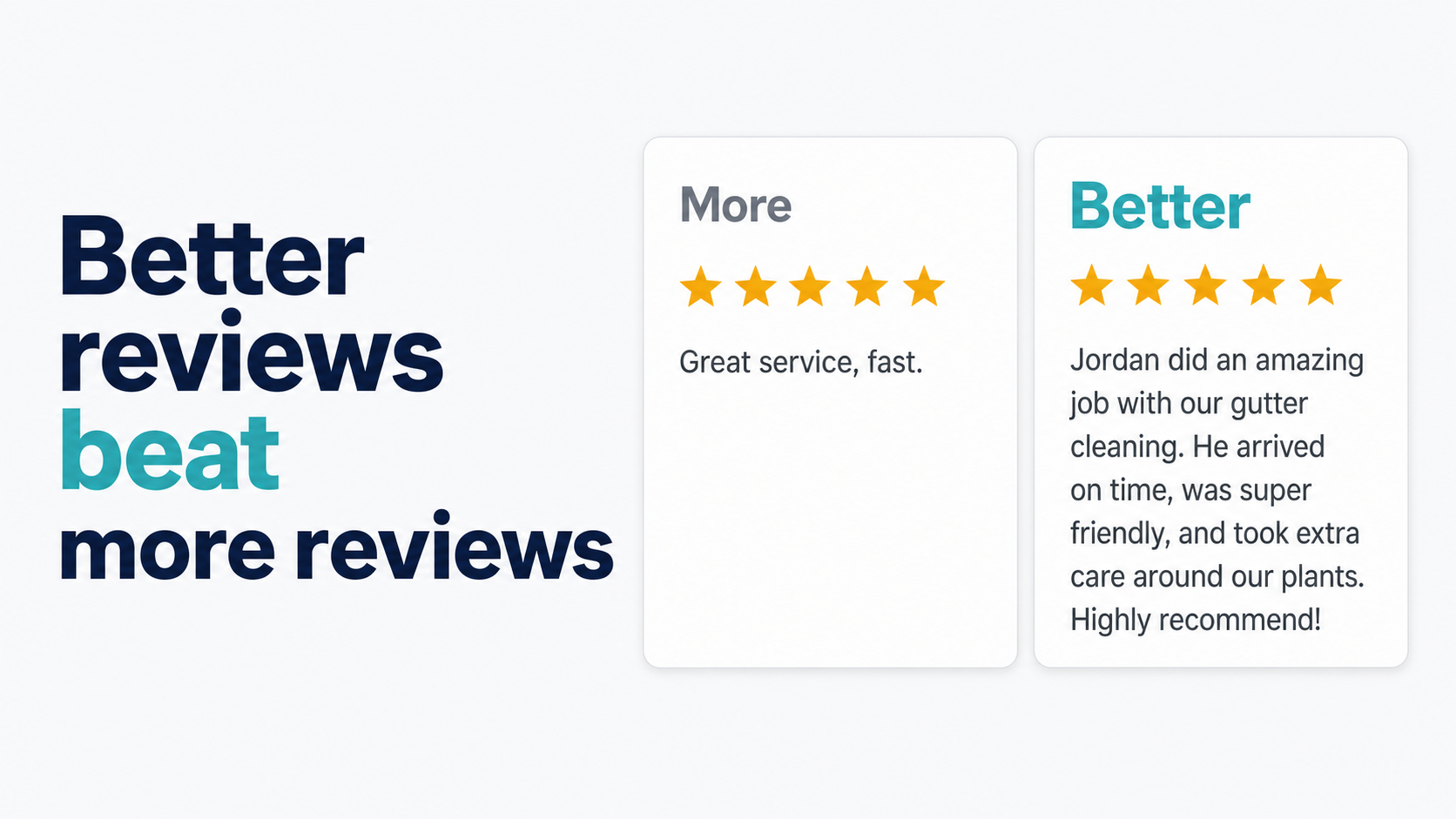
"Great service!" is a 5-star review. So is "Jake arrived on time, cleaned both story gutters in under 2 hours, showed me what he found, and left the driveway spotless. Definitely booking again for the spring clean." These are not equivalent.
The second review does more work:
Specificity signals credibility. A detailed review is harder to fake and more credible to prospects comparing service providers. When a customer reads "great service!" on 400 reviews, the value is the count. When they read specific service descriptions, the value is in the substance.
Keyword richness strengthens your GBP. Review text is indexed by Google and becomes part of your business profile's content. When customers mention specific service names ("pressure washing driveway," "gutter cleaning October"), those phrases create associative signals between your business and those search queries. Some of our best Top Care reviews mention specific services by name — "window washing," "cleaned gutters in October," "exterior house washing." Those reviews have made our GBP profile more relevant to specific service searches.
Named reviews build internal accountability. When reviews name technicians, it creates a leaderboard dynamic — technicians who are named in positive reviews take pride in the performance that generated the review. This is a virtuous loop that directly improves service quality.
Star delta compounds. A 4.9 average on 400 reviews is a different commercial asset than a 4.6 average on 400 reviews. Detailed, specific reviews are more often 5-star than vague ones — the customer who took time to write a thorough review was more satisfied, not less. Quality of review correlates with quality of star rating.
How review quality affects your GBP
Google surfaces review text in the local knowledge panel. When a prospect clicks your Google listing, they see your most recent and most helpful reviews — the ones Google selects as representative. Specific reviews with service names, location references, and technician mentions are more likely to appear as Google's "highlighted reviews" than generic one-liners.
The local keyword signal from review text is a secondary but real SEO benefit. Reviews that contain "gutter cleaning Grand Rapids" or "house washing near Fulton Street" add geographic and service-specific language to your GBP content. This doesn't replace other local SEO work, but it's an incremental signal that costs nothing to accumulate.
Long-tail keyword signals from review text: "pressure washing concrete driveway" in a customer review creates an association in Google's index between your business and that specific service. Over hundreds of reviews, these associations accumulate into a richer, more relevant profile.
How to ask in a way that prompts detail (without scripting)
The wrong approach: "Please leave us a 5-star review." This is prohibited under Google's policy (you cannot instruct reviewers to leave positive content), and it produces low-quality, compliant reviews — the "great service!" one-liner that fulfills the ask without providing detail.
The right approach uses open-ended prompts that invite specific reflection:
- "If you were happy today, we'd love to hear what stood out."
- "Tell us about your experience with [Technician Name] today."
- "What made your service experience today worth mentioning?"
The technician name prompt is particularly effective. When a customer is asked specifically about a named person, they're more likely to write about that person — which produces a named, specific review ("Alex was thorough, took extra time to check the screens") rather than a generic "they were great."
Many of our Top Care reviews mention technician names and specific services — we believe the prompt language in the Hosted Reviews SMS contributes to this pattern. We haven't run a formal count, but technician name mentions are common enough in our review text that it shapes how we write the ask.
Timing reinforces quality: send the ask within 2 hours of job completion, when the experience is specific in the customer's memory. A customer asked about the service they had this morning can describe what the technician did, what the result looked like, and what made it satisfying. A customer asked three days later remembers "it was good" and writes accordingly.
Funnel screening as a quality filter
Funnel screening (How to Get Good Google Reviews — Funnel Screening 101) ensures only satisfied customers reach the review prompt. A genuinely happy customer is more likely to write a specific, positive review than one who was on the fence when they tapped through.
The combined effect of funnel screening + quality prompts:
- Funnel screen: only customers who said "yes, I was happy" reach the review prompt
- Quality prompt: those customers are asked a specific question that encourages detail
- Result: a higher proportion of specific, detailed, 5-star reviews relative to the total asks sent
This is the quality ceiling you're building toward — not just more reviews, but reviews that contain service-specific language, technician names, and the kind of detail that converts prospects who read them.
The technician-attribution effect
When reviews name a technician, something interesting happens operationally: the technician starts paying attention to their review count.
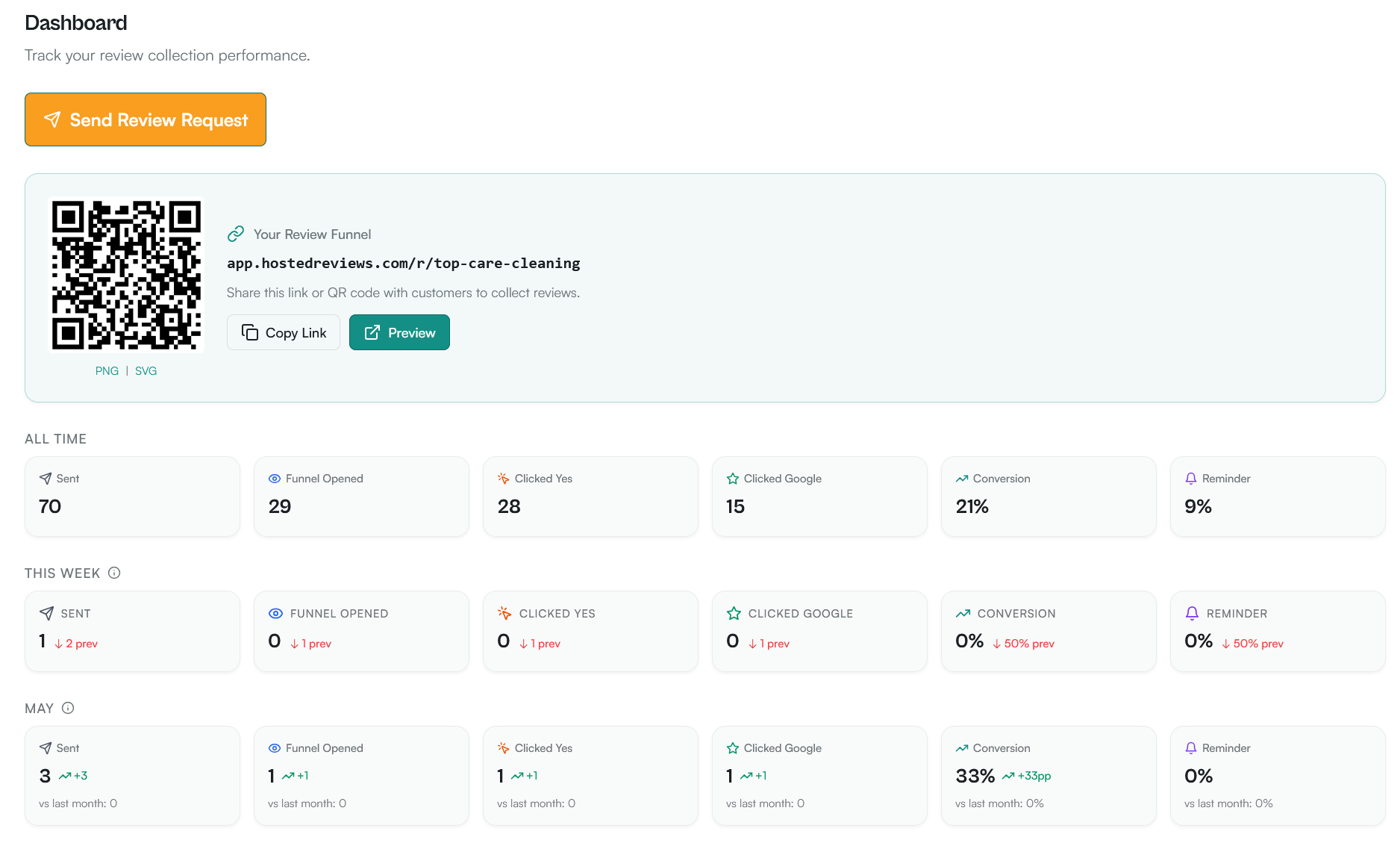
In the Hosted Reviews dashboard, we track review conversion by technician. Our top-performing technician converts at roughly 2× the team average. The named reviews are part of why. The technician knows their name is going into the reviews, knows I can see their conversion rate, and that accountability produces better in-person interactions with customers — which produces more reviews.
Named reviews create a virtuous loop: technician pride → better service → more detailed reviews → more named reviews → more pride. The loop compounds over time and produces a team where individual performance is visible and celebrated.
The same dynamic works in the other direction: if a technician is generating very few reviews despite a high job volume, that's a signal worth investigating. Low review conversion from a specific technician might indicate service quality issues, or it might indicate that the technician isn't doing the in-person verbal ask that primes the SMS conversion.
For the dashboard screenshot from Top Care: the leaderboard shows technician initials and conversion rates. Our top converter generates reviews at roughly 2× the rate of the team average. Names are redacted in our public-facing content per our team data policy.
Responding to reviews as a quality signal
For positive reviews, a short specific response acknowledges the customer and signals to prospects that a real person is managing the business:
- "Thanks, [Name] — we'll make sure [Technician] sees your kind words. Looking forward to your next cleaning."
- "Really appreciate the detailed review, [Name]. [Specific detail they mentioned] is exactly what we aim for."
For negative reviews, the response is the recovery opportunity. A measured, non-defensive response to a 1-star review can influence how prospects interpret the review. Prospects who read reviews often read the business's response — a response that acknowledges the complaint and explains how it was resolved changes the context of the negative review.
For a complete treatment of negative review response strategy, see the resources in Pillar 5 on review management. The brief version: respond within 24 hours, don't argue, acknowledge the complaint, describe what you did or are doing to fix it, and invite further conversation offline.
Note on ranking impact: review responses are GBP activity signals. There is no confirmed direct ranking boost from responding, but GBP engagement is consistently cited as a positive signal in local SEO research.
Closing
Hosted Reviews sends the post-job ask with technician attribution built in — so your best reviews name the right people. Start a 14-day trial — no card required: app.hostedreviews.com.
Frequently asked questions
Can I tell customers what to write in their Google review?
No. Google's review policies prohibit instructing reviewers to leave positive content, write specific phrases, or assign specific star ratings. You can ask a customer about their experience using open-ended prompts, but you cannot script the review. Reviews must reflect the customer's genuine opinion in their own words.
Do longer reviews help my Google ranking?
Review text contributes to your GBP's content. Longer, more specific reviews with service names and location references may create stronger keyword associations. There is no confirmed "length = ranking boost" mechanism, but the secondary effect of keyword-rich review text on GBP relevance is a recognized local SEO signal.
What should I do if a customer leaves a vague 5-star review?
Accept it graciously. A 5-star review is a 5-star review regardless of text length. Respond with a brief thank-you that includes the service name and location — "Thanks, [Name], glad the gutter cleaning in [Neighborhood] went smoothly!" — which adds context around the vague review in the response.
How do I respond to a 4-star review without making it awkward?
Acknowledge the positive elements, ask what could have been better, and leave the door open. "Thanks for the 4-star review, [Name] — we're glad [specific element they mentioned] went well. If there's anything we could have done to earn the fifth star, we'd love to hear it." Keep it brief and non-defensive. A 4-star review is a positive review — don't treat it as a failure.
About the author
Alex Host runs Top Care Cleaning, a Grand Rapids cleaning and exterior service with 400+ Google reviews, and built Hosted Reviews to automate what he was doing manually. I run Top Care Cleaning, a Grand Rapids cleaning and exterior service with 400+ Google reviews, and I built Hosted Reviews to automate what I was doing manually. Read more at hostedbrands.com/about and topcarecleaning.com.