By Alex Host · Founder of Top Care Cleaning · Updated 2026-05-04
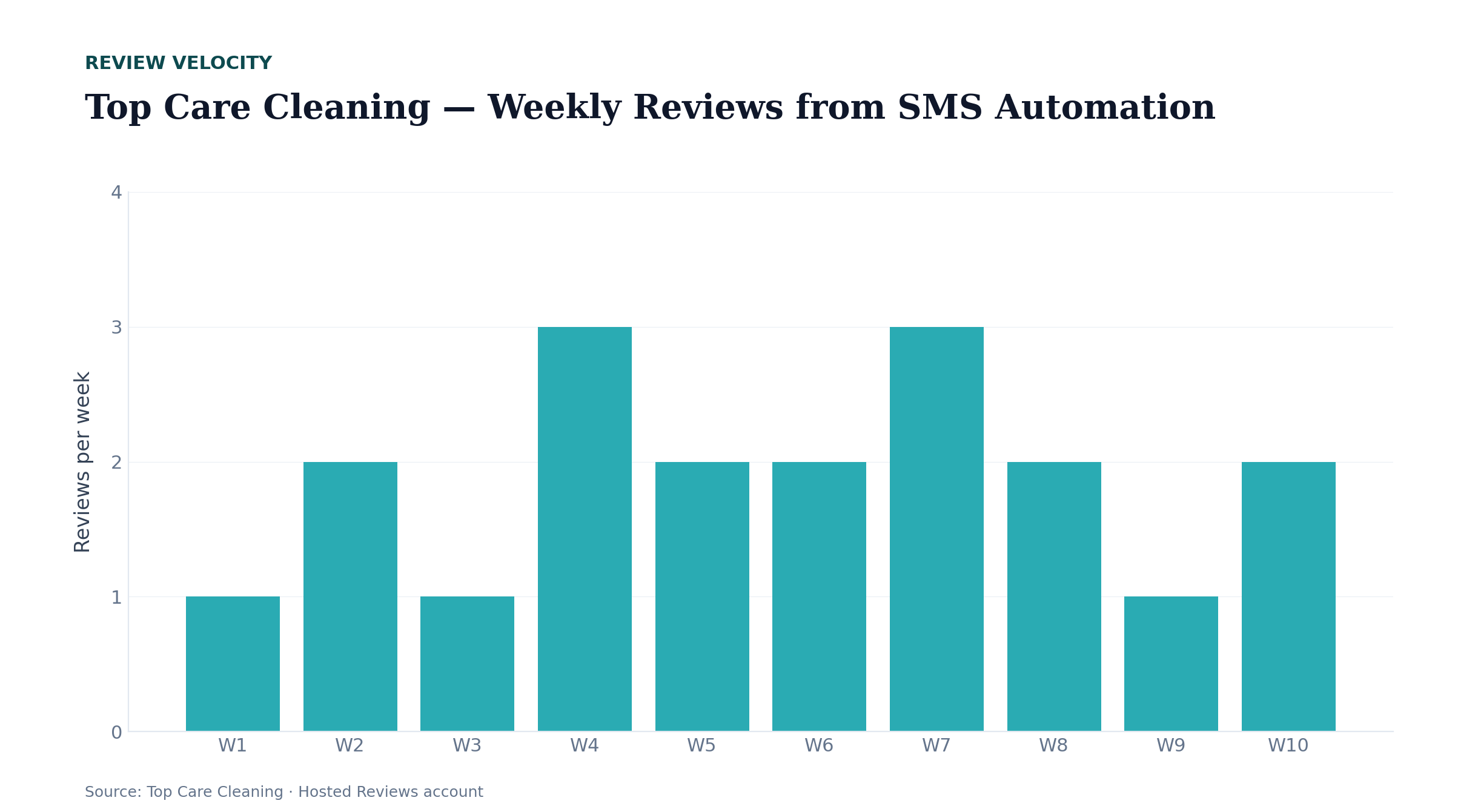
The fastest legitimate path to more Google reviews is automating a post-job SMS sent within 24 hours of service completion. At Top Care Cleaning, our review-to-send rate is 21% (n=70 sends) — meaning 1 in 5 customers who receive the SMS leave a review. Tuesday sends convert at 35%. The most common mistake that kills review velocity is asking too late or not following up after the initial ask.
Why "fast" requires a system, not a campaign
The word "fast" in the context of Google reviews is a trap. Operators who interpret "fast" as "one big push" run a campaign, get a burst of reviews, and then go back to zero velocity. That approach produces a spike that looks suspicious to Google's algorithm and a hollow result for the business.
The real meaning of "fast" is: the fastest sustainable path to a higher review count is getting your system live and consistent. Once the automated post-job send is running, reviews accumulate every week. Three months of steady-state beats one campaign every time.
One-time blast campaigns have three problems. First, they look unnatural — a business that normally gets 2 reviews per month suddenly receiving 30 in a week raises algorithmic flags even when every review is legitimate. Second, they're inefficient — contacting old customers about jobs they had 6 months ago produces much lower conversion than contacting new customers right after their service. Third, they're finite — you exhaust your customer list, the spike ends, and you're back to zero velocity.
The system approach: every completed job generates a review request automatically. Velocity is consistent, gradual, and looks exactly like what it is — a business with a lot of customers who are regularly satisfied.
The 4 levers that actually increase review velocity
Lever 1 — Timing (the 24-hour window)
This is the highest-impact lever. At Top Care Cleaning, 71% of our reviews come in within 24 hours of the request being sent. The median time from send to review is 2.5 hours.
What this tells us: when a customer acts, they act fast — within a few hours of receiving the request. The window of peak motivation is the day of service. Asking a week later — after the job has faded into the background of the customer's week — produces a fraction of the conversion rate of a same-day ask.
The day-of-week pattern compounds this: Tuesday sends at Top Care convert at 35%, compared to 7% on Wednesday and 0% on weekends. If you have any flexibility in when jobs complete or when you send requests, prioritize Tuesday completions for your highest-value customers.
Lever 2 — Channel (SMS vs email vs in-person)
SMS is the highest-converting channel. At Top Care, our review-to-send rate via SMS is 21%. For comparison: industry benchmarks from BrightLocal indicate email review requests typically convert at 5–10% versus SMS at 15–25% for service businesses. Top Care has not run a controlled email arm — we don't have a head-to-head number from our own data — but the directional finding is consistent with what other operators report.
The reason SMS outperforms: less friction. The customer doesn't open an app, find the message in a clutter of promotions, and click a small button in an email. They get a text message with a link, they tap the link, they're on the review form. Two steps.
In-person asks are effective at priming the customer before the SMS arrives. A technician who says "if you were happy today, we'll text you a link to leave a quick Google review" primes the customer to expect the text and act on it. Paired with automated SMS, the in-person ask reliably lifts conversion.
Lever 3 — The follow-up (the 35% who click the reminder)
The first send captures customers who act immediately. The reminder captures customers who saw the message, intended to act, and then got pulled into something else. At Top Care, our reminder click-through rate is 35%.
The timing for the reminder: send 24 hours after the initial request. At 24 hours, the experience is still reasonably fresh. At 48–72 hours, conversion drops. At a week, the reminder is more likely to feel like a pest than a helpful nudge.
We track first-reminder click-through rate at 35%; second and third reminder data isn't statistically meaningful at our current send volume (n=70). We don't send beyond one reminder at Top Care.
The language for the reminder should be brief and low-pressure: "Hi [Name], just a quick follow-up on the Google review link — if you haven't had a chance yet, here it is: [link]. No worries if not, and thanks again for the business."
Lever 4 — Automation (removes human inconsistency)
This is the lever that makes the other three work at scale.
Before Top Care had automation, our review ask coverage was roughly 20% of completed jobs — the jobs where I or a technician remembered to follow up. After automating with Hosted Reviews, we send to 100% of completed jobs. Every customer gets the ask within 2 hours of job completion, regardless of who worked the job, what day it was, or how busy we were.
I built Hosted Reviews to automate this for Top Care Cleaning — and now for other local service businesses. 14-day trial, no card required.
Hosted Reviews automates Levers 2, 3, and 4 simultaneously: the post-job SMS send, the 24-hour reminder, and the conversion tracking dashboard. Start a 14-day trial — no card required: app.hostedreviews.com.
The "fast" tactics that backfire
Buying reviews. Paid review services are sold to local business owners regularly. The pitch is quick volume. The reality: Google's detection systems are tuned for the patterns associated with purchased reviews — accounts with no other activity, clusters from the same geographic source, review text that matches templates. Getting caught results in review removal and potential profile penalties. The recovery time is months. The short-term count bump is not worth it.
Incentivizing reviews (offering discounts, gifts, or contest entries). This violates Google's review policies. Reviews obtained through incentives can be removed, and patterns of incentivized reviews can result in penalties to your GBP. A discount in exchange for a review is a common tactic that operators try — and it's fully prohibited.
Asking employees or family. Reviews from people with a direct relationship to the business raise flag patterns. The same-IP, same-network signals that Google's algorithm uses to identify suspicious reviews are present when employees post from the office. Same-device, same-network reviews get filtered.
Mass-importing old customer lists. Sending a bulk review campaign to 500 old customers at once looks like a velocity spike — which it is. Even when every review is legitimate, the pattern is anomalous for a business that normally gets 2 reviews per month. Bulk campaigns can trigger Google's review filter for that period.
Using fake profiles. Google's account age, activity history, and behavioral signals are used to identify fake reviewer accounts. Reviews from newly-created accounts with no other activity are filtered at high rates. Don't go down this path.
What a 90-day acceleration plan looks like
The 90-day plan for a business starting from a low review count:
Week 1: Claim and verify your GBP, retrieve your review link, confirm it works in an incognito browser. Setup covered in How to Set Up Google Reviews for Your Business. If you need your review link, use the free tool at /tools/google-review-link.
Week 1–2: Set up your automated post-job SMS workflow. Whether you use Hosted Reviews or a manual reminder system, the goal is 100% send coverage on completed jobs.
Weeks 3–12: Consistent post-job send cadence. At a 21% conversion rate, 50 sends per week = ~10 new reviews per week. Review velocity accumulates week over week.
Month 3 checkpoint: Check Google Search Console for any local pack position movement. Review GSC impressions for your primary category keywords ("house cleaning [city]," "gutter cleaning [city]"). Velocity increases typically correlate with impression increases in this timeframe.
About the author
Alex Host runs Top Care Cleaning, a Grand Rapids cleaning and exterior service with 400+ Google reviews, and built Hosted Reviews to automate what he was doing manually. I run Top Care Cleaning, a Grand Rapids cleaning and exterior service with 400+ Google reviews, and I built Hosted Reviews to automate what I was doing manually. Read more at hostedbrands.com/about and topcarecleaning.com.