By Alex Host · Founder of Top Care Cleaning · Updated 2026-05-04

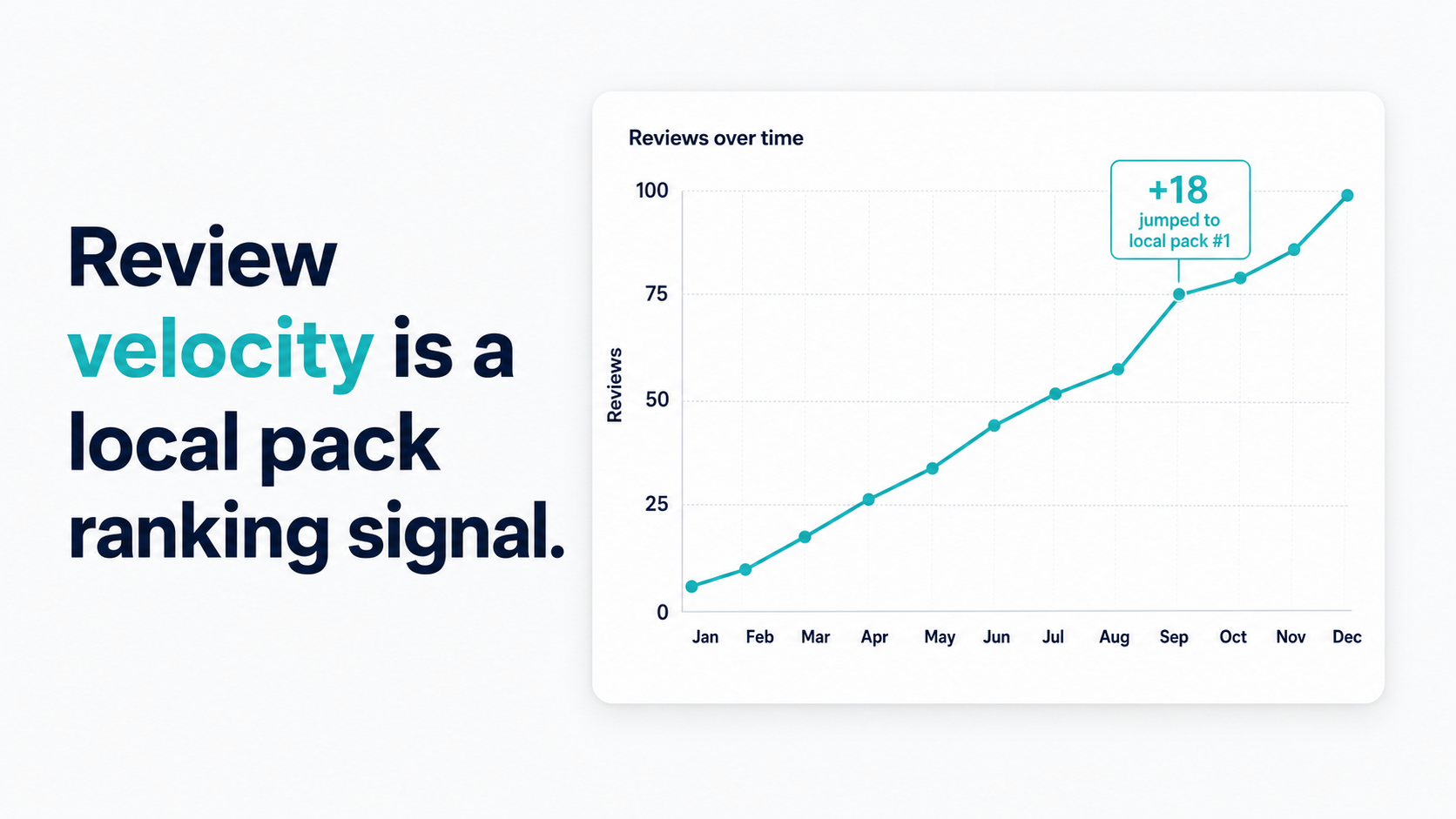
Review velocity — how many reviews you receive per week or month — is one of the signals Google uses to rank businesses in the local pack. A business with 50 reviews but a steady stream of recent reviews can outrank a business with 200 reviews but none in the past year. Velocity matters; recency matters; total count is not the only metric.
What review velocity actually is (and isn't)
Velocity is a rate, not a count. It's reviews per week or reviews per month — how fast your profile is accumulating new reviews, not how many you have in total.
This distinction matters because the local pack algorithm is dynamic. It doesn't evaluate your review profile once and assign you a permanent ranking. It evaluates it continuously, and recency is a factor in that evaluation. A business with 500 reviews, all from three years ago, is demonstrating something different to the algorithm than a business with 120 reviews, with 15 of them from the past 30 days.
Think of the distinction this way: volume is a stock, velocity is a flow. A high stock with no flow tells Google you used to have customers who were happy. A consistent flow tells Google you currently have customers who are happy. For a local business competing in real-time for local search visibility, the current signal is more valuable.
The parallel to stale reviews: a review from this week counts more than one from two years ago, and a profile with recent reviews consistently outranks a profile with the same absolute count but no new additions. Google surfaces businesses that appear actively relevant to the searcher — recency is part of that relevance calculation.
Review velocity is one of roughly 10 local pack ranking factors. For a complete picture of what influences local pack position — citations, GBP completeness, proximity, behavioral signals — see the Hosted Presence local pack ranking guide when it publishes.
How Google uses review velocity in local pack ranking
Google's local search algorithm considers multiple review-related signals: total review count, average star rating, recency of reviews, and the rate at which new reviews are arriving. These signals are grouped under what local SEO researchers call "review signals."
Moz's Local SEO Ranking Factors research identifies review signals as among the top factors influencing local pack rankings. Review signals — encompassing count, velocity, diversity, and star rating — contribute meaningfully to whether a business appears in the three-pack for category searches. They are not the only factor, but they are among the most actionable.
The compounding dynamic is worth understanding. A business that accumulates consistent reviews builds velocity, which improves local pack position. Higher local pack position means more clicks. More clicks means more customers served. More customers served means more review opportunities. The loop feeds itself — but only if you're systematically asking for reviews after every job.
The businesses that fall out of the local pack after years at the top usually share a common pattern: they stopped collecting reviews consistently. A 6-month review drought on a previously active profile is enough to lose ground to a competitor who has been consistently adding 3–5 reviews per week.
What velocity looks like in practice — Top Care Cleaning data
At Top Care Cleaning, our review collection data shows what steady-state velocity looks like in a residential cleaning and exterior services business.
In our Hosted Reviews data (n=70 sends), 71% of reviews come in within 24 hours of the request being sent. When we send on Tuesdays, our review rate is 35% — which creates a predictable weekly velocity spike. A Tuesday with 10 post-job sends might produce 3–4 new reviews in a single day. That's a meaningful velocity signal delivered on a regular cadence.
Before we automated post-job review requests at Top Care, our review count grew slowly and inconsistently. After automating — sending after every completed job — we moved to averaging 3–5 new reviews per week on active weeks. That steady-state cadence is what built the 400+ review profile that now holds consistent local pack positions.
On the local pack position before and after: our local pack visibility improved noticeably after we established a consistent review cadence. We don't have a precise before/after ranking measurement from that period — we were a small cleaning business figuring out the system, not running a controlled SEO experiment. The correlation between establishing our automated send process and seeing increased inquiry volume from Google Search was clear enough that I built the product around it.
How to build sustainable review velocity (not spikes)
There are two velocity strategies: spikes and steady-state. One works; one doesn't.
Spike strategy: once a month (or once a quarter), blast a campaign to your customer list and ask everyone for a review. You get a surge of reviews in a short window, velocity peaks, then drops to zero until the next campaign.
Steady-state strategy: after every completed job, an automated SMS goes to the customer within 24 hours. Reviews trickle in daily and weekly. Velocity is consistent and gradual.
Google's algorithm, and Google's spam detection, are both optimized for the difference. A sudden spike of 30 reviews in a week from a business that normally gets 1–2 per week can look suspicious — even when the reviews are legitimate, the algorithmic filter doesn't know that. A steady pattern of 3–4 reviews per week for 52 weeks is unambiguously natural.
The steady-state approach is also more sustainable for your customers. Campaign-blasting old customers who had their service 6 months ago produces lower conversion than contacting customers right after their job, when the experience is fresh and specific.
For the acceleration tactics that work within a steady-state framework — timing, channel, and follow-up — see How to Increase Google Reviews Fast — and What NOT to Do.
Review velocity red flags (what NOT to do)
Bulk campaign to your entire customer list. Sending 100 review requests in a single day from a business that normally gets 5 reviews per month is a velocity spike that Google may interpret as artificial. Even if every review is legitimate, the pattern is anomalous.
Paying for reviews. Paid reviews are against Google's terms of service. Google's detection systems are tuned for patterns associated with purchased reviews — accounts with no other review activity, clusters of reviews from the same geographic region or IP address, review text that matches templates. Getting caught results in review removal and potential GBP penalties that can take months to recover from.
Asking employees, family, or vendors. Any review that comes from someone with a direct relationship to the business is a conflict of interest under Google's policies. The algorithm specifically looks for reviews from accounts associated with the business owner's network. These reviews get filtered or removed, and patterns of this behavior can result in profile penalties.
Incentivizing reviews. Offering discounts, entries into contests, or any other reward in exchange for a review violates Google's review policies. Incentivized reviews can be removed, and the incentive pattern — if detectable in your communications — can trigger manual review of your profile.
Hosted Reviews sends post-job requests automatically — steady, consistent, and compliant with Google's policies. Start a 14-day trial — no card required: app.hostedreviews.com.
Frequently asked questions
How many reviews do I need to rank in the local pack?
There is no fixed threshold. The competitive review count varies by market, category, and the strength of competing businesses. In a mid-size city with a relatively uncrowded cleaning service category, 30–50 recent reviews may be enough to hold a local pack position. In a large urban market with established competitors, 150+ may be needed. BrightLocal data shows the median review count for businesses ranking in the local pack varies significantly by category and geography. The practical answer: outpace your direct local competitors in velocity.
How quickly do new reviews affect local pack ranking?
Google's indexing of new GBP reviews is typically fast — hours to a day. Whether a new review influences your ranking position depends on the competitive dynamics of your market. A single new review from a business already holding a strong position won't produce a measurable shift. But a sustained increase in review velocity over 4–8 weeks is often correlated with local pack position improvements, especially for businesses that were already close to the top three.
Does responding to reviews help local pack ranking?
Google has indicated that activity on your GBP is a positive signal, and responding to reviews is GBP activity. There is no confirmed, isolated ranking boost from review responses, but the engagement signal may contribute to overall GBP activity scores. More importantly, responding to reviews influences conversion — prospects who read your profile see that you engage with customers, which increases trust and booking probability.
Can I lose local pack position if I stop getting reviews?
Yes, over time. A profile that stops accumulating reviews while competitors continue collecting will eventually lose ground. Google's recency weighting means that reviews from 12–18 months ago are worth less than reviews from last week. The practical floor: if you stop collecting reviews entirely for 3–6 months, expect to start losing local pack positions in competitive markets.
About the author
Alex Host runs Top Care Cleaning, a Grand Rapids cleaning and exterior service with 400+ Google reviews, and built Hosted Reviews to automate what he was doing manually. I run Top Care Cleaning, a Grand Rapids cleaning and exterior service with 400+ Google reviews, and I built Hosted Reviews to automate what I was doing manually. Read more at hostedbrands.com/about.