By Alex Host · Founder of Top Care Cleaning · Updated 2026-05-04
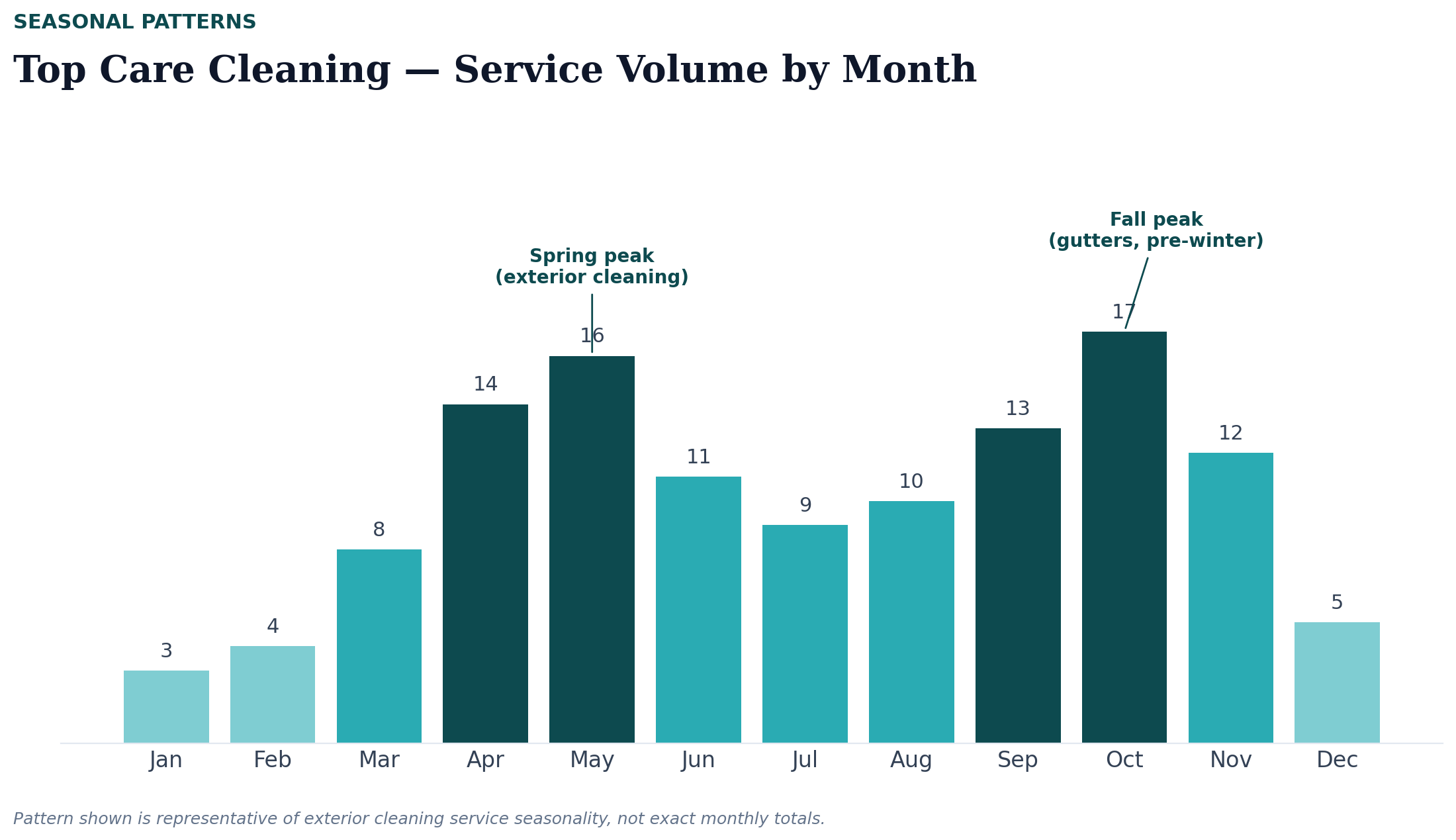
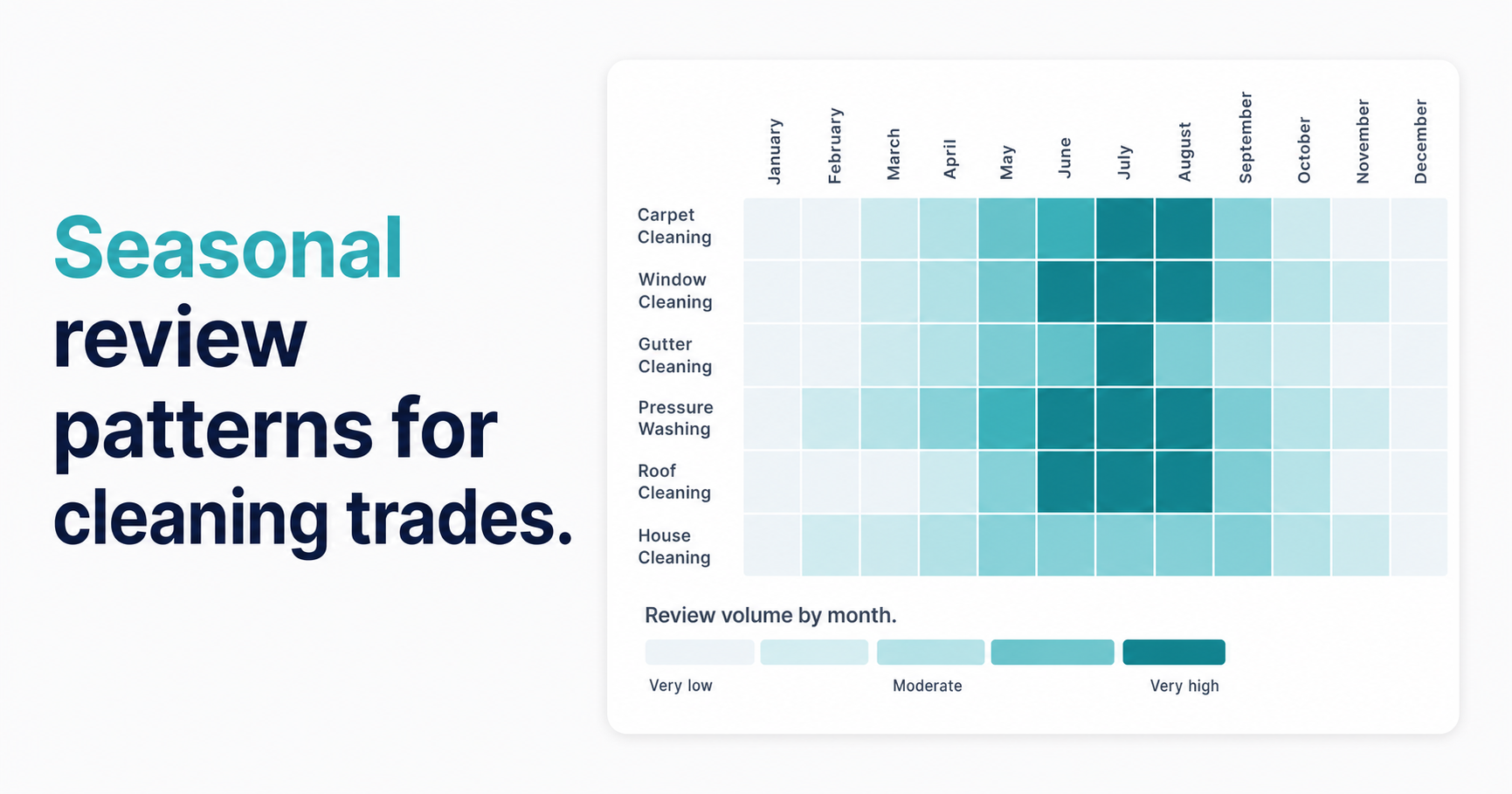
For cleaning and exterior service businesses, review collection follows the job calendar: spring exterior work and fall gutter cleaning generate the highest job volume and therefore the most opportunity for review requests. Summer is steady-state. Winter (excluding snow removal) is maintenance mode. The "push" windows are spring (March–May) and fall (September–October) — two 6–8 week periods when high job volume combines with high customer satisfaction to produce the best review velocity.
Why seasonality matters for review velocity
Review velocity is reviews per unit time. The raw material for review velocity is jobs completed — you can't get a review from a job that didn't happen.
This creates a direct connection between your job calendar and your optimal review collection strategy. High job volume seasons are natural push windows. Low job volume seasons are maintenance mode. The businesses that build strong review profiles year-over-year are the ones that align their review push effort with their peak service windows.
The risk of ignoring seasonality: coasting through a high-volume window without systematically collecting reviews leaves velocity on the table. A cleaning company that completes 80 gutter cleanings in October but only sends 15 review requests is missing 65 opportunities. At a 21% conversion rate, that's 13 lost reviews from a single month.
The secondary risk: a winter velocity drop can cost local pack position. Google weights recency, and a business that went from 8 reviews per week in October to 0 per week in December shows a velocity cliff that competitors who maintain year-round collection can exploit.
At Top Care Cleaning, understanding our seasonal calendar changed how we think about the automated send system — not as something to turn on and off seasonally, but as a year-round baseline that naturally spikes during high-volume periods.
Top Care Cleaning's seasonal calendar
The Top Care operational calendar in Grand Rapids, MI is the source for this framework. Grand Rapids is a four-season Midwest market with distinct seasonal service patterns.
Spring (March–May): push window
Spring is our highest new-customer acquisition period. Post-winter deep cleans, exterior washing, window cleaning, and the first gutter inspection of the year bring in a high proportion of new customers. New customers are the best review candidates — first impressions are the strongest, and a customer who experienced Top Care for the first time is more motivated to document that experience than a recurring customer who has had the same excellent service 12 times.
Our spring strategy: the automated post-job send runs for every job. We add one additional element for new customers: a personal verbal ask from the technician at job completion. "Hi [Name], if you were happy with your first experience with Top Care, we'd really appreciate a Google review — I'll text you the link right now." The dual ask (verbal + SMS) lifts conversion among new customers.
In spring, our job volume doubles compared to winter, and our review velocity follows. More jobs means more sends; more sends at our 21% conversion rate means more reviews per week.
Summer (June–August): steady-state
Summer is recurring cleaning season. The same customers who got spring deep cleans or exterior washes are now on regular cleaning schedules. Recurring customers are excellent service users, but they're familiar — the satisfaction level is consistent rather than peaked.
The strategy for recurring customers: don't over-ask. Once a customer has left a Google review, asking them again within 6 months doesn't produce another review and can feel presumptuous. For recurring customers who haven't yet left a review, summer is a natural re-ask window — they've had multiple services, they know the quality, and they're a reliable yes-tap candidate.
Summer strategy: maintain automated sends for all jobs. Identify recurring customers who haven't yet reviewed and include them in the ask flow if they haven't been asked in the past 90 days.
Fall (September–October): push window
Our highest review-velocity period at Top Care. Fall gutter cleaning, leaf removal, and pre-winter exterior work generate a surge of jobs — and seasonal urgency creates a natural customer satisfaction peak. Customers who got their gutters cleaned before the October rains are relieved. Customers who got their driveways pressure washed before winter are satisfied with a job done at the right time.
At Top Care, we get more new reviews in October than any other month. The combination of high job volume, seasonal completion satisfaction, and new customers (homeowners who waited until fall to book their exterior work) produces the year's best velocity window.
Fall strategy: same as spring — automated send for every job, plus verbal uplift from technicians for first-time exterior service customers.
Winter (November–February, excluding snow removal): maintenance mode
Outdoor service volume drops significantly. Indoor cleaning continues on recurring schedules, but new customer acquisition slows and the satisfaction peak that drives review velocity is less pronounced.
Winter strategy: coast. The automated system continues running — every completed job gets the ask — but don't run campaigns, don't push hard on non-review customers, and don't artificially inflate velocity with old-contact bulk sends. Focus on responding to existing reviews, maintaining GBP completeness, and preparing for the spring push.
The snow removal exception: if your business does snow removal, winter becomes a situational push window. Customers who had their driveway cleared after a major storm are grateful in a way that's specific and memorable — the experience has the same satisfaction peak as a great exterior cleaning job. Ask within 2 hours of the snow removal while the relief is still fresh. These reviews often mention the storm, the fast response, and the specific result — the kind of detail that makes a high-quality review.
Service-vertical seasonal patterns beyond cleaning
The seasonal framework applies across cleaning-adjacent service verticals, with different peak windows:
Pressure washing: Spring-dominant (post-winter concrete, decks, siding) and early fall (driveway prep, deck cleaning before winter). Ask during and immediately after job completion — the visual transformation is at its most dramatic.
Window cleaning: Spring residential exterior and commercial (post-winter grime is visible and motivating). Residential window cleaning is highly seasonal in cold-climate markets.
Gutter cleaning: October-dominant. The urgency of pre-winter gutter cleaning — preventing ice dams, water damage, foundation issues — means customers are especially satisfied when the job is done. Best single-month review opportunity for exterior service businesses.
Lawn care and landscaping: Spring-dominant (first cut, spring cleanup) and fall (leaf removal, winterization). The spring "first cut" is often a new-customer moment — ask for a review then.
HVAC: Spring (A/C tune-up before summer) and fall (heating check-up before winter). The "peace of mind before the season" satisfaction peak is strong — customers who had their A/C serviced in April are relieved when it runs smoothly in July.
Plumbing: No strong seasonality. The best review opportunity is after emergency service — a fast response to a burst pipe or failed sump pump is among the highest-satisfaction experiences a plumber can provide. Ask within 2 hours while the relief is at its peak.
How to build a seasonal review calendar
A practical 4-step framework for mapping your review push windows to your service calendar:
Step 1: Map your job volume month by month. Pull invoices from the past 12 months and count jobs per month. This shows your natural high-volume periods.
Step 2: Identify your top 2–3 high-volume months. These are your push windows. For most cleaning and exterior service businesses in four-season markets, that's April, May, and October.
Step 3: Set automated post-job sends year-round as your baseline. This ensures you never miss a review opportunity regardless of season.
Step 4: During push windows, add one manual element: a verbal ask from the technician for first-time customers. This lifts conversion on the jobs that matter most — new customers who had a strong first impression.
For the velocity science behind why consistent push windows outperform one-time campaigns, see How Review Velocity Affects Your Google Local Pack Ranking.
Hosted Reviews runs automatically year-round — seasonal job surges become review surges without any manual effort. Start a 14-day trial — no card required: app.hostedreviews.com.
Frequently asked questions
When is the best time of year to ask for Google reviews?
For cleaning and exterior services: spring (March–May) and fall (September–October). These periods have the highest job volume and the strongest satisfaction peaks from seasonal work completion. Automate the ask year-round and add a manual uplift layer during your two or three best months.
Should I ask recurring customers for reviews multiple times?
Not within the same 6-month window. A recurring customer who has left a review doesn't benefit from a second ask in the near term — it feels repetitive and can create friction in the relationship. For recurring customers who haven't yet reviewed, ask once per 6 months. A customer who has been with you for two years without reviewing is a candidate for a personal ask from the owner: "We value your business, and a Google review would mean a lot to our team."
Does review velocity drop in winter hurt my Google ranking?
It can, over a sustained period. Google weights recency in review signals. A business that produces 4–6 reviews per week in October and then drops to near zero in December will show a velocity cliff. If competitors are maintaining year-round collection, they can gain ground during the winter. The mitigation: automated sends keep the velocity from going completely to zero even in slow months.
How do I keep review velocity up in slow seasons?
The automated system handles the baseline. For proactive slow-season collection: identify recurring customers who have never left a review and include them in a gentle ask sequence. Re-ask customers who tapped "yes" on the funnel screen but didn't leave a review. These are the low-hanging fruit in a slow month.
About the author
Alex Host runs Top Care Cleaning, a Grand Rapids cleaning and exterior service with 400+ Google reviews, and built Hosted Reviews to automate what he was doing manually. I run Top Care Cleaning, a Grand Rapids cleaning and exterior service with 400+ Google reviews, and I built Hosted Reviews to automate what I was doing manually. Read more at hostedbrands.com/about and topcarecleaning.com.