By Alex Host · Founder of Top Care Cleaning · Updated 2026-05-04
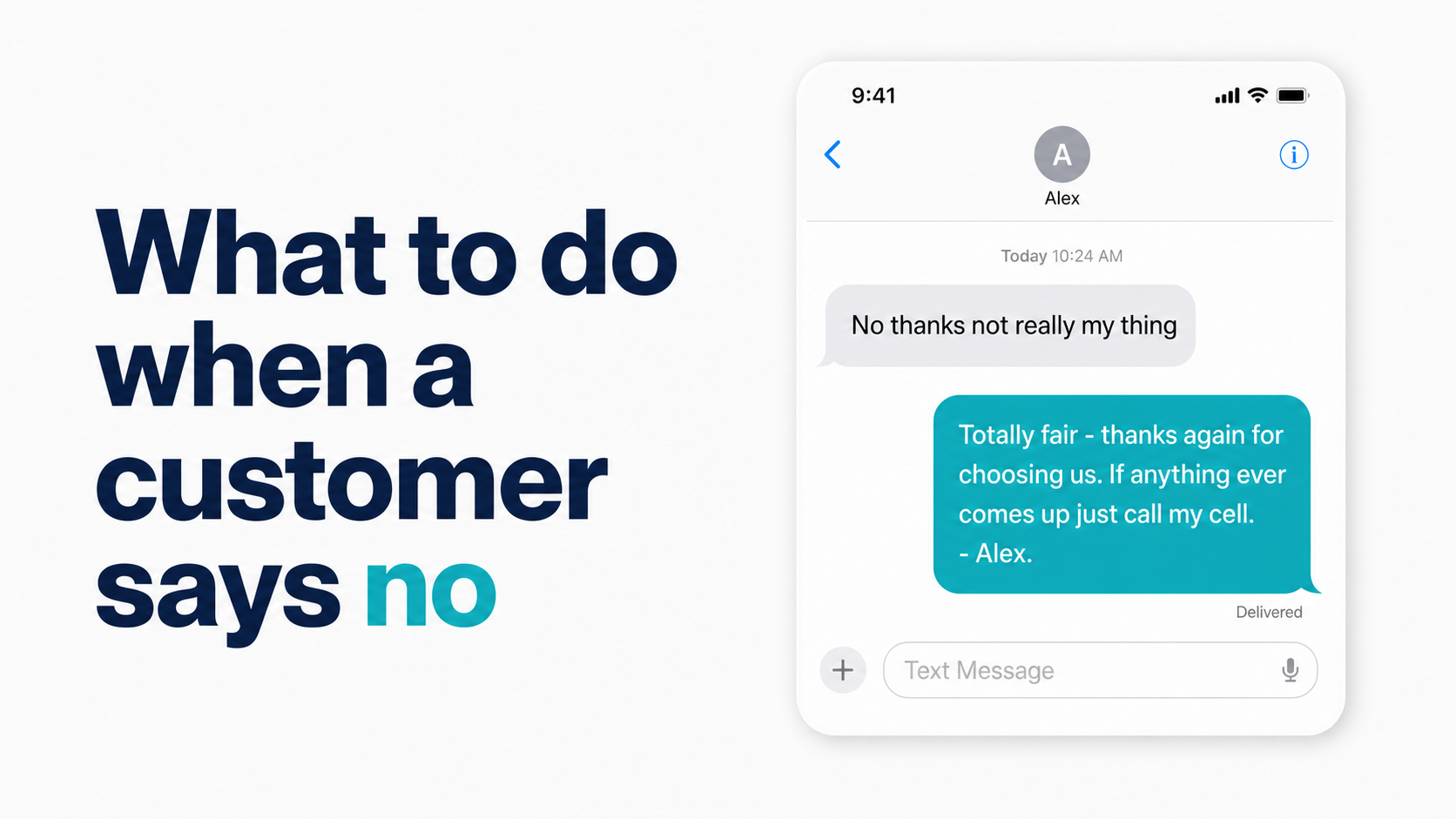
When a customer taps No to your screening question, you have learned something useful: there is a service issue or a trust gap. The right move is a direct follow-up from the owner — not another review request. At Top Care Cleaning (n=70 sends), 46% of yes-tappers who clicked through did not complete the review — that is a separate path from customers who actively said no, and each path has its own response.
Two different kinds of "no"
A non-review from a customer after a review request is not one uniform thing. There are at least three distinct scenarios, and each calls for a different response.
The active No — service issue signal
An active No is when the customer taps the No button in the screening message. This is a signal, not just a statistic. The customer actively took a moment to tell you something is wrong. They did not ghost — they engaged.
An active No is worth more than ten ignored texts. It is a service recovery opportunity before the customer has vented publicly.
What the active No usually means: a specific thing went wrong. The tech was late. Something was missed. The customer expected something different from the service than they received. Your job is to find out what that thing was.
The passive No — friction or timing issue
A passive No is when a customer received the review request but did not respond at all. No tap, no reply. This is the most common outcome: in our Top Care data, 60% of customers did not tap Yes on the screening message (n=70). Some of those are active No situations that did not engage with the binary choice. Most are customers who received the text, thought "I'll do this later," and later never came.
The passive No is not necessarily a service failure. It may simply be friction — busy schedule, phone in a pocket, review link arrived at the wrong moment.
For passive Nos, one reminder is the appropriate response. See the full reminder cadence discussion in Reminder Cadence for Review Requests: How Many Follow-Ups, How Far Apart.
The drop-off after Yes
This is a distinct category: a customer who tapped Yes on the screening message, saw the review link, and did not submit. At Top Care, 46% of yes-tappers fell into this group (n=70 sends through 2026-05-04).
The 46% drop-off after a Yes tap is mostly friction: the Google sign-in prompt appeared, the review form loaded slowly, the customer set their phone down and forgot. Most of these customers had genuine intentions to review.
The reminder step is designed specifically for this cohort. For the reminder cadence and templates, see Reminder Cadence for Review Requests.
When a customer actively says No
Do not re-request the review immediately
The instinct is to try harder. Resist it. Sending another review request text to a customer who just tapped No to your screening message is the wrong move. It signals that you either did not see their response or do not care about it.
The No tap is the customer telling you they are not ready to leave a positive review. Sending a review request anyway inverts the purpose of the screening system.
The service recovery message
The first response to an active No is a personal message from the owner or manager — not a templated automated text:
"Hi [First Name], sorry to hear we didn't meet your expectations today. Can we make this right? Happy to come back and address anything that was missed. — [Owner name], [phone]"
This message has three components:
- Acknowledgment — "sorry to hear we didn't meet your expectations." No defensiveness, no asking what happened before acknowledging the disappointment.
- Offer — "can we make this right." A concrete commitment to fix the problem.
- Personal signature — the owner's name and a way to reach them directly.
A call is better than a text for service recovery with active-No customers. A text gets the conversation started; a call shows you take the feedback seriously enough to invest time in a real conversation.
Follow up privately, not via the automated system
The service recovery follow-up is a manual, personal interaction — not another automated send. Turn off the automated sequence for this customer. Flag the job in your system as a service recovery case.
If you run the recovery conversation well — acknowledge the issue, offer to fix it, and follow through — a meaningful percentage of customers who tapped No will become long-term loyal customers. Some will even leave a review months later without being asked.
At Top Care, we have had multiple situations where a customer tapped No, we made a follow-up call the same day, came back and fixed the issue, and the customer later became one of our highest-value recurring clients. The No tap is the beginning of a service recovery opportunity, not the end of the relationship.
What to do if the customer leaves a negative review afterward
If a customer taps No and then leaves a negative Google review before you reach them, respond to the review publicly and promptly:
- Acknowledge the experience without arguing
- Describe what you did or offered to do to address it
- Invite the customer to contact you directly if the issue was not resolved
A professionally handled negative review with an owner response often signals more trust to prospective customers than a business with only 5-star reviews and no visible owner engagement. Do not ask the customer to remove their review — that is a Google policy violation.
For deeper treatment of negative reviews and response strategy, see the Negative Reviews & Reputation Defense silo (coming in a later content phase — not yet live).
When a customer ignores your review request (passive No)
Is a reminder appropriate?
Yes — one reminder, 3–5 days after the first request. A customer who received your text but did not respond is not necessarily uninterested. Most non-responses are attention gaps, not rejections.
The reminder should be shorter and softer than the first request. The tone is "following up" not "pushing":
"Hi {customer_first_name}, just a quick follow-up from my earlier text — if you had a great experience with Top Care, we'd still appreciate a quick Google review: {review_link}. No pressure at all, thanks either way. — {tech_name}"
For the full reminder cadence, timing, and data, see Reminder Cadence for Review Requests.
How many reminders before you stop
One. After the initial request and one reminder with no response, the customer has effectively opted out mentally even if they have not replied STOP. Sending a third or fourth message crosses into harassment territory and risks the relationship with a customer you want to retain.
The exception: a very long-term recurring customer where you have a strong personal relationship. In that case, a direct personal ask the next time you see them is more appropriate than additional automated texts.
The opt-out path
If a customer replies STOP to any message in your review request sequence, that is the end. Remove them from all automated sequences immediately — no further texts on any topic without new documented consent. Sending additional texts after a STOP reply is a TCPA violation.
What the data shows about drop-offs
Top Care drop-off data (n=70)
In our Hosted Reviews data from Top Care Cleaning: 46% of customers who tapped Yes on the screening message did not complete the review (n=70 sends through 2026-05-04).
That 46% drop-off is not primarily hostility. These are customers who said they were happy, reached the review form, and did not submit. The most common causes:
- Google sign-in friction — Google requires a signed-in account to submit a review. Customers without an active Google session on their phone hit a login screen that adds steps
- Distraction — the customer opened the link, got a phone call, and forgot
- Screen timeout — the phone locked before they finished the review
- Low-priority timing — they opened it at a moment when they did not have 90 seconds of uninterrupted attention
Most of these customers would review if the friction were lower. The reminder captures a meaningful portion of them.
Templates for the No-path
Service recovery message (active No)
"Hi [First Name], sorry to hear we didn't meet your expectations today. Can we make this right? Happy to come back and address anything that was missed. — [Owner name], [phone]"
Send this manually within the same business day as the No tap. Not via automated system.
Gentle reminder (passive No — first follow-up)
"Hi {customer_first_name}, just a quick follow-up — if you had a great experience with Top Care, we'd still love a Google review when you have a moment: {review_link}. Thanks, {tech_name}"
Send this 3–5 days after the initial request if no response. One reminder only.
For the full template library by channel and vertical, see Review Request Templates: SMS, Email, and In-Person Scripts That Work.
Should you ever ask again?
| Scenario | Ask again? | How |
|---|---|---|
| Active No — customer tapped No | No, not via automated system | Address the service issue; let the customer initiate if they change their mind |
| Passive No — customer ignored request | Yes, once | One reminder 3–5 days later |
| Drop-off after Yes — customer tapped Yes but did not complete | Yes, once | One reminder 3–5 days later (same as passive No) |
| Opted out (replied STOP) | Never | No further automated contact without new documented consent |
| Active No + service recovery completed | Possibly, much later | If the recovery was successful and the customer seems satisfied, a manual ask at the next job may be appropriate — not via automated system |
Frequently asked questions
Can I ask a customer again if they said No?
For an active No (tapped the No button): no, not through the automated system. If you resolved the service issue and the customer is now satisfied, you can ask once at the next job — but do it personally, not via automation.
What if the customer who tapped No later calls and says they'd like to leave a review?
Send them the direct review link manually and thank them. This is the best possible outcome from a service recovery situation: a customer who had a complaint and was so impressed by how you handled it that they want to tell others.
Does a No response affect my review-to-send rate in Hosted Reviews?
Yes — the Hosted Reviews dashboard shows the overall review-to-send rate across all sends, including those that resulted in a No tap or no response. The 21% rate at Top Care reflects the full funnel including No-path customers.
How do I know if a customer opted out vs just ignored my request?
A STOP reply is definitive opt-out. Silence is ambiguous — it may be a passive No (ignored the request) or a timing issue. The reminder is appropriate for silent non-responses. If the reminder also goes unanswered, treat it as an opt-out from a practical standpoint: no further automated sends.
The system that manages this automatically
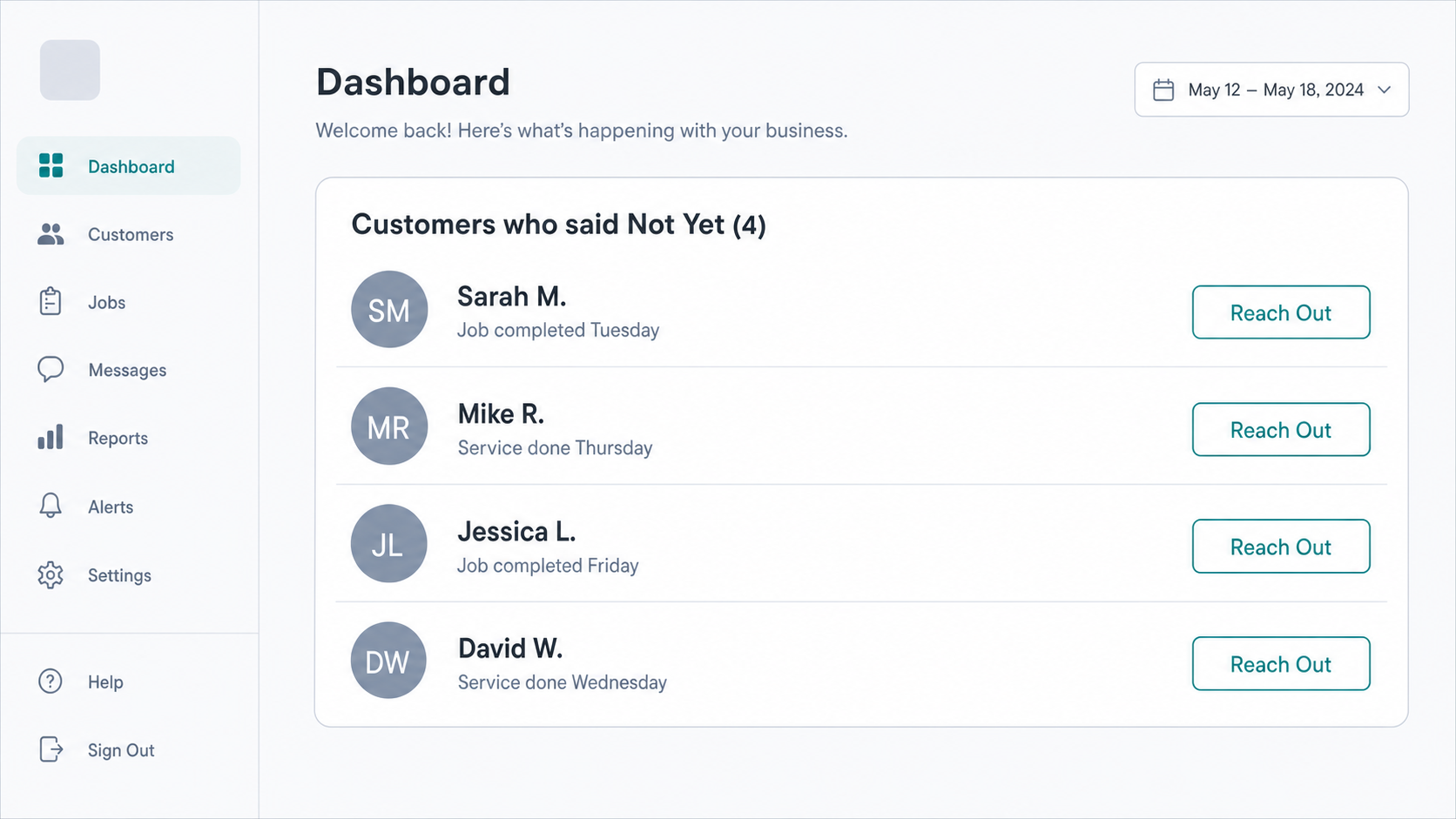
The Hosted Reviews dashboard flags active No-taps in real time so you can respond to service recovery situations the same day. Manual follow-ups are faster when you know immediately who needs attention.
I built Hosted Reviews to automate this for Top Care Cleaning — and now for other local service businesses. 14-day trial, no card required.
About the author
Alex Host runs Top Care Cleaning, a Grand Rapids home services company with 400+ Google reviews, and built Hosted Reviews to automate what he was doing manually. Reviews-facet bio.
I run Top Care Cleaning, a Grand Rapids home services company with 400+ Google reviews, and built Hosted Reviews after manually asking for reviews for years. The data in these articles comes from our own system. — hostedbrands.com/about