By Alex Host · Founder of Hosted Reviews and operator of Top Care Cleaning · Updated 2026-05-22
Important: This article describes general patterns for navigating Google review situations. It is not legal advice. Defamation laws, fair-use boundaries for public responses, and the rules around naming/identifying customers vary by state and country. Before pursuing legal action against a reviewer, sending a cease-and-desist, or naming a customer in a public response, consult an attorney licensed in your jurisdiction. The author runs a residential cleaning business and is not a lawyer.
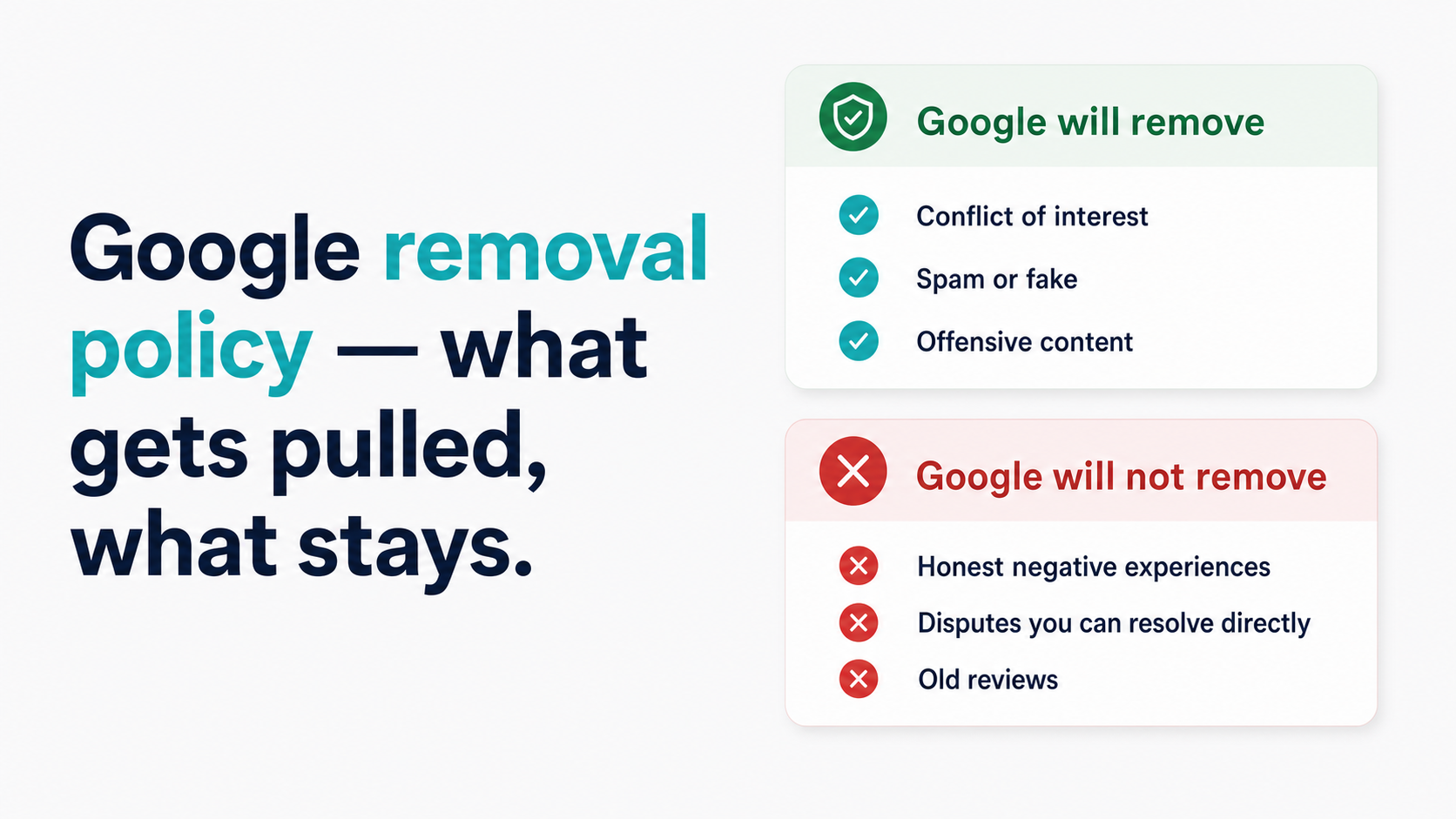
Google's review removal policy is real — but it only covers a narrow set of violations. Most negative reviews, even unfair ones, don't qualify for removal. Before you invest time in the flagging process, it's worth understanding what the policy actually says and what it means for your specific situation.
This article is a plain-English breakdown of Google's Contribution Policy (as of May 2026), the 8 categories of reviews Google will remove, the categories it won't touch, and the gray areas that fall somewhere in between.
90-day refresh note: Google updates its review policies periodically. This article was last reviewed in May 2026. Editors: check the Contribution Policy URL at each 90-day refresh and update the date stamp and any category descriptions that have changed.
The 8 categories Google WILL remove reviews for
Google's Contribution Policy defines the review content it considers a violation. As of May 2026, removable reviews fall into 8 categories.
1. Spam and fake reviews
This includes reviews that were paid for, incentivized (free service in exchange for a 5-star), or coordinated across multiple accounts. It also covers reviews posted by the same person from multiple profiles, or reviews that are clearly bot-generated with templated, non-specific language.
What qualifies: A competitor pays 10 people to post 1-star reviews on your profile. Reviews posted by a reputation management company you hired in exchange for 5-stars. A flood of identical-sounding 1-stars posted within a 48-hour window.
What doesn't: A real customer who happens to post the same language pattern as another customer — the similarity alone isn't enough.
2. Conflict of interest
Reviews from people with a direct personal or financial stake in how your business is rated. This covers business owners reviewing their own business, employees reviewing their employer, and in some cases, reviews from people who have a close personal relationship with the owner.
What qualifies: A review from an account connected to your employee. A review from a business account you own. A review from a direct competitor.
What doesn't: A review from a former customer who happens to be a friend of a friend — that's too attenuated for Google to act on.
3. Off-topic content
Reviews describing an experience at a different business, a different location of a chain, or content that has nothing to do with the business being reviewed.
What qualifies: A review that describes a carpet cleaning company in Orlando when your profile is for a carpet cleaning company in Grand Rapids. A review posted on the wrong business listing in error.
What doesn't: A review that's about your business but focuses on only one aspect of the service (the price, the receptionist, the parking) — that's still on-topic even if you'd prefer they talk about the cleaning.
4. Restricted or illegal content
Reviews that promote or facilitate illegal products, services, or activity. This includes reviews mentioning regulated substances, illegal services, or content that violates laws in the reviewer's jurisdiction.
What qualifies: A review that references buying illegal products through your business. A review that contains instructions for illegal activity.
What doesn't: A review that mentions a legal complaint or lawsuit — even a threatened one. Threatening to sue in a review is frustrating but not itself illegal content.
5. Terrorism and dangerous organizations
Reviews that promote, glorify, or provide support to terrorist organizations or violent extremist groups. This category applies rarely to local service business profiles.
6. Sexually explicit content
Reviews containing sexually explicit descriptions or graphic sexual language unrelated to an adult-entertainment business context.
What qualifies: A review containing explicit sexual content on a residential cleaning company's profile.
7. Harassment, hate speech, and personal attacks
Reviews that contain personal attacks on individuals (employees, owners, staff) by name, or that contain hateful language targeting people based on protected characteristics — race, religion, gender, national origin, disability, or sexual orientation.
What qualifies: A review that names a specific employee and includes slurs. A review that attacks you personally with threats.
What doesn't: A review that says your service was terrible and your team was unprofessional — that's opinion, not a personal attack under Google's definition.
8. Deceptive content and impersonation
Reviews that misrepresent the reviewer's identity (posting as a different real person), that make provably false factual claims intended to deceive readers, or that impersonate a staff member or public figure.
What qualifies: A review posted from an account impersonating a local news reporter. A review claiming your business caused injuries with fabricated specifics designed to look like journalism.
What doesn't: An exaggerated or hyperbolic opinion ("this was the worst cleaning company in the history of the state") — that's rhetoric, not deception in Google's policy sense.
What Google WON'T remove (common misconceptions)
Many business owners flag reviews expecting removal and are frustrated when nothing happens. These categories are why.
Negative opinions, even harsh ones
Google's policy explicitly protects opinion-based reviews under a free speech rationale. A review that says "I hated the service and would never recommend them to anyone" — even in strong language — is generally not removable unless it crosses into personal attack or hate speech territory.
Unflattering but accurate descriptions
A review that accurately describes what happened — "they arrived 40 minutes late, the bathroom wasn't cleaned properly, and I had to follow up three times to get a refund" — is not removable even if you dispute the framing. If the factual claims are accurate, the review reflects a real experience.
Reviews from customers you disagree with
Google doesn't have a mechanism to verify whose account of events is correct. If a customer says the service was below standard and you believe they're wrong, that dispute doesn't make the review policy-violating. Your public response is the tool in that case.
Low ratings with no text
A 1-star review with no explanation is frustrating, but Google's policy doesn't require reviews to include written content. A bare star rating without text is not removable on that basis alone.
Pricing disputes (unless they escalate to harassment)
A review that says "they charged more than the quote" or "the price was not worth it" is an opinion about a business practice, not a policy violation. If the same reviewer follows up with threats or continued harassment, those individual posts may qualify under the harassment category.
If the review falls into this category, your public response is the primary tool — not the flag. See the negative review response templates for how to handle these situations.
The gray areas Google's policy doesn't fully resolve
These are the categories where operators feel most frustrated, because the review looks like a violation but doesn't fit cleanly into a removal-eligible bucket.
"This person was never my customer"
This is the most common gray area. You flag a 1-star review from an account you don't recognize, and you're certain this person never used your service. The problem: Google requires evidence you can't always provide. Customer job records, appointment logs, and payment receipts help — but Google's automated systems don't have access to your data and don't always act on manual escalations.
What to do: Document the discrepancy in your own records. Flag the review citing "spam or fake content." If Google denies the flag, escalate through GBP support with your documentation. Accept that the review may stay.
Competitor sabotage
If a competitor posts a fake 1-star review, it likely falls under "spam/fake" or "conflict of interest" — but proving coordination requires pattern evidence. Multiple reviews from accounts linked to the same IP address, similar profile creation dates, or identical phrasing creates a stronger case, but you typically can't access that data directly.
What to do: Document the pattern with screenshots. Flag each review individually. In your GBP support escalation, present the pattern evidence you can see (posting time windows, reviewer profile ages, similar phrasing) even without the IP data.
Former employee retaliation
A former employee posting a 1-star review sits closer to "conflict of interest" than a random fake review — but Google's conflict-of-interest category is designed for current employees and owners, not former staff. Whether a former employee post qualifies depends on how Google's automated system categorizes it.
What to do: Flag under "conflict of interest" and note the employment relationship in your escalation. The flag may succeed if you can provide context. If it doesn't, a measured public response that acknowledges the source (without identifying the person directly) is often more effective than continued escalation.
How Google enforces the policy (and why it's frustrating)
Google's review enforcement runs in two stages: automated detection first, human review on escalation.
The automated system catches clear patterns — review flooding from new accounts, reviews with known spam signatures, reviews that match flagged keyword patterns. It misses nuanced violations that require reading the content in context.
When you flag a review manually, you're asking for a human review. Google doesn't publish data on removal rates or decision timelines. In practice, many flags don't result in removal even when the review appears to violate policy — the automated system may have already evaluated the content and set a decision.
From running Top Care Cleaning with 373 Google reviews and 4.9 stars over 45 years, I've flagged reviews a handful of times. My rough experience: about 1 in 3 flagged reviews gets removed — but the outcomes vary significantly based on how clear-cut the violation is. TODO[REAL_REVIEW] — if a specific flagging outcome from Top Care can be shared here, swap in pre-publish with disclosure.
Example synthesized from common Top Care customer scenarios — not a real customer. Patterns reflect Top Care's actual experience navigating residential cleaning review flagging.
For a step-by-step walkthrough of the flagging procedure itself, see How to Flag a Fake or Spam Google Review for Removal.
What to do if your review doesn't qualify for removal
This is the outcome most operators face. The review is real — maybe unfair, maybe exaggerated — but it doesn't violate Google's policy. Here's what to do:
Accept it and respond professionally. A thoughtful public response that acknowledges the reviewer's experience, describes what you did or will do differently, and invites further resolution does more for your reputation than a removal attempt on a non-violating review. Prospective customers read your responses, not just the reviews. Use the templates in the negative review response playbook.
Generate more authentic reviews to improve your average. The math is on your side at scale. If you have 373 reviews at 4.9 stars, one 1-star review moves your average by about 0.01 points. At lower review volumes, each review matters more — which is the reason to build review velocity before you need it.
Document it. If the same reviewer posts again, or if you see a pattern, your documentation becomes evidence for a future escalation. Keep screenshots with timestamps.
Consult an attorney only if the review contains provably false factual statements. Opinion reviews aren't actionable. Reviews that make specific false factual claims — "this company stole from me" when no theft occurred — may support a defamation claim, but that determination requires legal counsel. See the YMYL disclaimer at the top of this article.
Frequently asked questions
Can Google remove a review if I just don't like it?
No. Negative opinion, harsh language, and unflattering-but-accurate descriptions of a customer experience are all protected under Google's review policy. Google's removal criteria are limited to the 8 violation categories above. Disliking a review isn't grounds for removal.
How do I know if my review violates Google's policy?
Compare the review content against the 8 categories in this article. Ask: Does it show signs of being fake or coordinated? Does it contain a personal attack, slur, or threat? Is it clearly about a different business? If none of those apply, the review likely doesn't qualify for removal. Use the flagging procedure guide to submit if you believe it does.
What if Google says my flagged review doesn't violate policy — can I appeal?
Yes, with limitations. After a flag is denied, you can escalate through GBP support chat or the Business Profile Help forum. Google's review team can manually review escalations, but they don't guarantee reconsideration. Provide as much supporting documentation as you can — job records, timeline inconsistencies, pattern evidence.
Does Google notify the reviewer when a review is removed?
Google does not publicly disclose its reviewer notification practices. In most cases, reviewers whose content is removed do not receive a specific explanation. The review simply disappears from the profile.
How often does Google update its review removal policy?
Google updates the Contribution Policy periodically — sometimes with significant category changes, sometimes minor language updates. There is no announced schedule. The best practice is to check the Contribution Policy page directly every 90 days, especially if you're managing flagging processes at scale.
Once you've handled the immediate fire, Hosted Reviews helps prevent the next one by routing unhappy customers to private feedback before they hit Google. Start a 14-day trial when the dust settles.
Next steps:
- To flag a review you believe qualifies: How to Flag a Fake or Spam Google Review for Removal
- For fake and spam reviews specifically: How to Deal with Fake or Spam Google Reviews
- For the full negative review response playbook: How to Respond to Negative Google Reviews
About the author
Alex Host runs Top Care Cleaning, a residential cleaning company in Grandville, Michigan with 373 Google reviews and a 4.9-star average built over 45 years of service. He built Hosted Reviews to help service business owners manage review collection and protect their reputation. He writes about negative review response, Google policy, and local SEO from the perspective of an operator who has navigated all of it firsthand — including the reviews he screwed up the response to. More at Hosted Brands.