By Alex Host, founder of Hosted Reviews and operator of Top Care Cleaning.
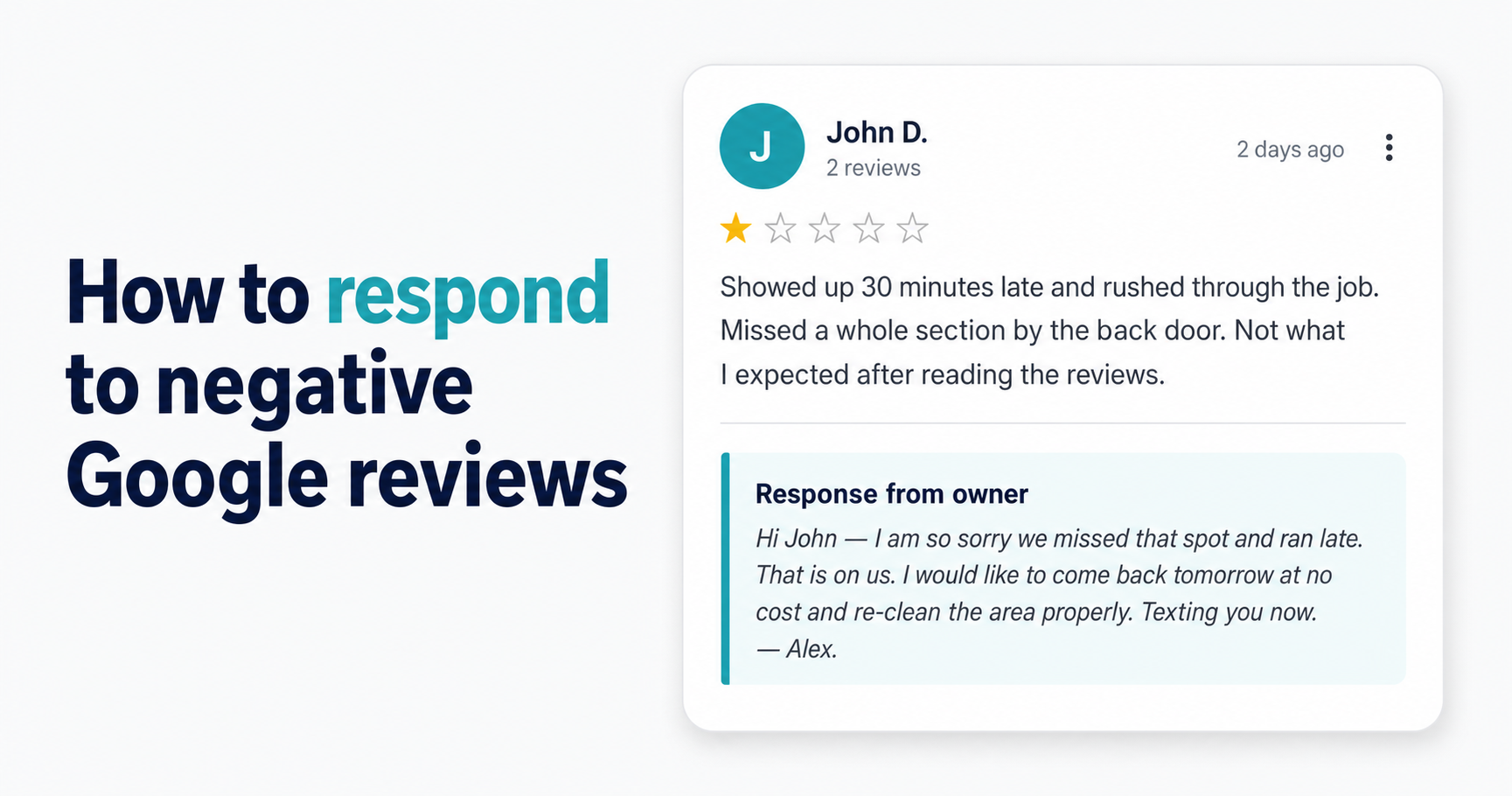
The review I screwed up
TODO[REAL_REVIEW: Insert real Top Care 1-star review screenshot here — anonymize customer name. Swap this synthesized example pre-publish.]
Here's a synthesized version of what happened, representative of a real scenario I've navigated:
"★☆☆☆☆ — Terrible communication. Cleaner showed up 45 minutes late, didn't apologize, and left without doing the upstairs bathroom. I paid full price for half a job. Will not be back."
Reviewer: J.M. — Google, 2024
Example synthesized from common Top Care customer scenarios — not a real customer. Patterns reflect Top Care's actual experience navigating residential cleaning negative reviews.
I read that review at 8:47 pm on a Tuesday. I was tired and defensive. I knew we'd had a tight schedule that day, and I was pretty sure the bathroom got done. So I wrote a response — and it was wrong. Not factually wrong. Tone-wrong.
TODO[REAL_RESPONSE: Insert Alex's actual bad response here — the one that made things worse. Anonymize customer name.]
Here's a reconstruction of the mistake I made:
"Hi J.M. — We always complete the full scope of work as agreed. Our records show the upstairs bathroom was on the job card and our tech confirmed completion. We're sorry you feel this way and hope to address your concerns if you contact us directly."
What I did wrong: I opened with an implicit contradiction ("our records show…"), I led with defense instead of acknowledgment, and "sorry you feel this way" is the most tone-deaf phrase in customer service. The reviewer didn't reply. They never came back. The review stayed.
What I should have written:
"J.M., I'm sorry we fell short. Late arrival and a missed area are not acceptable — I'd like to make this right directly. Please call me at [number] or reply here and I'll reach out personally. — Alex"
Fourteen words of acknowledgment, one specific offer to fix it, no debate. That's the framework for everything in this playbook.
Jump straight to your scenario
If you're reading this at 9pm with a new 1-star on your screen, skip ahead:
- Template 1 — Service complaint where you were genuinely wrong
- Template 2 — Service complaint where the work was done correctly
- Template 3 — Miscommunication or expectation mismatch
- Template 4 — Expectation mismatch (they expected more than the scope)
- Template 5 — Personality conflict, no service issue
- Template 6 — Fake or suspected fake review
- Template 7 — Suspected competitor sabotage campaign
- Template 8 — No-show or no-pay retaliatory review
- Template 9 — Billing or pricing dispute
- Template 10 — Employee behavior complaint
- Template 11 — Weather or circumstance complaint
- Template 12 — Vague or detail-free review
The 4-second rule: why speed matters more than perfection
The most important thing about your response is not the words. It's that one exists.
Research on review response behavior consistently shows that prospective customers weight an unanswered negative review more heavily than a negative review with a professional reply. When someone reads your Google listing and sees a 1-star with no response, the mental model is: "the business either doesn't care or can't defend itself." When they see a 1-star with a calm, professional response, the mental model is: "this business is engaged and accountable."
The practical window for a confident response is 24 hours. For complex situations — billing disputes, employee complaints, anything where you need to review your own records — allow up to 48 hours. Beyond 48 hours, the delay itself signals disengagement.
At Top Care, our standard is to respond within four business hours for straightforward cases. The fastest I've moved from new review to published response is 11 minutes. That wasn't brilliant — that was a vague 1-star with no text, and I used Template 12. The point is that the template existed and I didn't have to start from scratch.
What happens to your star average when a 1-star sits unanswered: The review doesn't get worse numerically. But every prospective customer who views your listing in that window sees an unresolved complaint with no rebuttal. With 373 reviews and a 4.9-star average at Top Care, one 1-star with no response doesn't tank the math — but it plants a doubt in the reader who's deciding between two cleaning companies. That doubt costs jobs.
Top Care's SOP: Read the review. Walk away for 30 minutes. Come back and respond from the template. Never respond in the first 10 minutes — that's when the response is likely to be defensive.
The 3 things every good response must do
Acknowledge without over-apologizing
"I'm sorry you feel that way" is not acknowledgment — it's deflection. Genuine acknowledgment names the specific problem. "I'm sorry we were 45 minutes late" is acknowledgment. "I'm sorry your experience didn't meet expectations" is not.
Over-apologizing has the opposite problem: it reads as performative and does nothing for the reviewer. "We are so deeply sorry for this horrific experience and completely understand how you feel" is canned-sounding and signals you didn't read the review closely.
The right register: sincere, specific, brief. "We fell short on [specific thing] and that's not acceptable" covers it in one sentence.
Take it offline (one ask, not a demand)
Every good response includes one invitation to resolve the issue privately. Phone number, email, or a request to contact you directly. One ask, clearly stated. Do not repeat it multiple times — it reads as desperate. Do not make it conditional ("if you want to resolve this, call us") — it reads as challenging.
The ask does three things: it shows future customers you're willing to fix problems, it gives the unhappy customer a path that doesn't involve escalating the public exchange, and it ends the public thread gracefully whether the customer responds or not.
Signal to future customers, not just the reviewer
The reviewer may or may not read your response. They may or may not change their rating. None of that is within your control. What is within your control is what a prospective customer reads when they visit your profile tomorrow.
Write the response for the next person who reads it, not for the person who wrote the review. "We take every piece of feedback seriously and hold ourselves to the standard that got us 373 reviews at 4.9 stars over 45 years" is written for the audience. It doesn't fight the reviewer — it signals character to everyone else.
The 12 templates — by scenario
Template 1 — Service complaint where you were genuinely wrong
When to use it: You reviewed the situation and the customer is right. The tech was late, the work was incomplete, the product wasn't what was expected. Your error, clear and uncomplicated.
Template:
[Reviewer name], you're right, and I'm sorry. [Specific issue] is not the standard we hold ourselves to, and it shouldn't have happened on your job. I'd like to make this right — please call me directly at [phone] or reply here with the best way to reach you. I'll follow up personally. — [Your name]
Key principles:
- Name the specific failure ("You're right, and I'm sorry" opens the door; "[specific issue]" proves you read the review)
- Offer a direct contact method, not a generic "contact us" button
- Sign with your name — a signed response signals personal accountability
What NOT to write:
- Don't add qualifications ("while we usually perform to a high standard…") — it undercuts the apology
- Don't promise a refund or specific remedy publicly — take that conversation offline
Template 2 — Service complaint where the work was done correctly
When to use it: You've reviewed your records, your tech's notes, and your job photos, and the work was completed correctly. The reviewer's description doesn't match what happened. This is the hardest template because you're disagreeing politely with a public reviewer.
Template:
[Reviewer name], thank you for reaching out. We take every concern seriously — after reviewing our job notes and [photos / tech checklist], we found [brief, specific description of what your records show]. I'd genuinely like to understand where the disconnect happened. Please call me at [phone] or email [email] so we can review this together. — [Your name]
Key principles:
- Lead with the review of records, not with contradiction ("our records show" is less combative than "you're wrong")
- Invite a private conversation — you want this resolved offline, not argued publicly
- Keep the tone curious, not defensive
What NOT to write:
- Don't say "we have photos that prove…" — that reads as adversarial and implies the reviewer is lying
- Don't name the tech or any other employees in a public dispute
Template 3 — Miscommunication or expectation mismatch
When to use it: Scope of work, timing, or what was included in the service differed from what the customer expected — and some of that was on your side. Neither party was fully wrong; the communication broke down.
Template:
[Reviewer name], I'm sorry we weren't clearer upfront about [specific scope / timing / inclusion]. That miscommunication is on us — we should have confirmed [specific expectation] before the job. I'd like to address this — please reach out at [contact] and let's find a way to make it right. — [Your name]
TODO[REAL_RESPONSE: Swap synthesized example above with a real Top Care miscommunication response pre-publish.]
Example synthesized from common Top Care customer scenarios — not a real customer. Patterns reflect Top Care's actual experience navigating residential cleaning negative reviews.
Key principles:
- Own the communication failure even if the service itself was technically correct
- Naming the specific miscommunication (not vague "confusion") shows you actually read the review
- The goal is resolution, not vindication
What NOT to write:
- Don't say "as was clearly stated in our booking confirmation…" — it puts the blame back on the customer
- Don't explain the miscommunication in detail publicly — that's a private conversation
Template 4 — Expectation mismatch (they expected more than the service scope)
When to use it: The customer expected a result your service doesn't include, or a level of quality that exceeds the booked service tier. They're disappointed but the expectation was theirs to own. Common in cleaning: "I expected a deep clean but booked a standard cleaning."
Template:
[Reviewer name], thank you for the feedback. It sounds like there was a gap between what you were expecting and what our [service type] covers — and I should have done a better job walking you through what's included before the appointment. I'd be glad to talk through what a [higher-tier service] would look like for your home. Please reach out at [contact]. — [Your name]
Key principles:
- Don't make the reviewer feel foolish for the expectation gap — frame it as your communication responsibility
- Mention the higher-tier service by name, not as a sales pitch but as genuine resolution
- Future customers reading this will understand you have multiple service tiers — that's a positive signal
What NOT to write:
- Don't say "this is standard in the industry" — it's dismissive
- Don't lecture the customer about what they should have booked
Template 5 — Personality conflict, no service issue
When to use it: The work was completed correctly but the reviewer had a friction-filled interaction with your tech — different communication styles, a misread tone, a minor personal conflict. No service failure, but the customer left feeling uncomfortable.
Template:
[Reviewer name], I appreciate you letting me know. Even when the work is done right, how the interaction feels matters — and I'm sorry the experience left you feeling [uncomfortable / dismissed / unheard]. I'd like to understand what happened so we can do better. Please reach out at [contact]. — [Your name]
Key principles:
- Validate the experience without prejudging your employee in public
- Don't throw the tech under the bus; don't defend the tech — acknowledge the customer's feeling and take it offline
- Acknowledging "how the interaction feels matters" signals high customer service standards to future readers
What NOT to write:
- Don't say "our tech is usually very friendly" — it implicitly calls the reviewer's experience into question
- Don't identify the tech by name in the public response
Template 6 — Fake or suspected fake review
When to use it: You've reviewed your job records and have no customer matching the reviewer name, the timing, or the scenario described. You believe the review is fabricated — possibly a competitor, possibly a mistaken identity.
Template:
[Reviewer name], we take every review seriously, which is why I reviewed our service records after seeing this one. We don't have any record of a job matching your name, this date, or the scenario you've described. If there's been a mix-up — perhaps you meant to review a different business — I'd encourage you to update the review. If you believe you were our customer, please contact me directly at [contact] so we can investigate. — [Your name]
Key principles:
- State the record discrepancy factually, without accusation
- Leave room for the possibility of a genuine mix-up (wrong business, old account, different name on file)
- Future customers reading this will understand you investigated — that's the signal
What NOT to write:
- Don't use the word "fake" or "fraud" in the public response
- Don't accuse the reviewer of being a competitor or of having malicious intent
For the next steps after writing this response — flagging the review with Google — see How to flag a fake or spam Google review for removal.
Template 7 — Suspected competitor sabotage campaign
When to use it: Multiple low-detail reviews from accounts with no review history arrived within a short window, and none correspond to customer records. You suspect a coordinated effort. This template is for the public response — not the escalation actions.
Template:
We've noticed a pattern of reviews recently that don't correspond to any customer records in our system. We've flagged these with Google and are working through their review process. If you were a genuine Top Care customer and had a problem with your service, please contact me directly at [contact] — I'd like to make it right. — [Your name]
Key principles:
- Respond once to the pattern, not individually to each review — individual responses to a campaign look panicked
- Don't name any individual reviewer or speculate publicly about who is behind it
- The goal of the public response is to signal calm competence to future customers reading your profile
What NOT to write:
- Don't name competitors or make public accusations
- Don't use inflammatory language ("coordinated attack," "trolls," "sabotage") in the public response — it reads poorly
Template 8 — No-show or no-pay retaliatory review
When to use it: A customer canceled last-minute without the required notice period, owes a cancellation fee, or refused to pay and has now left a 1-star in apparent retaliation. The review often includes inaccurate claims about your business practices.
Template:
[Reviewer name], I'm sorry to see this review. I'd welcome the chance to discuss what happened between us and find a resolution — I believe there may have been a miscommunication about our [cancellation policy / billing process]. Please contact me at [contact] and I'll review the situation personally. — [Your name]
Key principles:
- Do not mention the payment dispute, unpaid invoice, or cancellation fee in the public response — that's a private matter
- "There may have been a miscommunication about our policy" is factual and non-accusatory
- Future customers reading this see a business owner who handles conflict professionally
What NOT to write:
- Don't post billing details, invoice amounts, or account information publicly
- Don't say "this person didn't pay" — even if true, it's not your strongest public position
Template 9 — Billing or pricing dispute
When to use it: The customer disputes the price charged — surprise charges, price increase without notice, a quote that differed from the invoice, or a belief that the work doesn't justify the cost.
Template:
[Reviewer name], I'm sorry the billing wasn't what you expected. Pricing surprises are avoidable and it's my job to make sure our quotes and our invoices match. I'd like to review your account — please reach out at [contact] and I'll go through the details with you directly. — [Your name]
Key principles:
- Don't quote dollar amounts, quote figures, or invoice details in the public response
- "Pricing surprises are avoidable" signals that you take this seriously without admitting liability
- Every billing dispute should be resolved offline — never in a public comment thread
What NOT to write:
- Don't post your pricing schedule or booking terms in the response
- Don't say "the price is clearly stated in your booking confirmation" — it comes across as dismissive
Template 10 — Employee behavior complaint
When to use it: The reviewer names or clearly refers to a specific tech whose behavior was the primary complaint — attitude, interaction style, something said during the job.
Template:
[Reviewer name], how our team treats you during a job matters as much as the work itself. I'm sorry your interaction with our tech fell short of that standard. I'd like to understand specifically what happened — please contact me at [contact] and I'll follow up personally. — [Your name]
Key principles:
- Don't name the employee in the public response — that's a private personnel matter
- Don't defend the employee's behavior publicly before you've investigated
- "How our team treats you matters as much as the work" is a strong signal to future customers — it's your standard, stated clearly
What NOT to write:
- Don't say "our tech has been with us for 10 years" — it sounds like a defense, not an investigation
- Don't dismiss the behavior complaint as a misunderstanding before talking to your employee
Template 11 — Weather or circumstance complaint
When to use it: External factors — a storm, road conditions, a client cancellation earlier in the day that pushed your schedule — contributed to a service gap. The customer is unhappy about the outcome even though the cause was outside your control.
Template:
[Reviewer name], I'm sorry the service didn't meet your expectations on [date / occasion]. [One brief factual note on the circumstance if relevant — e.g., "Our team was affected by the weather that day"] — but that doesn't change what you experienced, and you deserved better communication from us about what was happening. Please reach out at [contact] and I'd like to discuss how we can make it right. — [Your name]
Key principles:
- Acknowledge the circumstance briefly but don't use it as an excuse — the customer's experience was the experience
- "You deserved better communication" acknowledges something you could have controlled even when the weather wasn't yours to control
- The offer to make it right is always worth extending even in circumstances outside your control
What NOT to write:
- Don't open with an explanation of the weather or circumstances — it reads as excuse-making
- Don't say "there was nothing we could do" — there's always something you could have done (called ahead, rescheduled proactively, communicated clearly)
Template 12 — Vague or detail-free review
When to use it: The review is a 1-star or 2-star with no text, a single word ("bad," "terrible"), or so little detail that you have no idea what happened. No names, no dates, no scenario described.
Template:
[Reviewer name] — I'm sorry to see this rating. I'd genuinely like to understand what went wrong and make it right. Please reach out at [contact] and I'll look into it personally. — [Your name]
Key principles:
- Short is right here — you have nothing to acknowledge specifically, so don't fabricate specifics
- "I'd genuinely like to understand" is a sincere invitation that signals good faith to future customers
- Signed with your name — personal accountability even for a mystery review
What NOT to write:
- Don't say "we can't respond without more information" — it reads as dismissive and the review stays unaddressed
- Don't ask multiple questions ("Can you tell us what happened? When was your job? What service did you book?") — one clear invitation to contact you is enough
What to do if the response doesn't work — the escalation ladder
A single professional response is the right move. More than that, and you're having an argument in public.
Step 1: Wait. Post one response. Wait. The reviewer may update the review, remove it, or respond to your offline offer. Most of the time, the situation resolves or goes quiet. Let it.
Step 2: If they reply and escalate in the review thread. Respond once more — calmly, briefly, reiterating your offline offer. Something like: "I understand you're frustrated. My offer to speak directly still stands — [contact]. I hope we can resolve this." Then stop. Two responses is the maximum. After two, you're feeding the thread, not resolving it.
Step 3: If the review appears fake or policy-violating. Flag it through Google Business Profile. See How to flag a fake or spam Google review for removal for the step-by-step process. Do not flag as a replacement for responding — do both.
Step 4: If the situation is legally sensitive. If the review makes specific false factual claims (not just negative opinions), if you believe you're facing a coordinated campaign, or if the reviewer has threatened legal action in the review text — stop responding publicly and consult an attorney licensed in your jurisdiction. Do not attempt to address legal-edge situations through the public response thread.
For more on handling fake or suspected fake reviews, see How to deal with fake or spam Google reviews.
How Top Care handles negative reviews — the full process
TODO[REAL_REVIEW: Insert Top Care win-back story — a 1-star that became a 5-star after the right response. Annotated screenshot, anonymized customer name. Swap pre-publish.]
Here's a synthesized version of a pattern that's happened multiple times at Top Care:
"★☆☆☆☆ — The cleaner missed the guest bathroom entirely. I paid for a full house clean and one room wasn't touched. Very disappointed."
Reviewer: K.D. — Google, 2024 (synthesized)
"K.D., I'm sorry — that's a clear miss on our part. I'd like to send the same tech back to complete the bathroom at no charge, or refund that portion of the job. Please call me at [phone] or reply here and I'll sort it within 24 hours. — Alex"
TODO[REAL_RESPONSE: Insert Alex's actual response to a comparable situation pre-publish.]
Example synthesized from common Top Care customer scenarios — not a real customer. Patterns reflect Top Care's actual experience navigating residential cleaning negative reviews.
The customer called. Alex had the tech return the next morning. The review was updated to 5 stars the same week.
That outcome doesn't happen every time. In fact, it happens in a minority of cases. What happens more often: the reviewer never responds, the review stays, and the response sits there as a signal to every future customer that Top Care is accountable and responsive. That signal compounds over 45 years and 373 reviews at 4.9 stars.
Frequently asked questions
How long do I have to respond to a negative Google review?
There's no hard deadline — you can respond to a review weeks or months after it's posted. But timeliness matters for how the response reads. A response posted within 24 hours signals engagement. A response posted three weeks later signals that you didn't notice, didn't care, or avoided the review. The sweet spot is 24 hours for clear cases, 48 hours maximum for situations that need investigation.
Can a customer edit or delete their review after I respond?
Yes. Customers can edit their review rating and text at any time. They can also delete the review entirely. A good response sometimes prompts a customer to update their rating — this is the "win-back" scenario described in Public reply patterns that win back unhappy customers. Don't count on it, but it happens often enough to be worth investing in a genuine response.
Should I respond to every negative review, even unfair ones?
Yes. An unanswered negative review signals disengagement regardless of whether the review is fair. The response isn't just for the reviewer — it's for every prospective customer who reads your profile. A calm, professional response to an unfair review often does more for your reputation than a response to a legitimate complaint, because it shows you handle conflict gracefully under pressure.
Can responding to a bad review make it worse?
It can — if the response is defensive, combative, or reveals information that reflects poorly on your business. The templates in this article are designed specifically to avoid those failure modes. The biggest risks: arguing the facts publicly, revealing private customer information, sounding like a form letter, or using corporate-speak ("we regret any inconvenience caused"). If you're unsure about a response, set it aside for an hour and re-read it with fresh eyes before posting.
What if the reviewer replies and keeps escalating?
Two responses maximum. Post your first response. If the reviewer replies in the thread and escalates — posts additional complaints, gets personal, keeps going — post one more response reiterating your offline offer and then stop engaging. Continuing the thread past two exchanges feeds the conflict and signals to future customers that you can't disengage. The goal is to show you tried, not to win the argument.
Does responding to reviews help my local SEO?
Responding to reviews signals engagement to Google's local ranking algorithm. Google's Business Profile Help confirms that review activity — including owner responses — is among the factors that contribute to local search prominence. The direct impact is modest compared to review volume and rating, but consistent response behavior, especially to negative reviews, contributes to the overall engagement signal that Google weighs in local pack rankings. For the review-building side of local SEO, see the Google Review Link Toolkit.
Cross-silo context
If you're working through a broader review strategy — not just the immediate crisis — these hub articles from the same site are relevant starting points:
- For building authentic review volume to offset negatives: the Hosted Reviews Playbook
- For the SMS review request system that generates consistent new reviews: the SMS Review Request System
- For choosing the right review tools: the Review Platform Buyer Guide
- For your Google review link and how to share it: the Google Review Link Toolkit
- For the full fake-review and flagging playbook: How to deal with fake or spam Google reviews
Also available in this silo:
- Public reply patterns that win back unhappy customers
- Negative review response examples by industry
- How to flag a fake or spam Google review for removal
Once you've handled the immediate fire, Hosted Reviews helps prevent the next one by routing unhappy customers to private feedback before they hit Google. Start a 14-day trial when the dust settles.
About the author
Alex Host is the founder of Hosted Reviews and the operator of Top Care Cleaning Services in Grandville, Michigan — a residential cleaning company with 373 Google reviews at 4.9 stars built over 45 years of family ownership. He writes about review management and local reputation from the perspective of a working operator, not a marketing consultant.
More at hostedbrands.com/about.
V2 flag: We'd like a Negative Review Response Template Generator here — flagging for V2.