By Alex Host · Founder of Top Care Cleaning · Updated 2026-05-04
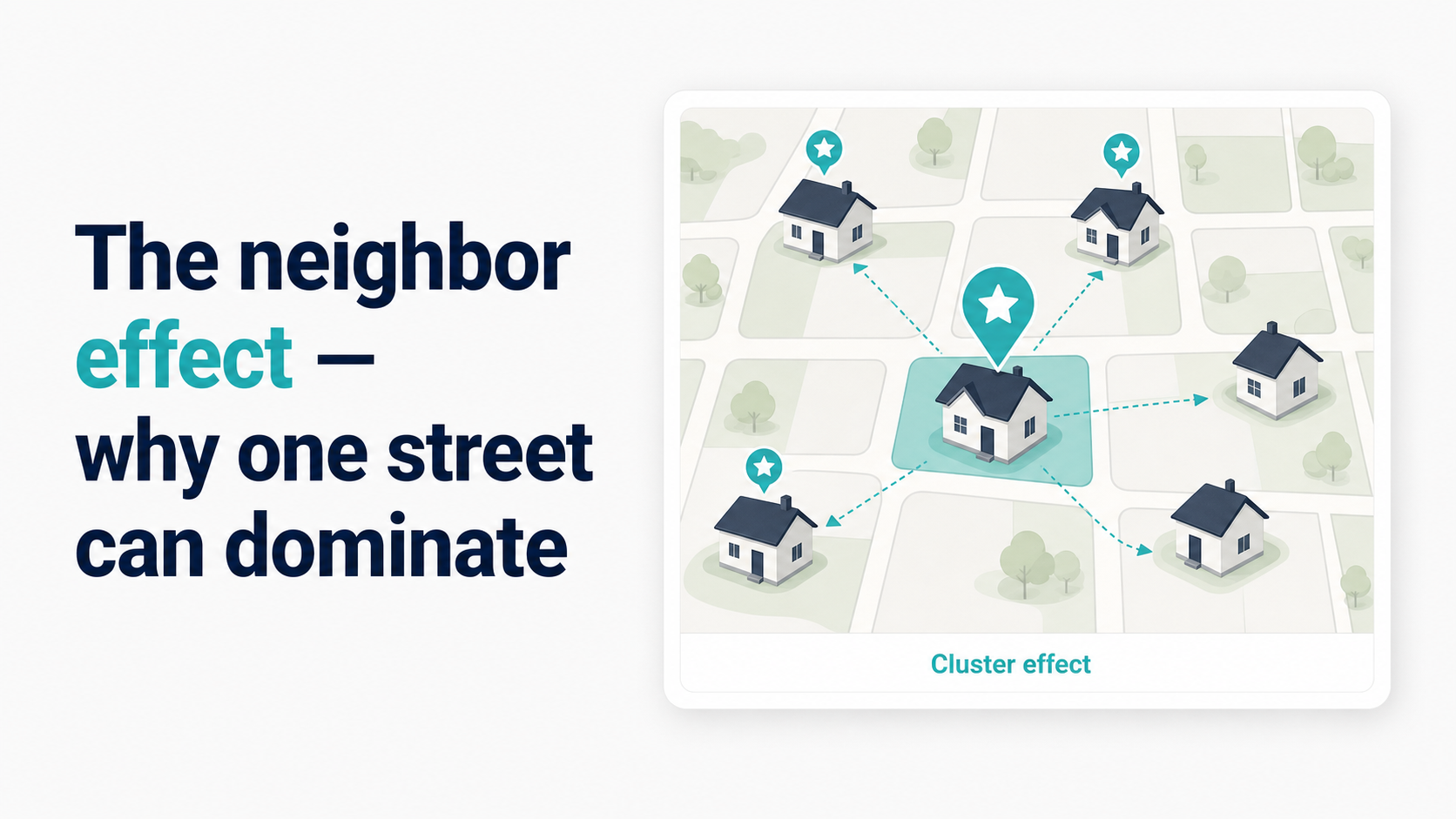
When a neighbor sees their street has five houses cleaned by the same company — and those houses have visible before/after results plus a row of 5-star Google reviews — they are significantly more likely to book. This is the neighbor effect: a geography-concentrated review cluster that makes one booking referral a street-level trust signal. At Top Care Cleaning, we've observed this pattern repeatedly in our ZIP-code booking data.
What the neighbor effect is
The neighbor effect is what happens when reviews and jobs cluster geographically: each new review from a customer in a given neighborhood increases the probability of bookings from nearby addresses.
It works through three reinforcing channels:
Visible physical results. Unlike a restaurant or a software product, a local service business leaves visible evidence. A house that's been window-washed, gutters that are clearly empty after cleaning, a pressure-washed driveway — these are visible to every neighbor who walks or drives past. The service result is a live advertisement on a street that other service businesses don't have.
Public social proof. When a customer from that street leaves a Google review, they're publicly associating the service business with a specific area. A review that mentions "they came out to Seventh Street last week and did our gutters" creates a geographic signal that every neighbor who searches "gutter cleaning near me" may encounter.
Word of mouth in neighborhood channels. Satisfied customers who belong to active Nextdoor communities or neighborhood Facebook groups often share their experience unprompted. A Nextdoor post — "just had Top Care do our exterior windows, highly recommend, they're working in the [neighborhood] area this week" — can produce multiple inquiries from neighbors within hours.
At Top Care, we first noticed the neighbor effect pattern clearly when a single Nextdoor post from a satisfied customer generated 6 bookings from the same street in a 3-week period. The post wasn't coordinated by us — the customer shared it voluntarily. We were already in the neighborhood doing the job, the work was visible, and the recommendation carried geographic specificity that a generic Google review doesn't have.
Top Care's ZIP-code booking data — the pattern in practice
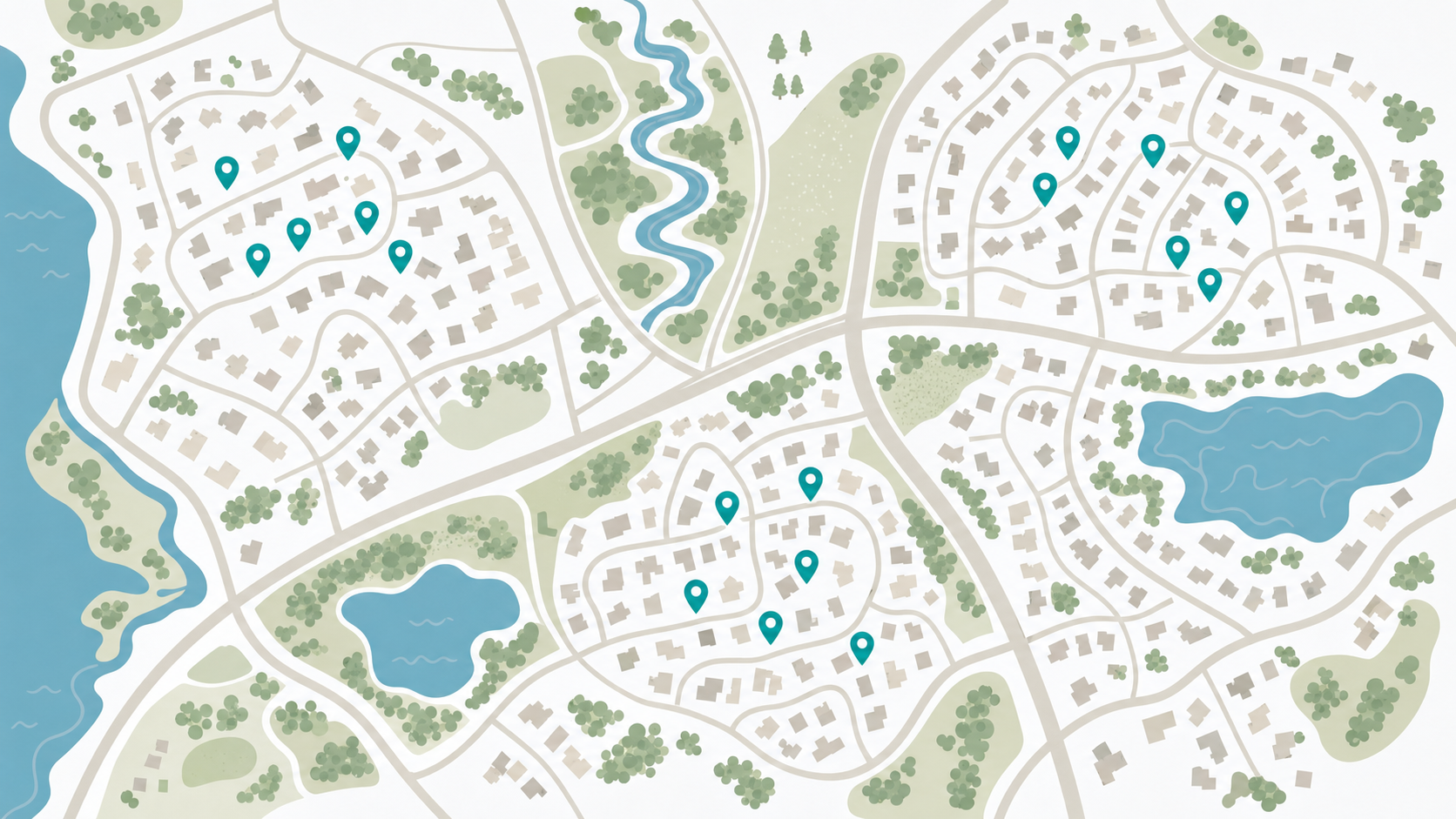
Looking at our booking patterns by ZIP code, jobs and reviews cluster geographically in ways that suggest the neighbor effect is real.
When we finish a gutter cleaning job on a street and the customer leaves a review mentioning the street or neighborhood, we typically see 1–2 additional inquiries from that street within 30 days. This isn't a controlled experiment — I can't isolate the review mention from the visible job or the potential Nextdoor sharing. But the pattern is consistent enough across multiple streets and neighborhoods that it shapes how we think about our collection strategy.
The mechanism is geographic search relevance. A review that mentions "Grand Rapids West Side" or "near Wealthy Street" adds geographic language to our GBP profile. When a homeowner in that neighborhood searches "window cleaning near me," Google's algorithm associates our business with that area partly because our review content mentions it.
In our top ZIP codes, new bookings from the same street as a recent existing customer are disproportionately common compared to random new bookings elsewhere in the same ZIP. The pattern is consistent enough across multiple neighborhoods that it shapes how we prioritize scheduling and review collection.
Why this matters for your review collection strategy
The neighbor effect has a practical implication for how you prioritize review collection: focus collection efforts on your densest service ZIP codes first.
A customer in a ZIP code where you already have 5 recent customers is worth more review-collection effort than a one-off customer in a ZIP where you have no other presence. Why? Because the review from the dense-ZIP customer, combined with the visible work on neighboring properties, has a multiplication effect. The review makes you findable to the neighbor. The visible work makes you credible. The combination produces a booking.
Review text as geographic signal: encourage customers in dense service areas to mention their neighborhood, street, or area in their review. You can't script the review (Google's policy prohibits instructing reviewers on content), but you can prompt with context: "Tell us about your experience with [Technician] today and what you had done." A customer in Eastown who was asked "tell us about your experience" may naturally write "they cleaned our gutters in October, right here in Eastown" — which creates the geographic signal.
Booking pattern implication: when you're planning a day of jobs in a dense service area, the end-of-day review asks from that cluster of jobs have compounding value. Five review requests from customers on adjacent streets, all sent the same day, could produce a visible review cluster that makes the street-level trust signal more powerful.
How to activate the neighbor effect deliberately
You can't manufacture the neighbor effect, but you can create the conditions for it:
Geographic clustering in scheduling. When possible, schedule jobs in geographic clusters. Three jobs on adjacent streets in the same afternoon creates visible evidence of your presence in that neighborhood. Customers can see your vehicle, see the results at neighboring properties, and see each other's reviews.
The leave-behind with neighborhood context. After finishing a job in a dense service area, add a specific line to the review request: "If you know a neighbor who might need [service], we're booking in your area this week." This nudge activates the word-of-mouth channel and gives the satisfied customer a natural way to share.
Nextdoor and neighborhood Facebook groups. After a cluster of jobs in a neighborhood, a brief Nextdoor post — "Top Care Cleaning is working in [Neighborhood] this week — if you've been meaning to book exterior cleaning, now's a good time" — pairs well with the organic review activity from that week's customers. The combination of a direct post and organic customer reviews creates density.
The leave-behind card. A physical card at the job site with a QR code to your review link — left in the door or under a door mat — gives curious neighbors a direct path to your review profile and booking page. For video testimonials as the premium version of this leave-behind, see How to Ask for a Video Testimonial from a Happy Customer.
For the funnel-screening approach to ensure high-value customers in dense areas leave strong reviews, see How to Get Good Google Reviews — Funnel Screening 101.
The limit of the neighbor effect
The neighbor effect is a multiplier, not a guaranteed booking driver. It works best under specific conditions:
Works best for:
- Residential services with visible results (cleaning, exterior services, landscaping, painting)
- Tight geographic markets where neighborhoods have identity and community channels (Nextdoor, neighborhood Facebook groups)
- Services with visible before/after transformations — pressure washing, window cleaning, exterior work
Works less well for:
- Commercial services with dispersed locations
- Highly transient neighborhoods with low Nextdoor/Facebook group activity
- Services where results aren't visible to neighbors (interior cleaning, HVAC repair)
- Areas with low digital engagement — the neighbor effect requires both visible physical results and digital review amplification
The compounding dynamic also requires a baseline of reviews to work. The neighbor effect amplifies an existing strong profile — it doesn't create one from scratch. Build the review count first (see the pillar hub at The Local Service Reviews Playbook), then let the neighbor effect compound on top of it.
Closing
Hosted Reviews tracks which jobs generated reviews — so you can see the neighbor effect clusters building in your own data. Start a 14-day trial — no card required: app.hostedreviews.com.
Frequently asked questions
Does Google count reviews from the same neighborhood differently?
Google doesn't publicly document geographic weighting of individual reviews. What is known is that review text content — including neighborhood and location mentions — contributes to the semantic signals associated with your GBP. A cluster of reviews that mention the same neighborhood may strengthen Google's association of your business with that area.
Can I target a specific neighborhood with my review requests?
You can prioritize collection from customers in a specific area by focusing your verbal ask and reminder follow-up on jobs completed in high-density service ZIPs. You can't technically filter review requests by neighborhood in most tools, but you can prioritize the manual layer of asks for the geographic clusters you're trying to build.
What is Nextdoor's role in local service reviews?
Nextdoor is a neighborhood-specific social network where residents share local recommendations. A Nextdoor recommendation of a local service business is functionally a hyper-local word-of-mouth amplifier — it reaches people who are already in the geographic area and likely to book a similar service. Nextdoor recommendations don't feed Google's local pack, but they drive direct bookings and can also produce new Google reviews when the customers they generate complete their service.
How do I know if the neighbor effect is working for my business?
Track new customer bookings by ZIP code and by street over time. If you see clusters of new bookings from streets where you have recent existing customers, the neighbor effect is likely contributing. In the Hosted Reviews dashboard, you can see which jobs generated reviews — over time, this data can reveal geographic patterns in your review collection.
About the author
Alex Host runs Top Care Cleaning, a Grand Rapids cleaning and exterior service with 400+ Google reviews, and built Hosted Reviews to automate what he was doing manually. I run Top Care Cleaning, a Grand Rapids cleaning and exterior service with 400+ Google reviews, and I built Hosted Reviews to automate what I was doing manually. Read more at hostedbrands.com/about and topcarecleaning.com.