By Alex Host · Founder of Top Care Cleaning · Updated 2026-05-04
A Google review for a local service business is a job-booking signal: reviewers become a referral engine that operates 24 hours a day. At Top Care Cleaning, 71% of reviews come in within 24 hours of the request being sent, and our overall review-to-send rate is 21% (n=70 sends). The system that produces those numbers is what this playbook covers.
Why Google reviews are different for local service businesses
Most content about Google reviews is written for restaurants, e-commerce stores, or faceless SaaS products. Local service businesses — cleaning, landscaping, HVAC, plumbing, gutters — are a different animal. A cleaning crew enters someone's home. An exterior crew shows up on a visible jobsite in a residential neighborhood. The trust calculus is different, and the review economics are different.
Reviews as a job-booking signal, not just a star rating
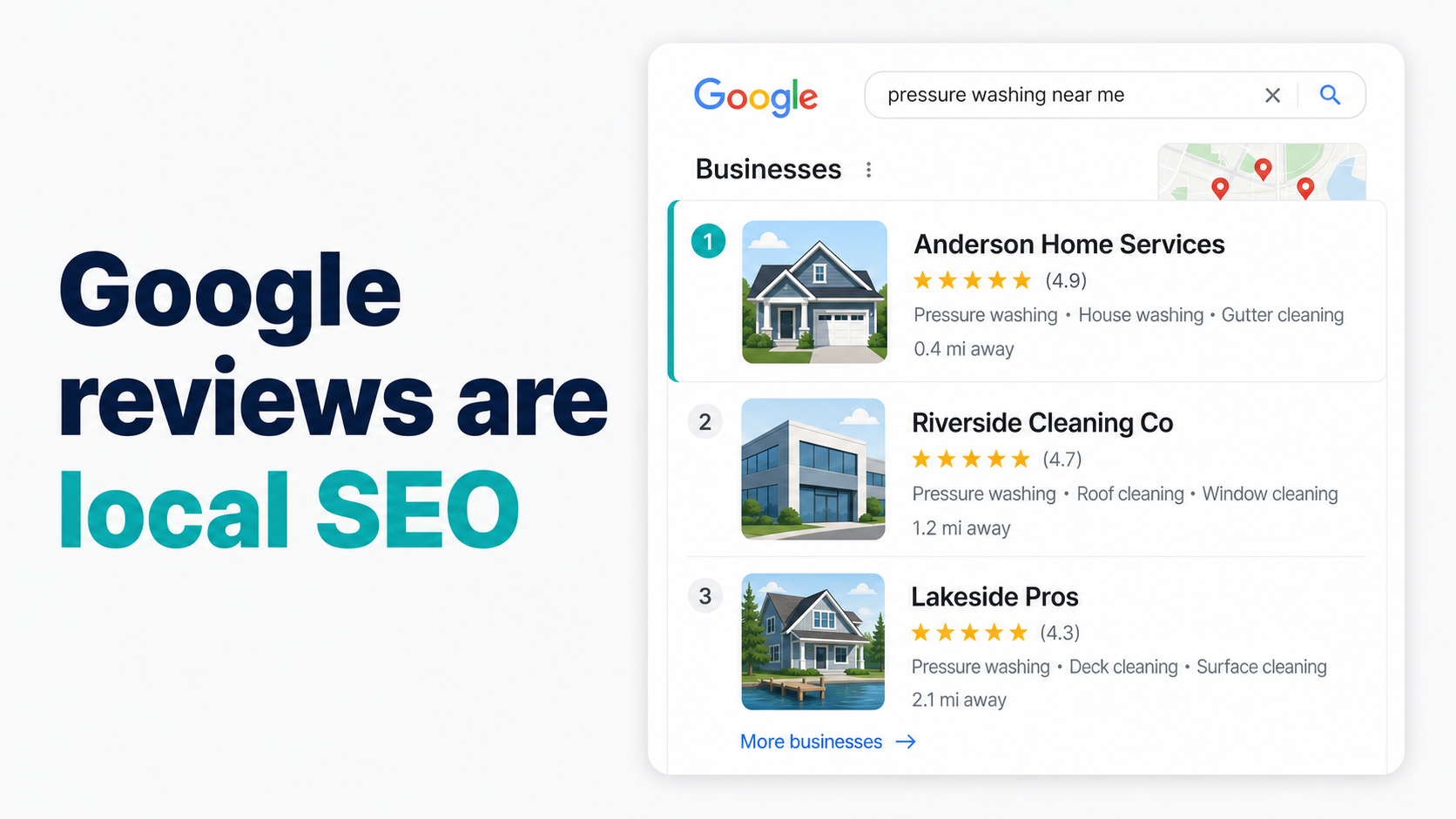
When a homeowner searches "house cleaning Grand Rapids" on a Tuesday morning, Google surfaces three businesses in the local pack. Those three slots are not random — review count, velocity, recency, and star rating all feed into the algorithm. The business that shows up in slot one gets the click. The business in slot three often gets nothing.
But the review's function doesn't stop at the SERP. Once a prospect finds you, reviews do the selling. A potential customer comparing two cleaning companies — one with 22 reviews and one with 380 — will almost always call the one with 380 first, even if the star averages are identical. Reviews are social proof at scale: each one says "a real person hired this company and was satisfied."
For local service specifically, the word-of-mouth amplification is geographic. A customer in a Grand Rapids neighborhood who leaves a Google review mentioning their street, service, and technician is essentially broadcasting a recommendation to every neighbor who searches the same thing. A review from a customer in Eastown reaches other Eastown homeowners disproportionately, because Google connects local search intent to local business profiles with local review content.
E-commerce businesses compete globally. Local service businesses compete in a 15-mile radius. That concentration means reviews compound faster and carry more weight per unit than they do in any other category.
What one review is actually worth (Top Care lifetime value math)
The ROI framing most operators miss: a Google review is not a marketing cost — it's a booking multiplier on the customers you've already served.
In the cleaning business, a recurring customer is worth $1,500–$3,000 over three years. A single exterior job customer — gutter cleaning, pressure washing — might book twice a year at $150–$300 per visit, adding up to $900–$1,800 over three years. If one 5-star review drives one new booking from a prospect who would have otherwise chosen a competitor, the value of that review equals the lifetime value of that customer.
At Top Care Cleaning, we have 400+ reviews after running a systematic ask-after-every-job process for three years. If even a fraction of those reviews directly influenced a booking decision, the cumulative value is significant. The math doesn't require certainty about attribution — it only requires that reviews shift the probability of a prospect choosing you. And every piece of consumer research confirms that they do.
Per BrightLocal's Local Consumer Review Survey, 98% of consumers used the internet to find information about a local business in the past year, and the majority read online reviews as part of that process. The review is not a vanity metric. It's a commercial asset.
What "good" looks like — the four stages of a local service review profile
Not all review counts are created equal. Where you are on this scale determines what your reviews are doing for you right now, and what the next 90 days of consistent collection can open up.
Stage 1 — 0 to 50 reviews (trust-building)
At this stage, your Google Business Profile is functionally invisible in competitive local pack queries. You may appear in branded searches ("Top Care Cleaning Grand Rapids"), but you won't reliably show up for category searches ("cleaning service near me") unless your competitors are equally thin.
The primary job of reviews at Stage 1 is credibility on first contact. A prospect who finds you through a referral or a flyer will search your business name before calling. They need to see enough reviews to confirm you're real and credible. BrightLocal data shows that most consumers want to see at least 10–25 reviews before they feel comfortable trusting a local business. Below 10, many will move on without contacting you.
The strategy at Stage 1: focus entirely on velocity. Ask after every job, send every request, collect every possible review. Don't worry about platform diversification or response strategy — just build the count.
Stage 2 — 50 to 150 reviews (local pack entry)
This is where reviews start doing real SEO work. At 50+ reviews with consistent velocity, you become competitive for local pack positions in your service area. The exact threshold varies by market and category — a cleaning business in Grand Rapids competes against different profile depths than one in Manhattan — but the 50-review mark is generally where you move from invisible to visible.
Review velocity matters more than absolute count at this stage. A business with 55 reviews, 10 of them from the past 30 days, often outranks a business with 80 reviews, none in the past 90 days. Google's local pack signals heavily weight recency. Getting reviews consistently — one or two per week, not one big campaign — is the goal.
Stage 3 — 150 to 300 reviews (competitive differentiation)
At this stage, your review profile becomes a competitive moat. Most local service competitors stall below 150 reviews because they don't have a systematic collection process. Getting past 150 puts you in a category that a significant portion of your market never reaches.
Top Care Cleaning is currently at 400+ reviews with a 4.9-star average. We reached Stage 3 roughly 18 months into our systematic ask process. The visible change at that point was noticeable: our local pack position stabilized, and new customer inquiries from Google Search increased meaningfully. The 400-review profile also changed how prospects reacted on the first call — we heard "I saw your reviews" as a reason for calling more frequently.
Stage 4 — 300+ reviews (compounding asset)
At 300+ reviews, the profile operates on its own momentum. New reviews come in because of the visibility the existing reviews helped create. Neighbors of happy customers search for cleaning services and find you at the top of local results, with a review count that immediately signals authority. Each new review reinforces a profile that is already strong.
The primary risk at Stage 4 is complacency. Review velocity matters more than review volume at this stage — stopping collection for 60–90 days can cause meaningful recency decay. The compounding only continues if you keep feeding it.
How review velocity connects to local pack position
Velocity is the metric most local service operators don't track, and it's the one that matters most to the algorithm.
Review velocity is reviews per unit time — reviews per week, reviews per month. Not your total count, which is static. Velocity is dynamic, and Google weights it dynamically.
A business with 200 reviews but no new ones in the past 3 months is losing ground to a business with 80 reviews that adds 3–4 per week. The algorithm interprets consistent new reviews as evidence that the business is active, serving customers, and currently relevant. Stale review profiles, even large ones, lose local pack positions over time.
According to Moz's Local SEO Ranking Factors research, review signals — including count, velocity, and diversity — are among the top factors that influence local pack rankings. Review signals are not the only factor, but they are one of the most actionable ones for a service business owner with no technical SEO budget.
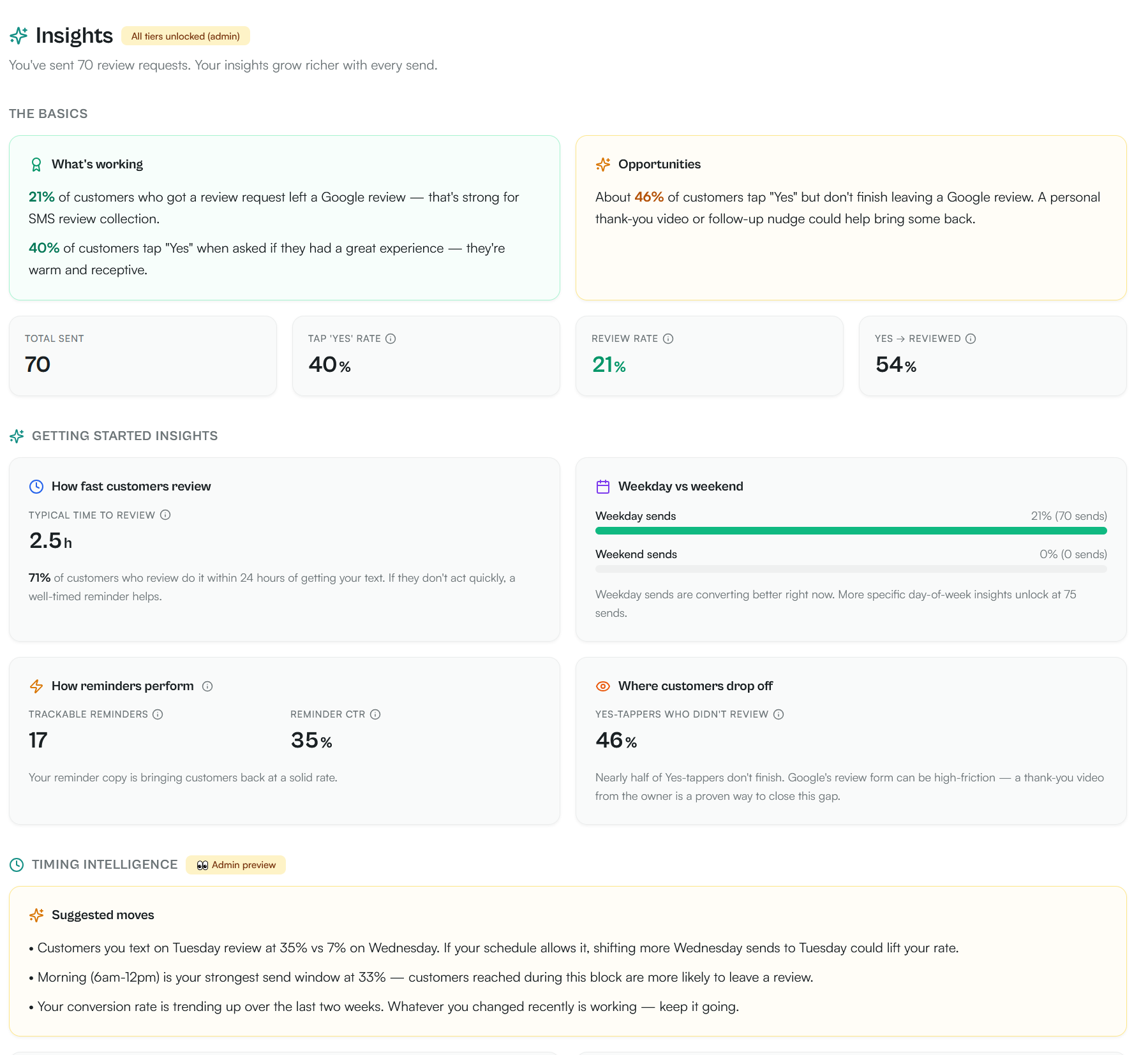
In our own data from Top Care Cleaning (n=70 sends), 71% of reviews come in within 24 hours of the request being sent. That means a single SMS send can produce a velocity spike the same day. A Tuesday send at 10am often produces reviews by Tuesday afternoon — a rapid velocity signal that a campaign-based approach could never replicate.
Tuesday sends at Top Care convert at a 35% review rate. Wednesday sends drop to 7%. We don't fully understand the day-of-week effect, but the pattern is consistent enough that we schedule high-value sends — new customers, first-time jobs — toward Tuesday when possible. The full timing analysis is in How to Get More Google Reviews for Your Local Service Business.
The platform question — Google vs Yelp vs Facebook for local service
The answer for local service is Google, and it isn't close.
Google reviews feed directly into the local pack, the knowledge panel, and Google Maps. When a homeowner searches "window cleaning near me," the three businesses that appear in the map pack are there partly because of their Google review profile. Yelp reviews don't feed that signal. Facebook Recommendations don't feed that signal. Only Google reviews do.
Yelp matters for some verticals and some geographies. In cities with high Yelp adoption — San Francisco, Los Angeles, New York — and in categories like restaurants, hospitality, and personal services, Yelp has meaningful reach. For a residential cleaning or exterior service business in a mid-size Midwest market, Yelp is a secondary consideration at best. We have a Top Care Cleaning Yelp profile. It exists and occasionally generates an inquiry. It is not where we focus review collection, and it has never produced a volume of results comparable to Google.
Facebook Recommendations have a role for businesses with an active Facebook community and strong neighborhood group presence. If you have 1,000 Facebook followers who are primarily local residents, a strong Facebook recommendation can travel through neighborhood groups and generate real bookings. But this is a word-of-mouth amplification strategy, not a local search strategy. It doesn't influence local pack rankings.
The time cost of managing three review platforms manually is prohibitive for a small service business. Before you try to spread requests across platforms, maximize Google. A 21% SMS-to-review conversion rate on Google is a floor to optimize, not an average to accept.
How to build a review collection system
The businesses that have 400+ Google reviews didn't get there by asking nicely once. They built a system that asks after every job, follows up with customers who didn't act, and tracks what works.
Step 1 — Get your Google review link
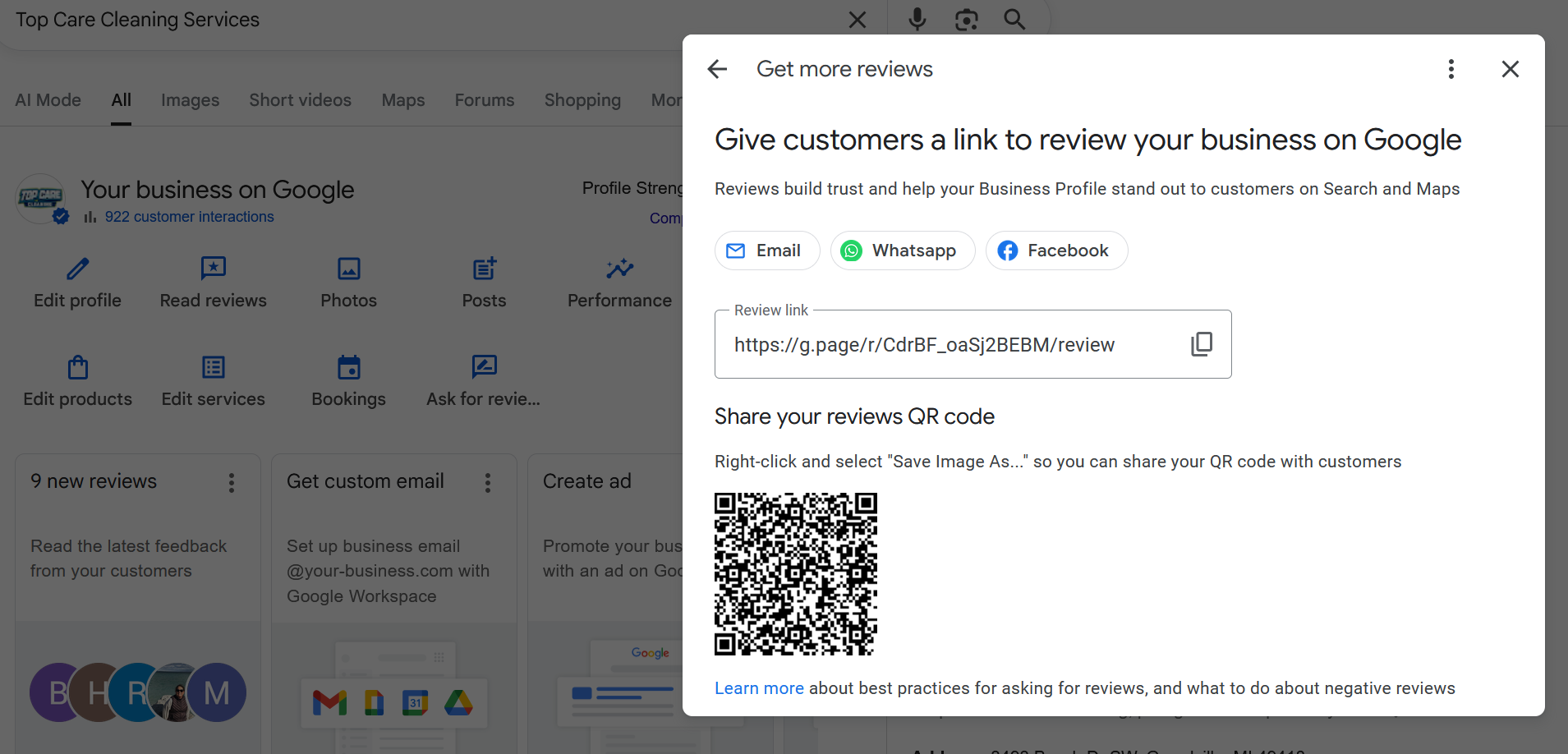
Your Google review link is the specific URL that opens the review form for your business directly. It's not your website. It's not your Google Maps listing. It's the link that takes a customer from their text message directly to the five-star rating screen — no searching, no clicking through listings.
Get the link from your Google Business Profile dashboard under "Get more reviews" > "Share review form." If you want all three link formats — the long write-review URL, the g.page short link, and the Place ID URL — use the free tool at /tools/google-review-link. For a complete breakdown of each format and how to find your link in four different ways, see The Google Review Link Toolkit.
Step 2 — Choose your ask channel (SMS vs email vs in-person)
SMS is the highest-converting channel for review requests in local service. At Top Care Cleaning, our review-to-send rate via SMS is 21% (n=70 sends). That's 1 in 5 customers who receive the text leaving a review. Industry benchmarks from BrightLocal put SMS review request conversion between 15–30% for service businesses — our rate sits at the middle of that range with a relatively small sample.
Email is a secondary channel. Top Care has not run a controlled email arm for review requests, so I can't give you a head-to-head comparison from our own data. BrightLocal's 2025 research shows email open rates for service business marketing around 22%, and review request email conversion rates vary widely based on subject line, timing, and list freshness. Email works, but the friction is higher: the customer has to open the email, read it, click the link, and leave a review — four steps instead of two.
In-person asks cost nothing and work well when paired with an automated follow-up. The verbal ask — "if you were happy today, I'll send you a quick text link to leave a review" — increases the conversion rate on the SMS that follows because the customer is expecting it.
Step 3 — Timing the ask (the 24-hour window)
The 24-hour rule exists because of how quickly the experience fades. At Top Care Cleaning, 71% of our reviews came in within 24 hours of the request. The median time from send to review was 2.5 hours. Once 48 hours pass, the probability of a customer leaving a review drops sharply — the job is no longer the freshest thing in their day, and the motivation fades.
Day-of-week matters. Our Tuesday sends convert at 35%. Wednesday sends drop to 7%. Weekends convert at 0% in our data. If you have scheduling flexibility on when to send, aim for Tuesday morning in the 6am–12pm window — morning sends are our strongest time-of-day window at 33% conversion.
Step 4 — Automate the follow-up
The first send captures the customers who act immediately. The follow-up captures the customers who saw the message, intended to leave a review, and then got pulled into something else. At Top Care, our reminder click-through rate is 35% — more than a third of customers who didn't act on the first send clicked the reminder.
The two-send sequence: Day 0 post-job SMS → Day 1–2 reminder. This covers the window where the experience is fresh enough to convert but the first send wasn't enough.
I built Hosted Reviews to automate this for Top Care Cleaning — and now for other local service businesses. The system sends the initial ask after job completion, sends the reminder 24 hours later, and tracks conversion by technician. 14-day trial, no card required.
How to respond to Google reviews (and why it matters)
Most articles about getting reviews skip what happens after you get them. Responding to your reviews is the step that turns a passive review profile into an active one — and it's the step that prospects actually notice when they're comparing businesses.
Every review you receive is a public conversation. When you respond, you show that a real person is behind the business, that you read what customers say, and that you care enough to acknowledge it. When you don't respond, the review sits there in silence, and prospects draw their own conclusions.
For positive reviews, a brief, specific response is all you need:
- "Thanks, [Name] — so glad the gutter cleaning went smoothly. Looking forward to your fall clean this year."
- "Really appreciate you taking the time, [Name]. We'll pass the compliment on to [Technician]."
- "Great to hear from you, [Name] — the window washing on that second story is always satisfying to see finished."
Notice what these responses do: they use the customer's name (personalization), acknowledge something specific (not a generic "thanks for the review!"), and often include a service name or location detail. This adds keyword-rich text to your GBP and signals to prospective customers that reviews here are read by a real person.
For negative reviews, the response is more important because prospects pay more attention to how businesses handle criticism than how they handle praise. A measured, non-defensive response to a 1-star review can reverse the damage — or at least limit it. The response formula:
- Acknowledge the experience without arguing
- Apologize for the gap between the experience and your standard
- Describe what you're doing to fix it or invite them to contact you directly
- Keep it short — two to four sentences, not a paragraph defending yourself
At Top Care Cleaning, we respond to every Google review within 24 hours. When we get a negative review, we respond within the hour. The response isn't for the unhappy customer — it's for the next 100 prospects who will read that review and our response when they're deciding whether to call.
The funnel screen — protecting your star average
Ask every customer for a review, and you'll eventually ask an unhappy one. Unhappy customers who receive a review link are far more likely to use it than happy ones — the motivation asymmetry between negative and positive reviews is real and documented. A dissatisfied customer who gets your review link will sometimes leave a 1-star review before you even know there was a problem.
Funnel screening solves this. Instead of sending your review link as the first thing a customer sees, you first ask a binary question: "Were you happy with your service today?" Customers who tap yes get the Google review link. Customers who tap no or indicate dissatisfaction get routed to a private feedback form — not your public Google profile.
At Top Care Cleaning, the funnel screen has produced two important outcomes. First, the reviews we do get are almost exclusively from customers who self-identified as satisfied, which means better average quality and higher star ratings. Second, we get early warning on service issues that might otherwise surface only as public 1-star reviews. A customer who taps "no" on the funnel screen and submits private feedback gives us a chance to call, apologize, and fix the problem — sometimes turning a potential 1-star into a loyal repeat customer.
The Top Care funnel math (n=70 sends): 40% of customers tap the affirmative. Of those, 54% go on to leave a Google review. That produces our overall 21% review-to-send rate — a rate composed entirely of satisfied customers.
The detailed funnel screening workflow is covered in How to Get Good Google Reviews — Funnel Screening 101.
Your website as a review showcase
Collecting reviews is half the system. The other half is deploying them where they do commercial work — specifically on your website, where prospects are making booking decisions.
When a prospect finds your website after seeing your local pack listing, they've already done one step of due diligence. The website is where they close the gap between "interested" and "calling." Your Google reviews, embedded on your homepage or service pages, do the closing work at this stage: a customer comparing quotes can see your 400-review profile without leaving your site.
The mechanics of embedding reviews — WordPress plugins, Wix widgets, Squarespace code blocks, and the Hosted Reviews native widget — are covered in full in How to Embed Google Reviews on Your Website.
Frequently asked questions
How many Google reviews do I need to show up in the local pack?
There is no fixed number. Google weights review velocity and recency alongside total count, and the competitive threshold varies by market and category. BrightLocal data shows most local pack positions feature businesses with 30–100+ reviews, but a cleaning company in a smaller market might hold a local pack position with fewer. The practical answer: get as many recent reviews as possible. At Top Care Cleaning, consistent velocity — not hitting a specific count milestone — is what held our local pack positions.
Can I ask customers directly for a Google review?
Yes. Google's review policies explicitly allow businesses to ask customers for reviews. What's prohibited is incentivizing reviews (offering discounts, freebies, or payments for reviews), instructing customers to leave positive reviews only, or posting from business devices. A straightforward ask — "If you were happy today, we'd appreciate a Google review" — is fully compliant.
What's a realistic review-to-send conversion rate?
At Top Care Cleaning, our rate is 21% (n=70 SMS sends). Industry benchmarks from BrightLocal and other review platform providers range from 15–30% for SMS review requests from service businesses. Email review requests typically convert lower, and in-person asks without a follow-up convert inconsistently. The 21% figure is one operator's data — your rate will vary by industry, market, and how quickly you send after the job.
Does responding to reviews affect my ranking?
Google has indicated that activity on your Google Business Profile is a positive signal, and review responses are a form of GBP activity. There is no confirmed direct ranking boost from responding, but responding shows engagement, influences how prospects perceive the business, and may contribute to overall GBP activity signals. The full treatment of review response strategy is in Pillar 5.
How often should I ask for reviews?
After every job. Not once a month, not when you remember to. After every completed job. Automated post-job sends are the only reliable way to achieve this consistency. A manual process will always miss jobs — before Hosted Reviews, we sent about one review request per week at Top Care. With automation, we send after every completed job.
Do Yelp reviews help local service SEO?
Indirectly. Yelp business pages can appear in Google search results for branded queries ("Top Care Cleaning Yelp"), and Yelp content can appear in local SERP results in Yelp-dominant markets. But Yelp reviews do not feed the Google local pack ranking algorithm. For local service businesses, Google reviews are the primary local pack signal. Build your Google profile first.
Closing
The system that built Top Care Cleaning's 400-review profile is available to any local service operator today. Start a 14-day Hosted Reviews trial — no card required.
About the author
Alex Host runs Top Care Cleaning, a Grand Rapids cleaning and exterior service with 400+ Google reviews, and built Hosted Reviews to automate what he was doing manually. I run Top Care Cleaning, a Grand Rapids cleaning and exterior service with 400+ Google reviews, and I built Hosted Reviews to automate what I was doing manually. Read more at hostedbrands.com/about.