By Alex Host · Founder of Hosted Reviews and operator of Top Care Cleaning · Updated 2026-05-22
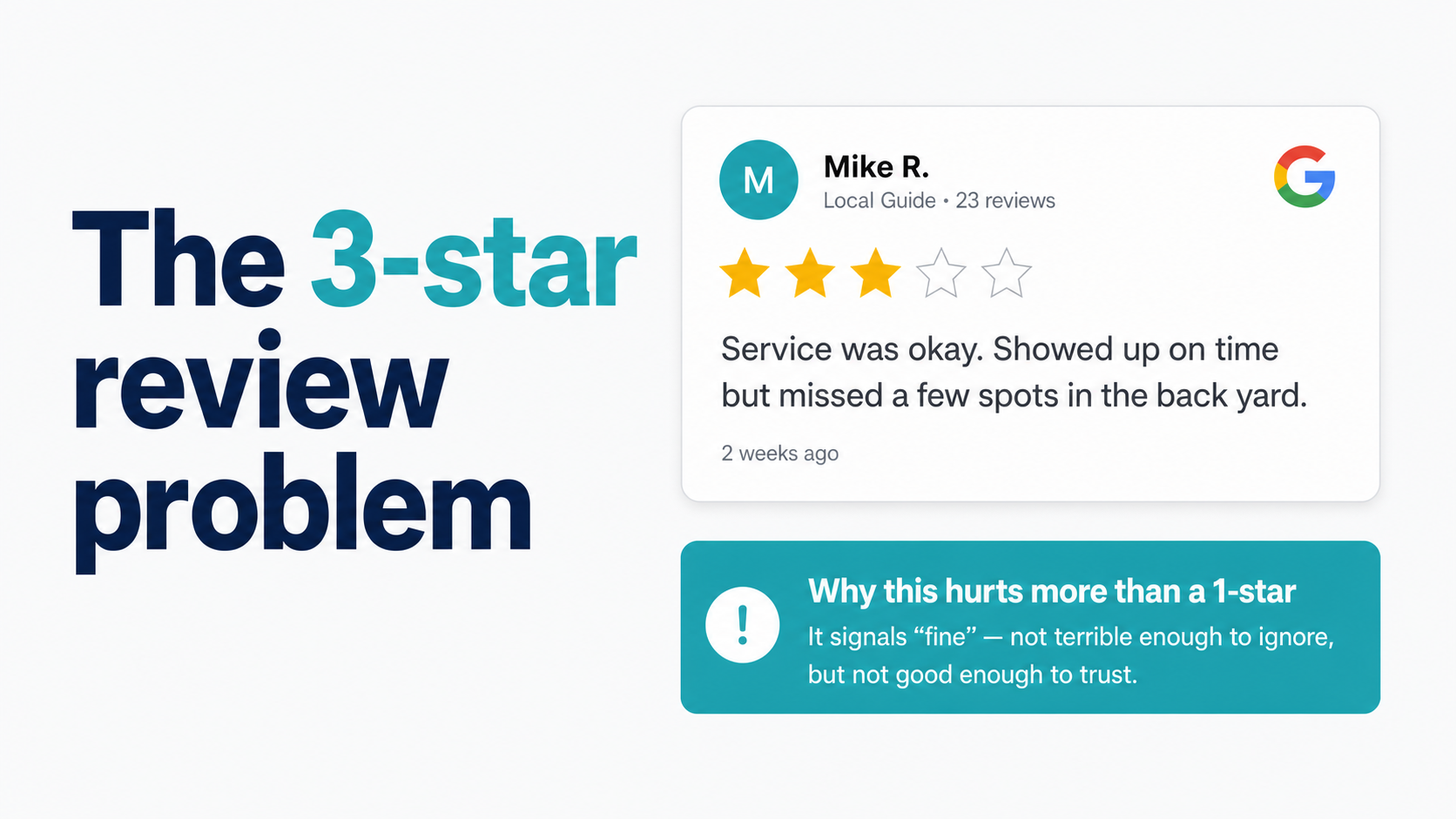
A 1-star review is obvious — you know what happened. A 3-star review is harder. It says "fine, but not great." The problem is that "fine, but not great" — repeated — is exactly what drops you from 4.9 to 4.6, and that's enough to change how Google ranks your profile in local search. Here's the math, and here's the fix.
The math of star averages (why 3-stars are more damaging than you think)
Most business owners track their review count and their average, but don't think about the mathematical relationship between them. It's worth understanding before you can do anything strategic about 3-stars.
A worked example using Top Care's actual baseline:
Top Care Cleaning currently has 373 Google reviews at a 4.9-star average. That means the sum of all ratings is approximately 1,828 points (373 × 4.9).
| Scenario | Reviews | Average |
|---|---|---|
| Current baseline | 373 reviews, 0 new 3-stars | 4.9 |
| +5 three-star reviews | 378 total | 4.86 (rounds to 4.9) |
| +10 three-star reviews | 383 total | 4.82 (rounds to 4.8) |
| +20 three-star reviews | 393 total | 4.75 (rounds to 4.8) |
| +30 three-star reviews | 403 total | 4.68 (rounds to 4.7) |
The same scenario at 50 reviews:
| Scenario | Reviews | Average |
|---|---|---|
| Baseline | 50 reviews, 4.9 average | 4.9 |
| +3 three-star reviews | 53 total | 4.73 (rounds to 4.7) |
| +6 three-star reviews | 56 total | 4.57 (rounds to 4.6) |
| +10 three-star reviews | 60 total | 4.4 |
Why 3-stars aren't neutral. In a 1–5 scale, the expected center is 3 — but that's not how reviewers or prospective customers interpret the scale. For service businesses, the effective baseline is 4.5 and above. A business below 4.0 in most service categories reads as struggling; a business between 4.3 and 4.5 reads as "probably fine but I'd check the alternatives"; a business at 4.8 or above reads as confidently good. A 3-star on a 5-star scale isn't neutral — it's a below-baseline signal in the category context.
With 373 reviews at 4.9 stars over Top Care's 45-year tenure, I've watched what happens to local pack visibility when the average dips toward the 4.7 range. The change in impression share is real — not catastrophic at that volume, but measurable.
What a 3-star review usually means (and what it almost never means)
Before deciding how to respond or what to do operationally, it helps to understand what most 3-star reviews are actually signaling.
What it usually means — mild disappointment, not disaster
The most common 3-star pattern in residential cleaning: the job was done, nothing was specifically wrong, but something felt slightly off. Common causes:
- The crew arrived 45 minutes later than the quoted window without a heads-up call
- One area of the house wasn't cleaned as thoroughly as expected
- The service met the technical scope but didn't exceed it — and the customer had higher expectations based on reviews they'd read
- A small communication gap between what was quoted and what was delivered
These aren't service failures. They're expectation mismatches, and most of them happen before the crew arrives at the door.
What it almost never means — total failure or bad faith
A 3-star rarely signals a complete service failure or a fake/coordinated review. If someone is motivated enough to leave a review in bad faith, they usually leave a 1-star. A 3-star requires a different motivation — the customer genuinely had a mediocre experience and is giving you credit for the parts that were fine while flagging the parts that weren't.
The follow-up question that matters
When I see a 3-star at Top Care, the first question I ask is: "Did this customer get what they paid for?" If the answer is yes — the service scope was completed — then a 3-star almost always points to an expectation-setting failure, not a service delivery failure. That distinction determines whether the fix is operational (change how we communicate) or training-based (change how the crew performs).
How to respond to a 3-star review (different from a 1-star)
The most common mistake with 3-star responses: treating them like 1-stars. A 1-star response needs to acknowledge a significant gap and demonstrate accountability. A 3-star response has a different goal — you're thanking the reviewer for the feedback, acknowledging what you could do better, and inviting specifics without over-apologizing for something that may have been largely satisfactory.
Don't over-apologize
A 3-star is an "I expected more" signal, not a "this company failed me" signal. Responding with a full crisis-level apology implies the review described something worse than it did. Prospective customers reading that exchange will come away thinking the experience was worse than the 3-star suggests.
Do invite specifics
"We'd love to know what we could have done better" is the most useful thing you can ask in a 3-star response. If the reviewer had a specific issue they didn't mention, giving them a direct channel to share it gives you operational information. It also shows prospective readers that you take feedback seriously and don't just respond defensively.
Template A — 3-star response when no detail is given
[Name], thank you for taking the time to leave a review. A 3-star rating tells us there was room for improvement, and we'd genuinely like to know what we could have done better. Please feel free to reach out directly at [contact] — we'd appreciate the chance to understand your experience.
Template B — 3-star response when the review identifies a specific issue
[Name], thank you for the honest feedback about [specific issue mentioned]. That's not the standard we hold ourselves to, and I want to understand what happened. I'll be reaching out directly to follow up — and if there's anything we can do to make this right, we will.
TODO[REAL_RESPONSE] — if a real Top Care 3-star response is available, swap in pre-publish with disclosure.
Examples synthesized from common Top Care customer scenarios — not real customers. Patterns reflect Top Care's actual response approach to 3-star reviews.
For the full library of response patterns by review type, see the negative review response template library.
The upstream fix — why 3-stars are usually a before-the-job problem
Most 3-star reviews are preventable — not by doing the job better, but by communicating better before the job happens.
The expectation-setting gap. The customers most likely to leave 3-stars are those whose expectations at booking didn't quite match what they received at service delivery. They didn't leave because something went wrong — they left because they expected the service to feel a certain way, and it felt slightly different. That gap closes at booking and confirmation, not during the clean.
What Top Care changed. We added a brief pre-job confirmation message that sets explicit expectations: arrival window (with a 30-minute buffer and a promise to call if running late), scope of what the clean includes, and what the customer can do to prepare the space. The 3-star frequency dropped after that change — not to zero, but measurably.
The private feedback connection. When mild dissatisfaction gets expressed through private feedback rather than a public review, it stays out of your star average and gives you the chance to address it directly. Hosted Reviews' two-step funnel routes customers to a private feedback form before the public review link — so the "fine but not great" signal comes to your inbox, not Google. That's not a pitch mid-article; it's worth describing as an operational mechanism because it addresses the 3-star category specifically.
How to recover a declining average
If you're already watching your average drift down from sustained 3-star volume, the recovery path is straightforward in principle and requires consistent effort in practice.
The velocity response: Generate more authentic 5-star reviews. The math is your friend at scale.
Using Top Care's baseline of 373 reviews at 4.9 stars:
- 5 new 3-stars: need approximately 25 new 5-stars to return to 4.9
- 10 new 3-stars: need approximately 50 new 5-stars to return to 4.9
At lower volumes, the arithmetic is faster but requires proportionally the same effort.
The lever that's always within your control: You can't guarantee that 3-star reviews stop coming, and you can't always get them removed (they rarely violate Google's policy). What you can control is outbound review velocity — how consistently you're asking happy customers to share their experience. A systematic SMS request system that reaches every customer within 24–48 hours of service completion is the most reliable way to build and maintain the review volume that buffers your average.
For building that velocity: SMS Review Request System for Service Businesses. For the broader strategic context of review management before a crisis hits: Google Reviews Playbook for Residential Service Businesses.
Frequently asked questions
Is a 4.6 Google star rating noticeably worse than 4.9?
In most residential service categories, yes. The practical threshold where the gap becomes meaningful in local pack performance is around 4.7 — below that, some search intent triggers Google to weight reviews more heavily in ranking signals. The perceptual gap for prospective customers is also real: a 4.9 reads as "very consistently good"; a 4.6 reads as "mostly good with some issues." That's a different positioning signal, especially for premium-priced services.
How many 5-star reviews do I need to offset one 3-star?
The math depends on your current average and review count. At a 4.9-star average, one 3-star review has minimal impact — you need roughly 2 new 5-stars to fully offset it in the displayed average. At a 4.5 average, one 3-star moves the needle less because the average is further from the ceiling. The lower your current review volume, the more each individual review matters.
Should I respond to 3-star reviews that have no text?
Yes. A bare 3-star with no explanation still benefits from a brief response: "Thank you for the rating — if you'd be willing to share what we could have done better, I'd genuinely appreciate the feedback." A response signals to prospective customers that you notice and care about all reviews, not just the ones with detailed text.
Why do some businesses with a 4.3 average outrank businesses with a 4.8?
Star average is one of several local ranking signals — it's not the only one. Review count, recency of reviews, keyword relevance in review text, proximity to the searcher, and overall GBP completeness all factor in. A business at 4.3 with 800 recent reviews and a fully optimized profile can outrank a business at 4.8 with 40 reviews and sparse GBP activity. Average matters, but it sits within a broader signal set.
Can I ask a customer to change a 3-star to a 5-star?
You can ask, but the approach matters. Google's terms of service don't prohibit asking a customer to reconsider a review, but asking in a way that feels like pressure or is tied to any incentive is a policy violation. The right path: if you've resolved an issue with a 3-star reviewer through direct outreach, you can let them know that you've made the changes they described and that you'd appreciate knowing if their view of the experience has changed. Keep the ask light and optional.
Once you've handled the immediate fire, Hosted Reviews helps prevent the next one by routing unhappy customers to private feedback before they hit Google. Start a 14-day trial when the dust settles.
Next steps:
- For response templates across review types: Negative Review Response Template Library
- For building the review velocity that offsets 3-stars at scale: Google Reviews Playbook
- For the full negative review response strategy: How to Respond to Negative Google Reviews
About the author
Alex Host runs Top Care Cleaning, a residential cleaning company in Grandville, Michigan with 373 Google reviews and a 4.9-star average built over 45 years of service. He built Hosted Reviews after years of navigating the math of review averages firsthand — including watching what sustained 3-stars do to local pack visibility over time. He writes about review management and local SEO from the operator's perspective. More at Hosted Brands.