By Alex Host · Founder of Hosted Reviews and operator of Top Care Cleaning · Updated 2026-05-22
Important: This article describes general patterns for navigating Google review situations. It is not legal advice. Defamation laws, fair-use boundaries for public responses, and the rules around naming/identifying customers vary by state and country. Before pursuing legal action against a reviewer, sending a cease-and-desist, or naming a customer in a public response, consult an attorney licensed in your jurisdiction. The author runs a residential cleaning business and is not a lawyer.
If you woke up to five new 1-star reviews this morning from accounts you've never seen, and your service team had no corresponding reports of problems — you're likely dealing with a coordinated attack. Stay calm. Here's what to do in the first 24 hours, and what the realistic recovery path looks like over the next 30–90 days.
This playbook is written for service business operators who have found themselves in this situation. The tone throughout is methodical, not combative — because the businesses that recover well are the ones that document carefully, escalate through the right channels, and build review velocity rather than spending energy on countermeasures that don't work.
Cross-platform scope note: This article covers Google review bombing only. The same situation on Yelp, Facebook, or other platforms requires different procedures and is outside the scope of this article.
First, verify it's actually coordinated (not a batch of real unhappy customers)
Before assuming coordination, check. This matters because the two situations — a coordinated fake attack and a real batch of dissatisfied customers — require entirely different responses. Responding to a real service failure as if it were a fake attack makes the situation significantly worse.
Signs it's coordinated
- Reviewers have little or no review history on their profiles (accounts created recently with 0–2 total reviews)
- Multiple reviews use similar phrasing, sentence structure, or mention the same specific (but vague) complaints
- Reviews were posted within a narrow window — multiple 1-stars in the same 24-hour period
- Reviewer profile photos are missing or appear stock/generic
- None of the reviewer names appear in your customer records
Signs it might be real
- Your team had a large job or event with multiple customers recently and something went wrong
- There was a rogue employee situation you weren't aware of
- A product or service change caused dissatisfaction you didn't catch in internal feedback
- The reviews describe specific, plausible details that your customer records could verify
Check your job log before assuming anything
If none of the reviewers appear as customers in your records, document that fact now — with dates, job logs, or your scheduling system's data. This documentation becomes evidence in your GBP escalation. But if you find a match, even a partial one, investigate the real complaint first.
"Don't assume coordination until you've checked the job log. Embarrassing mistakes happen; so does deliberate sabotage. Both need different responses."
The first 24 hours — what to do right now
If verification confirms this is coordinated, the first 24 hours are about documentation and escalation — not retaliation, not emotional public responses, not social media posts about being attacked.
Step 1 — Screenshot and document everything
Before you do anything else: screenshot every suspicious review. Capture the review text, the reviewer's profile name and photo, the reviewer's profile URL, and the timestamp. Save these to a dated folder (name it something like "review-bombing-evidence-YYYY-MM-DD").
This documentation is your evidence when you escalate. Google's support team responds better to structured evidence — timestamps, pattern data, reviewer profile information — than to a frustrated narrative about what's happening.
Step 2 — Do not respond to every review in rapid succession
The instinct to respond immediately and individually to every fake review is understandable. Resist it. Rapid-fire responses to a cluster of fake reviews signals to Google's automated systems that you're engaging with the reviews rather than flagging them as policy violations. It can also make the situation more visible on your profile.
Post one calm, measured public response (Step 5 below). Let the flagging and escalation process do its work.
Step 3 — Flag each review through your Google Business Profile
Log into business.google.com, navigate to each suspicious review, and flag it as a policy violation. For each review, select the category that best fits — "spam or fake content" is usually the right choice for coordinated fake reviews.
For the detailed flagging procedure, see How to Flag a Fake or Spam Google Review for Removal.
Flag each review individually. Google's system requires individual flags — there is no bulk-flag mechanism.
Step 4 — Escalate immediately to GBP support
Don't wait for the standard 3–5 day flag resolution process on a coordinated attack. This warrants immediate escalation.
Go to support.google.com/business and open a support chat or request a callback. When you reach a support agent:
- State that you're experiencing a coordinated review attack — multiple fake reviews posted within a narrow time window
- Provide the specific review URLs you documented in Step 1
- Describe the pattern evidence: reviewer profile ages, similar phrasing, no match to customer records
- Ask for expedited review of the flagged content given the coordinated nature
Google's support team does take coordinated attacks more seriously than individual flag requests. The escalation is worth the effort even if the immediate outcome is uncertain.
Step 5 — Write one calm, professional public response
Post a single response — not one response per fake review. This response doesn't deny, deflect, or accuse. It acknowledges the pattern matter-of-factly for prospective customers reading your profile.
Template — coordinated attack public response:
We've noticed a pattern of reviews posted recently that don't correspond to any customer records in our system. We're working directly with Google to address this situation. If you have a genuine experience with [Business Name] that you'd like to discuss, please reach out to us at [contact] — we respond to every message. We appreciate the continued support of our real customers.
TODO[REAL_RESPONSE] — if a real Top Care or known-operator example of this type of response is available, swap in pre-publish with disclosure.
Example synthesized from common patterns in operator-documented coordinated review situations — not from a real Top Care customer event. Patterns reflect documented approaches to coordinated review attacks.
The 30-day recovery plan
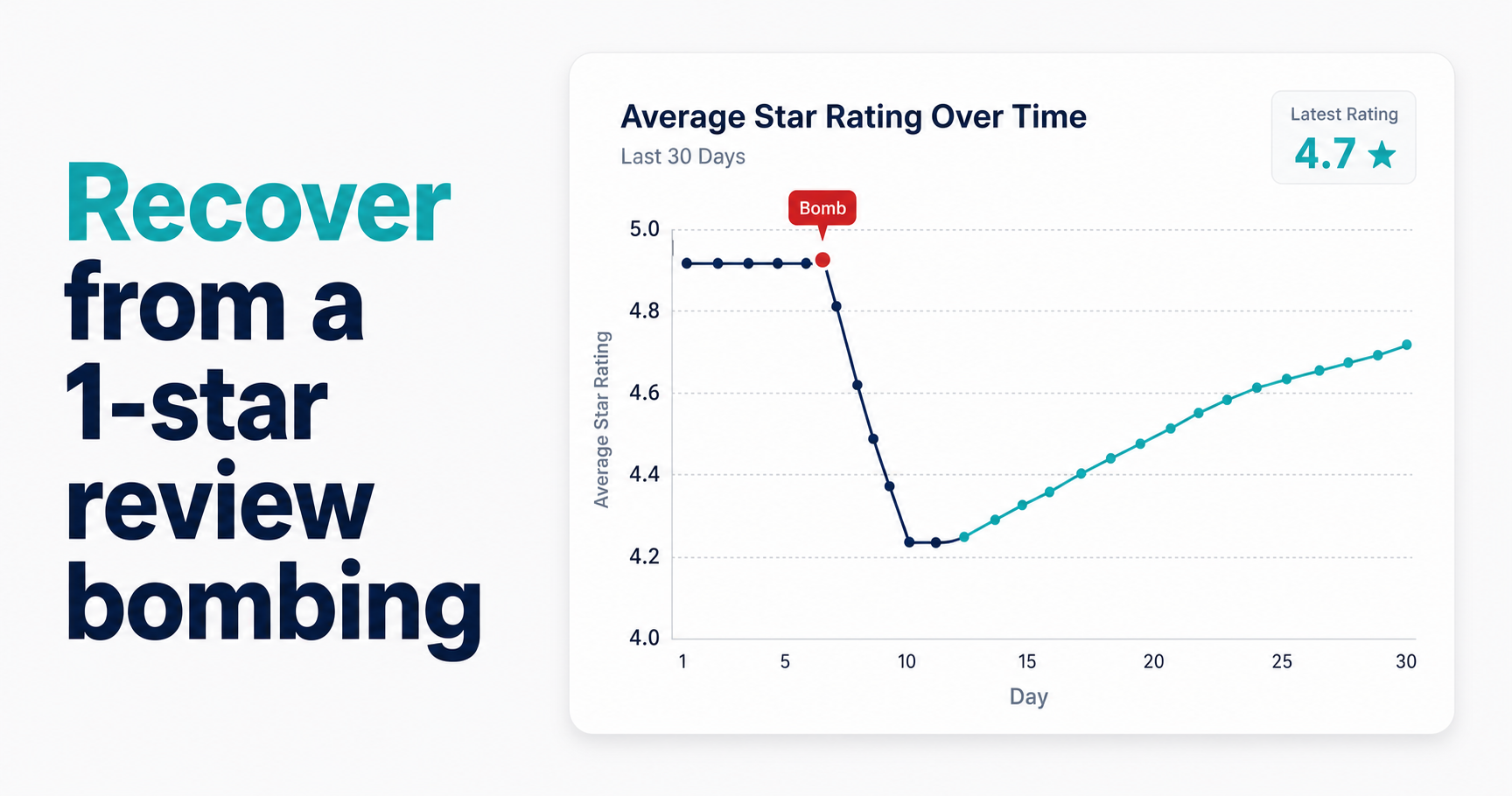
Once the immediate documentation and escalation work is done, recovery happens across two parallel tracks: the escalation track (working with Google to remove the fake reviews) and the velocity track (generating authentic reviews to rebuild your average). Both matter; only one is fully within your control.
Weeks 1–2 — Escalation track
Follow up on your GBP support escalation if you haven't received a response within 3 business days. When you follow up:
- Reference your original case number or ticket
- Provide any additional pattern evidence you've gathered since the initial escalation
- Be specific: "As of [date], X of the Y flagged reviews are still live. Each reviewer has [description of pattern evidence]."
If GBP support chat isn't producing results, the Google Business Profile Help Community has Google-employed Product Experts who handle escalations that support chat hasn't resolved. Post there with your documented evidence and a clear description of the pattern.
Honest expectation: Google does take coordinated attacks seriously when pattern evidence is clear and well-documented. But removal is not guaranteed, and the timeline is unpredictable. Some reviews from coordinated campaigns are removed within days; others take weeks; some are never removed even when the pattern seems obvious from the outside.
Weeks 2–4 — Velocity track
This is the track that's fully within your control, and in practice it's the most reliable path to recovery.
The math of dilution: if a bombing campaign added 10 fake 1-stars to your profile, and your current average before the attack was 4.8 based on 100 authentic reviews:
| Recovery scenario | New authentic 5-stars needed | Resulting average |
|---|---|---|
| After 10 fake 1-stars (100 authentic base) | 0 (just after attack) | ~4.5 |
| After generating 10 new 5-stars | 10 new reviews | ~4.6 |
| After generating 20 new 5-stars | 30 total authentic since attack | ~4.7 |
| After generating 40 new 5-stars | 50 total authentic since attack | ~4.8 |
For building systematic review velocity through SMS requests: SMS Review Request System for Service Businesses.
Weeks 3–6 — Legal options assessment (if escalation fails)
This section describes the existence of legal options — it is not legal advice. Consult an attorney licensed in your jurisdiction before taking any of the steps described here.
If Google's escalation process hasn't produced removals and the reviews are causing material business harm, an attorney in your jurisdiction may be able to: send a cease-and-desist to identified responsible parties, pursue a defamation claim if reviews contain provably false statements of fact (not opinion), or seek a court order compelling removal where available.
The practical reality: defamation litigation is expensive, slow, and uncertain. For most local businesses, the velocity response is more cost-effective than legal action. That's not a reason to avoid consulting an attorney — it's a reason to understand the cost-benefit before committing.
For the full context on what Google's policy covers: Google Review Removal Policy — When Google Will and Won't Remove a Review.
What a realistic recovery looks like — honest expectations
The two things that matter most for setting realistic expectations:
Google won't remove all fake reviews on your timeline. Some will stay even after escalation, even when the pattern evidence is strong. That's a frustrating outcome after doing everything right. Accept it and redirect energy to the velocity track.
Review average recovery is measured in weeks and months, not days. Most service businesses that face a coordinated attack and pursue the velocity response recover to within 0.2–0.3 stars of their pre-attack average within 90–120 days — if they're consistently generating authentic reviews. That timeline assumes a systematic request process, not ad hoc asks.
"Recovery is not about getting back to exactly where you were in 72 hours. It's about systematic dilution over 60–90 days."
The Top Care context: 373 reviews at 4.9 stars built over 45 years represents a volume cushion that limits how much damage any single campaign can do. Getting to that level of review history is the long-term protection — which is why building review velocity before a crisis is more valuable than any reactive measure after one.
What to tell your customers
During a bombing campaign, some of your real customers may notice the sudden drop in your average and ask about it. Your front-line team needs a brief, factual response.
Brief statement for your service team:
We've noticed a pattern of reviews that don't correspond to actual customer experiences. We're addressing it directly with Google. Our team and service quality haven't changed.
If the attack is significant and you have a customer email list, a brief note is appropriate — not a complaint about the attack, but a factual acknowledgment and an invitation for real customers to share their experience. Keep any communication factual, brief, and free of accusations or speculation about who is responsible.
Preventing the next campaign
The most effective defense against a future coordinated attack is a large, genuine review history that absorbs damage without meaningful change to your average or local pack position.
The math is a defense. At 373 reviews and 4.9 stars, a 10-review coordinated attack moves Top Care's average by about 0.1 points — a nearly invisible change at that volume. At 40 reviews, the same attack is catastrophic. Building review volume before you need it is the only preparation that reliably limits the damage of any future campaign.
Private feedback routing reduces the population of semi-dissatisfied customers who could theoretically be recruited into a coordinated campaign. If your mild dissatisfaction gets addressed through a private feedback channel before it reaches a public review form, there are fewer loose threads available to weaponize. That's the mechanism Hosted Reviews' two-step funnel creates — private feedback first, public review second.
For the broader review-building strategy: SMS Review Request System and How to Respond to Negative Google Reviews.
Frequently asked questions
Will Google automatically detect and remove coordinated fake reviews?
Google's automated systems flag some coordinated patterns — short-history accounts, identical phrasing, known spam signatures. But automated detection misses well-constructed campaigns using aged accounts with varied phrasing. Manual flagging and GBP support escalation are usually necessary.
Can I find out who is behind a review bombing campaign?
In most cases, no — not without legal process. Google's reviewer accounts are pseudonymous and Google doesn't disclose account information outside of court-ordered discovery. Tracing anonymous accounts to specific individuals typically requires legal action.
Should I post about the attack on my website or social media?
Generally no. Public posts about being attacked can attract attention to the negative reviews, can come across as defensive to prospective customers, and could complicate legal options. A brief factual note on your website that you're aware of the situation is acceptable; a social media post about being wronged is usually not useful.
What if a competitor or former employee is behind it — does that change my legal options?
It changes the practical feasibility. If you can demonstrate a specific individual or business is behind the campaign, that's a stronger foundation for a defamation or tortious interference claim. The legal analysis still requires an attorney in your jurisdiction.
How long before my review average recovers after a bombing campaign?
This depends on the scale of the attack, your pre-attack review volume, and how consistently you generate authentic reviews afterward. For most local service businesses, a 10–15 fake 1-star attack followed by systematic authentic review generation typically returns the average to within 0.2–0.3 stars of the pre-attack level within 90–120 days.
Once you've handled the immediate fire, Hosted Reviews helps prevent the next one by routing unhappy customers to private feedback before they hit Google. Start a 14-day trial when the dust settles.
Next steps:
- For flagging the reviews right now: How to Flag a Fake or Spam Google Review for Removal
- For understanding what Google's policy will and won't cover: Google Review Removal Policy
- For fake and spam reviews in general: How to Deal with Fake or Spam Google Reviews
- For the full negative review response framework: How to Respond to Negative Google Reviews
About the author
Alex Host runs Top Care Cleaning, a residential cleaning company in Grandville, Michigan with 373 Google reviews and a 4.9-star average built over 45 years of service. He built Hosted Reviews to help service businesses manage review collection and defend their reputation before a crisis hits. He writes about negative review response, Google policy, and local SEO from the perspective of an operator who has navigated the full range of review situations — including coordinated ones. More at Hosted Brands.