Transparency disclaimer: I run Top Care Cleaning and built Hosted Reviews. Read this knowing I'm biased toward my own product. I will tell you exactly when a competitor is the better fit.
By Alex Host, founder of Hosted Reviews and operator of Top Care Cleaning
This guide is for you if you run a sub-50-employee cleaning, HVAC, plumbing, window-washing, or lawn-care company, have demoed Birdeye or Podium, and balked at $300–$600 per month. You want a real operator's view — not a chart from a SaaS marketer's blog, and not a G2 listicle with 50 vendors sorted by "sponsored."
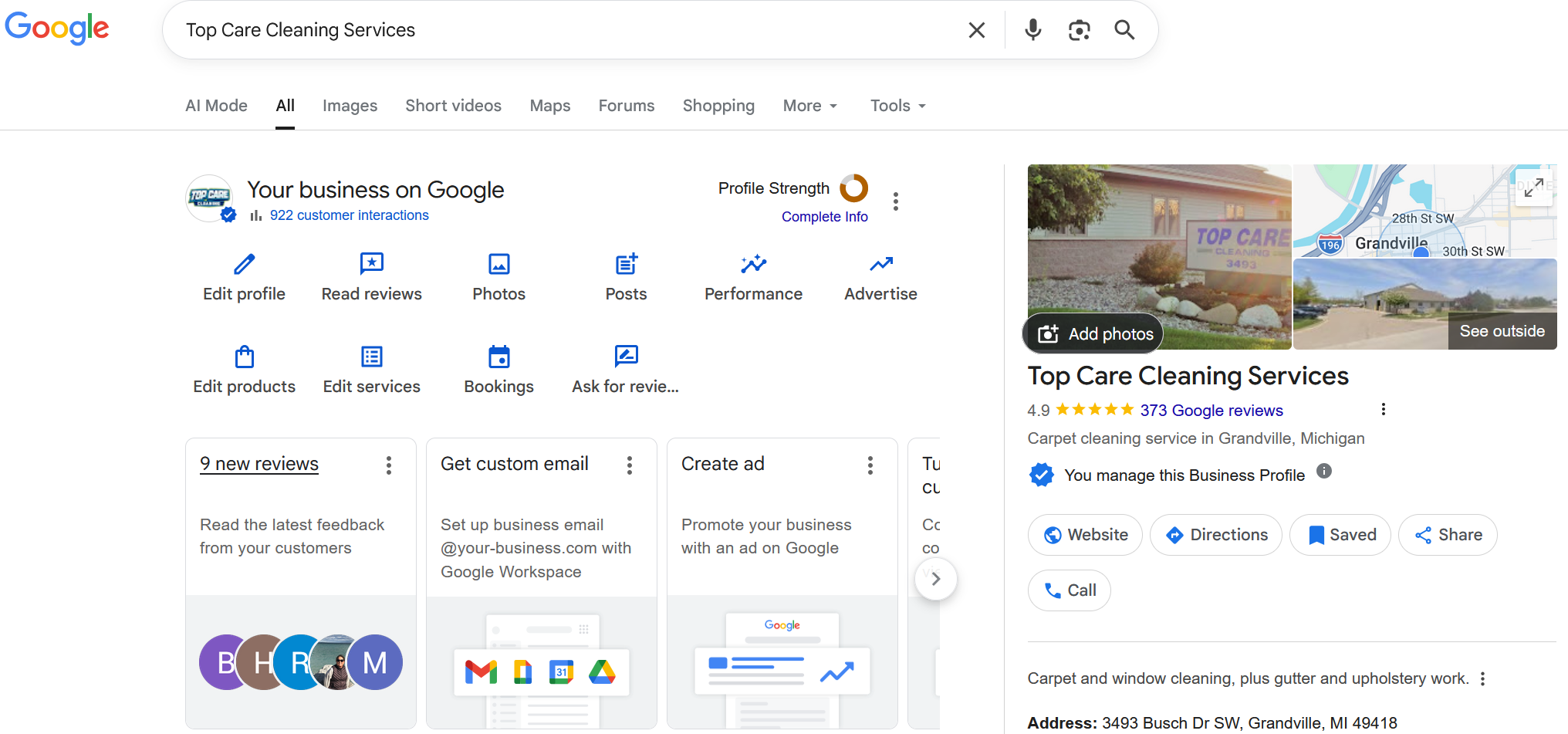
I am an operator. Top Care Cleaning is a 45-year residential cleaning business in Grandville, MI. We have 373 Google reviews at 4.9 stars. I built Hosted Reviews because I couldn't find a review tool that fit my price point, my team size, and the way field service businesses actually work. That bias is real. So are the numbers I'm going to share.
What I looked at before building Hosted Reviews — and why this market is broken for small operators
I evaluated six tools before writing a line of code. The market problem was obvious within the first two sales calls.
The price problem — why $300–$599/month is inaccessible for a 12-person cleaning company
Birdeye starts at roughly $299 per location per month on an annual pre-pay contract, per Wiser Review's Birdeye pricing breakdown and Reviewflowz's analysis (both as of May 2026). Podium publishes its prices: $399/month for Core, $599/month for Pro, per Podium's pricing page.
A 12-person cleaning company grossing $400,000 per year — which is a solid, well-run operation — cannot sustain a $3,600–$7,188 annual software line item for review collection. That's 0.9–1.8% of gross revenue for one tool. These platforms are priced for businesses doing $1M+ annually that need a full communications stack, not for the operator who wants review requests sent after every cleaning job.
The funnel-screening gap — why most tools send unhappy customers straight to Google
Most review tools work the same way: send an SMS or email, include a link to your Google review page, and hope for the best. The problem is the "hope for the best" part. When you send a review request to every customer without any kind of screening step, unhappy customers — the ones who had a bad experience — get the same link as the happy ones.
Funnel screening is the practice of inserting a satisfaction check before the review link. Customers who give a low score are routed to a private feedback form instead of a public review site. Happy customers get sent to Google.
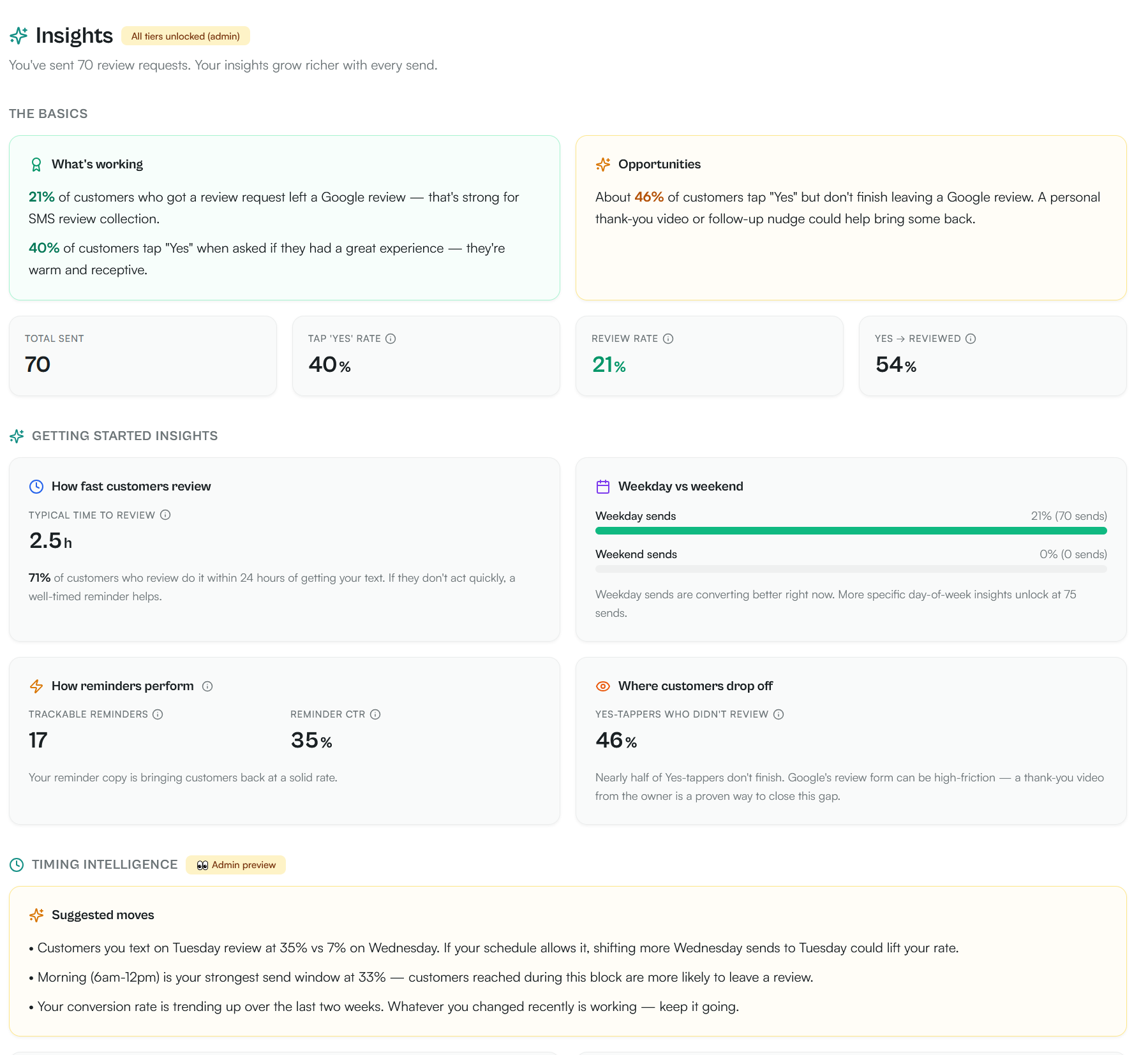
Why does this matter? At Top Care, 46% of respondents start the review form but don't finish it. Those dropouts represent customers who engaged but didn't convert. Without a funnel screen, some of those dropouts would instead have left a public 1- or 2-star review. With the screen in place, they have a private channel to express frustration — and we have a chance to respond before the review goes public.
Not every tool includes this. Podium, for example, has no native funnel screen — customers go straight to a public review site. Birdeye does include a negative intercept flow. Hosted Reviews does too.
What "operator-built" actually means (Top Care Cleaning, Grandville MI, 373 reviews, 4.9 stars)
I didn't design this product from market research. I tested it on a real crew, in the field, with real customers. Tyler converted 25% of his 32 SMS sends. Jayden led the team at 31% on 13 sends. Parker was at 10% on 21 sends — that gap told me the message timing and tech coaching mattered as much as the software.
We learned that Tuesday sends produced 35% of our total reviews for that cohort, while Wednesday sends produced only 7%. Morning sends (6am–12pm) accounted for 33% of conversions. Weekday sends converted at 21%; weekend sends converted at 0%.
That data came from 70 SMS sends to real Top Care customers. It's not a hypothetical. It's the foundation this product is built on.
The 6 tools I evaluated (and the one I built instead)
Here's the compressed version of the six platforms I looked at. Full breakdowns are in the linked articles.
| Vendor | Entry price | SMS native? | Funnel screen? | Best for |
|---|---|---|---|---|
| Hosted Reviews | $29/month | Yes (Twilio toll-free) | Yes | Sub-50-employee single-location service businesses |
| NiceJob | $75/month | Trigger + email follow-ups | No | Jobber/Housecall Pro users wanting zero-touch automation |
| Podium | $399/month | Yes (10DLC) | No | Businesses needing a full SMS communications stack |
| Birdeye | ~$299/location/month | Yes (two-way) | Yes | Multi-location mid-market businesses (4+ locations) |
| Grade.us | $110/month (Solo) | Add-on | Yes | Marketing agencies managing multiple SMB clients |
| Whitespark Reputation Builder | $79/location/month | Yes (300 credits/month cap) | Yes | Local SEO agencies |
For Podium pricing detail, see Podium pricing — what an operator actually pays. For Birdeye, see Birdeye pricing — operator-voice breakdown. For the full side-by-side of all six, see the best review management software roundup.
Sub-theme A — Head-to-head comparisons
These are the highest-intent articles in this silo. If you've already shortlisted two tools and want someone to make the call, start here.
Podium vs Birdeye — the two dominant names
Podium and Birdeye are the two brands that come up first in most searches for SMS review tools. They're both genuinely strong platforms. Neither is the right fit for a sub-50-employee single-location operator at their price points — but if you're at the stage where budget isn't the primary filter, the comparison matters. Full breakdown: Podium vs Birdeye — an operator's honest take.
NiceJob vs Hosted Reviews — closest ICP match
NiceJob is the tool I evaluated most carefully before building Hosted Reviews. It's the closest competitor in spirit — SMB-focused, local-service-oriented, no enterprise pricing bloat. It has the highest G2 and Capterra ratings in the category. If you're on Jobber or Housecall Pro and want zero-touch post-job automation, it may be the right call. Full breakdown: NiceJob vs Hosted Reviews (build cohort — coming soon).
Birdeye alternatives — if sticker shock sent you searching
Most operators who evaluate Birdeye don't buy Birdeye. The price is the most common reason. If you're in that group, there are four alternatives worth considering at significantly lower price points. Full breakdown: Birdeye alternatives for local service operators (build cohort — coming soon).
Podium alternatives — same story, different logo
Podium is often the first tool a local service operator finds when searching for SMS review tools. It's $399/month. If that number ended your evaluation, here are the alternatives that handle the core use case (SMS review requests with funnel screening) for less. Full breakdown: Podium alternatives for sub-50-employee local service businesses.
Grade.us vs NiceJob vs Hosted Reviews — the funnel-screening three-way
Three tools in this category have genuine funnel-screening capability built in. If funnel screening is your primary criterion, this is the comparison to read. Full breakdown: Grade.us vs NiceJob vs Hosted Reviews (expansion cohort — coming later).
Sub-theme B — What these tools actually cost
Pricing pages are marketing documents. This sub-theme breaks down what operators actually pay — including the hidden fees.
Podium pricing — the full bill after add-ons
Podium's $399/month Core plan is the advertised number. Add the mandatory $5/month 10DLC registration fee, the $15/month High-Volume Carrier-Verified Messaging add-on (needed for reliable delivery at scale), and a single user's Phones add-on, and a 15-person cleaning company is paying $419–$449/month before touching the AI features. Full breakdown: Podium pricing — what an operator actually pays.
Birdeye pricing — why the number isn't on their website
Birdeye's pricing page shows no dollar amounts. Based on third-party research from Wiser Review and Reviewflowz (as of May 2026), Birdeye Starter runs approximately $299/location/month on annual pre-pay. Full breakdown: Birdeye pricing — operator-voice breakdown.
NiceJob pricing — the $75/$125 tiers and what's missing
NiceJob publishes its prices, which is a point in its favor. $75/month gets you automated review requests and native CRM integrations. $125/month adds referral automation, booking reminders, and AI review replies. Full breakdown: NiceJob pricing (build cohort — coming soon).
Reputation.com pricing — not for you unless you manage 5+ locations
Reputation.com targets enterprise and franchise businesses. Their pricing is sales-gated, their ICP is multi-location national brands, and their feature set is designed for operations that have a dedicated marketing team. Not relevant for most readers of this guide. Full breakdown: Reputation.com pricing (build cohort — coming soon).
Whitespark Reputation Builder — 300 SMS credits and why that matters
Whitespark Reputation Builder is $79/location/month with 300 SMS credits per month. If you run 100+ jobs per month and send review requests to most customers, you'll exhaust that cap. For local SEO agencies or lower-volume operators, it's a reasonable mid-tier option. Full breakdown: Whitespark vs Hosted Reviews (expansion cohort — coming later).
Sub-theme C — Roundups and vertical guides
Best review management software for local service — all 6 vendors compared
The full side-by-side of all six tools — pricing, SMS capability, funnel screening, setup time, G2/Capterra ratings, and an honest recommendation for each use case. Coming in week 3 of the launch cohort: best review management software for local service businesses.
Window cleaning operators — the SMS-specific short list
Window cleaning is one of the tightest margins in local service. Tool cost is not a minor consideration. This vertical guide surfaces the two or three tools worth considering for a window cleaning operation and explains why the others don't fit. Best SMS review tools for window cleaning.
Pressure washing operators — same criteria, different vertical
The same framework applied to pressure washing — where seasonality, job frequency, and customer lifetime value all affect which tool makes the most economic sense. Best SMS review tools for pressure washing.
How to choose the right tool for your stage
The right tool depends on where you are in your operation. Here's a plain-language framework — no matrix jargon.
0–5 technicians: You're sending fewer than 60–80 review requests per month. Any tool with SMS and a basic automation workflow will handle this. Price matters most. Hosted Reviews ($29/month), NiceJob ($75/month), and Whitespark ($79/month) are all worth evaluating. Avoid tools with credit-bucket systems that can block sends mid-month.
6–20 technicians: You're sending 100–300 review requests per month. Credit buckets become a real constraint — Podium's Core plan at 250 credits/month will run out. You want either a credit-free model (Hosted Reviews) or a higher-tier plan (Podium Pro at 500 credits). Funnel screening starts to matter more at this scale because the volume of unhappy-customer exposures grows.
20+ technicians, single location: You're at a scale where a full communications platform might be worth the price. Podium's inbox, payments, and AI phone become meaningful if your team uses them daily. But if you only need review requests, you're paying $399+/month for a lot you won't touch.
Multi-location (2–5 locations): Birdeye's multi-location rollup dashboards and listings management are genuinely useful here. The per-location pricing compounds, but if managing reputation across locations is a real operational need, the feature set justifies more of the cost.
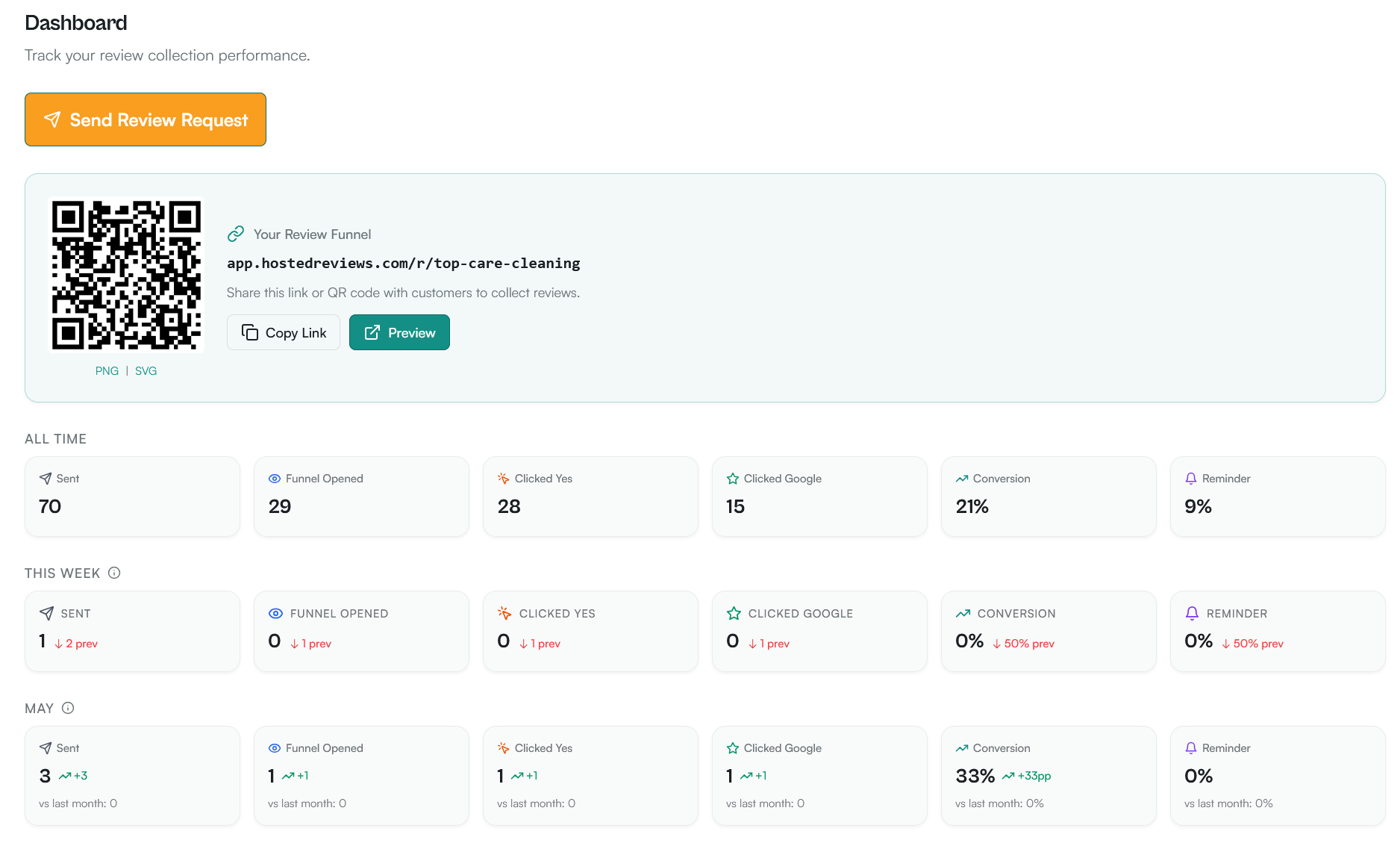
My own path: Top Care is a single-location 12-person team. We evaluated Podium and Birdeye, ran the math, and the economics didn't work. We sent 70 SMS requests in our first Hosted Reviews cohort, collected 15 reviews, and hit a 21% conversion rate. The median time-to-review was 2.5 hours. 71% of our reviews came in within 24 hours of the send. That's what "right tool, right stage" looks like in practice.
What my real numbers look like — so you can calibrate
I'm publishing these because every other review tool comparison article is written by someone who doesn't have a review funnel of their own. You should be able to see what real performance looks like before evaluating whether any tool can match it.
Top Care Cleaning — SMS review cohort data:
| Metric | Value |
|---|---|
| SMS sent | 70 |
| Conversion rate | 21% (15 reviews) |
| Tap-yes rate | 40% |
| Yes-to-reviewed rate | 54% |
| Median time-to-review | 2.5 hours |
| Finished in 24 hours | 71% |
| Reminder CTR | 35% |
| Reminder rate | 9% |
| Didn't finish form | 46% |
| Tech | Conversion | Sends | Reviews |
|---|---|---|---|
| Jayden | 31% | 13 | 4 |
| Bryton | 27% | 15 | 4 |
| Tyler | 25% | 32 | 8 |
| Mike | 23% | 22 | 5 |
| Kurt | 19% | 26 | 5 |
| Alex | 18% | 11 | 2 |
| Parker | 10% | 21 | 2 |
| Ben | 7% | 15 | 1 |
| Fred | 0% | 4 | 0 |
- Tuesday: 35% of reviews
- Wednesday: 7%
- Morning (6am–12pm): 33%
- Weekday: 21% / Weekend: 0%
The 15-point gap between Jayden (31%) and Parker (10%) is the clearest argument I can make for per-tech reporting. Without that data, I'd have no idea which team members needed coaching and which timing strategies were working.
Frequently asked questions
Is review management software worth it for a 5-person company?
Yes, if you're sending more than 20–30 jobs per month and currently getting fewer than 2–3 reviews organically. At 5 people, you're probably doing 60–100 jobs per month. A 21% conversion rate on 70 sends is 15 reviews. That kind of velocity over 12 months compiles a review count that local competitors relying on organic reviews can't match. The tools that cost $29–$75/month pay for themselves on the first month if even one new customer finds you because of your reviews.
What's the difference between review management software and a review widget?
A review widget is a display element — it shows your existing reviews on your website. Review management software is the system that generates new reviews in the first place: sending SMS or email requests, screening for unhappy customers, tracking which technicians are converting, and following up with reminders. Widgets are downstream of the review volume problem; review management software solves the volume problem upstream.
Can I build my own review request system with Twilio and Zapier?
Yes, and some operators do. You can connect Twilio for SMS delivery, Zapier for job-completion triggers from your field service CRM, and a Google Form or Typeform for the funnel screen. The build takes a full day to set up correctly, and you'll spend time maintaining it every time Zapier updates its interface or Twilio changes a pricing structure. If you bill yourself at $50/hour, that day-one build costs more than a year of Hosted Reviews. The DIY approach makes sense if you have a technical co-founder who enjoys building and maintaining systems — otherwise you're trading ongoing time for upfront savings that disappear within months.
Do any of these tools work with Jobber or Housecall Pro?
NiceJob has the deepest native integrations with Jobber and Housecall Pro — job completion automatically triggers a review request with no manual action. Hosted Reviews uses CSV import and webhooks. Podium and Birdeye have broad integration ecosystems (200+ each) but CRM-specific setup takes more configuration time. If you're on Jobber and want a zero-touch workflow, NiceJob's native integration is a genuine strength worth paying for.
What's funnel screening and why does it matter?
Funnel screening is a satisfaction check built into the review request flow. Before sending a customer to Google to leave a public review, the software asks them to rate their experience. High scorers get the Google review link. Low scorers get routed to a private feedback form — a direct message to the business rather than a public review.
It matters because not every customer is going to leave a 5-star review. If you send every customer straight to Google without any filter, the ones who had a bad experience will sometimes use that link. With funnel screening, they have a private channel to vent — and you have a chance to fix the problem before it goes public.
Is Hosted Reviews genuinely better or are you just selling me your own product?
Both things are true at the same time. I built Hosted Reviews to solve problems the other tools in this category don't address for sub-50-employee operators: price, funnel screening, SMS-first flow, and 10-minute setup. For those four criteria, I believe it's the best option. For other criteria — native Jobber/HCP integration (NiceJob wins), full communications stack (Podium wins), multi-location dashboards (Birdeye wins), agency white-label (Grade.us wins) — the competitors are better. I've named them throughout this guide. My goal is for you to buy the right tool, not just my tool.
The operator's view in a sentence
The tools exist. The price difference is real. The funnel screening gap is real. You now have the full picture — without a sales call.
Try Hosted Reviews free for 14 days — no card required. Start at app.hostedreviews.com.
I built Hosted Reviews, so my opinion is biased — but the trial is risk-free and you can decide for yourself.
If you want to keep comparing before you decide, the Podium vs Birdeye head-to-head and the best review management software roundup are the next logical reads.
Before comparing tools, it's worth getting your review link set up: use the free Google review link generator — no signup required.
Cross-pillar context: Local Service Reviews Playbook | SMS Review Request System | Negative Reviews & Reputation Defense
About the author
Alex Host runs Top Care Cleaning, a 45-year residential cleaning company in Grandville, Michigan, with 373 Google reviews at 4.9 stars. He built Hosted Reviews after years of manually texting review requests to Top Care customers and wanting a system that ran without him. He writes about review collection, local SEO, and what it actually takes to operate a service business at scale. Full bio and background →